
Running on Empty? The Smarter Way to Think About Energy Support
You know the feeling: waking up tired, losing focus by midday, reaching for coffee just to keep going. But feeling drained isn't always about needing more stimulation. Sometimes the smarter question is what your body actually needs to support steadier energy from the inside out.
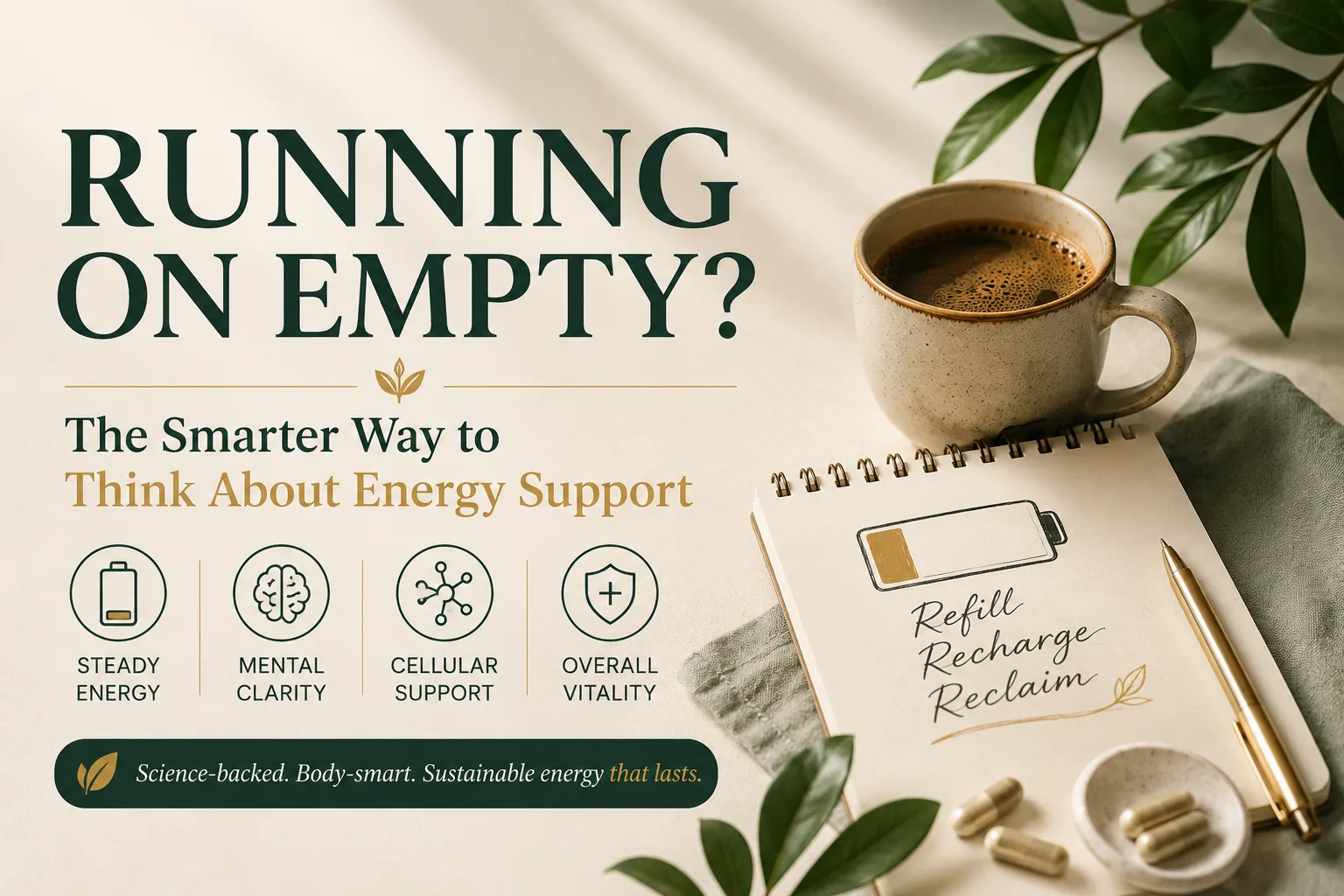
Running on empty isn't always about willpower
Tiredness gets treated like a motivation problem. You push harder, drink more coffee, ignore the signs, and hope the day somehow gets easier. Real energy support starts somewhere else entirely.
But energy isn't just a mindset. It's connected to a lot of systems working together — sleep quality, nutrient status, mitochondrial function, your stress response, hydration, how much your liver is handling, and how efficiently your body creates energy at the cellular level.
That's why you can sleep a full night and still wake up feeling flat. It's also why coffee can help in the moment and still leave you stuck in the same cycle later. Stimulation makes tiredness easier to push through; it doesn't necessarily address why your body feels depleted in the first place.
Feeling tired can involve sleep, stress, nutrient status, cellular energy, hydration, liver support and daily routine. Coffee may help you push through the moment, but real energy support looks deeper at what your body needs to function well.
Energy starts at the cellular level
Every day, your body depends on its cells to create usable energy. Mitochondria — the tiny structures inside your cells that act as their power plants — are central to that process, converting nutrients into a form your body can actually use.
This is where NAD+ enters the energy conversation. NAD+ is a coenzyme found in every living cell, and it plays a role in energy metabolism, mitochondrial function, cellular repair pathways and healthy ageing processes.
As more people take an interest in longevity and daily vitality, cellular energy has become a bigger wellness focus. The goal isn't artificial stimulation. It's supporting the systems involved in energy production, recovery, clarity and resilience.
That's why we approach energy support as a whole-body conversation rather than a quick lift.
Why coffee isn't the whole answer
Coffee is genuinely useful, and plenty of people build a good routine around it. The issue is when caffeine becomes the only strategy for getting through the day.
Caffeine can temporarily support alertness, but depending on timing, your own sensitivity and how much you're having, it can also affect sleep quality. When sleep suffers, the next day gets harder — which tends to lead to more caffeine, and the same tired pattern repeating.
A smarter energy routine looks beyond the quick lift. It asks what's happening with sleep, stress, nutrient intake, hydration, movement and cellular function. It also asks whether your body has enough of the core building blocks it needs to support steady daily energy.
None of this means giving up coffee. It means not asking coffee to do a job your whole body should be supported to do.
A whole-body approach to energy support
Energy support works best when it looks at the full picture rather than a single product.
NAD+ support may form part of a cellular health routine focused on energy metabolism, recovery and healthy ageing. Vitamin D support may be relevant if your vitamin D status is low, particularly when tiredness is part of a wider picture. And liver support matters here too, because the liver is involved in metabolism, nutrient processing and many of the body's natural cleansing processes.
That's the thinking behind how we've built our energy range: support smarter, rather than push harder. There's no single magic product — just a more complete approach to daily vitality, clarity, recovery and long-term wellness.
When you're running on empty, the answer isn't always to force more output. Often the better starting point is supporting the systems that help your body create and sustain energy in the first place. None of this is medical advice — if tiredness is persistent or troubling you, that's worth raising with a practitioner who knows your situation.
- NAD+ Longevity Protocol LathMized® NAD+ Longevity Protocol is designed as practitioner-guided cellular support for energy metabolism, recovery, clarity and healthy ageing routines. It fits the wider approach of supporting energy from the cellular level rather than stimulating your way through the afternoon.
- Vitamin D3 60,000 IU A high-strength vitamin D option intended for targeted support where vitamin D status is being addressed. Because of the dose, it should be used with appropriate guidance — as part of a wider energy and wellness picture rather than on its own.
- Liver Support Designed to support the body's natural liver function and cleansing processes. It belongs in the energy conversation because the liver plays an important role in metabolism, nutrient processing and overall daily vitality.
Common questions about energy support
A few questions come up often once people start looking past the coffee. The answers below stay within what this article and its references support.
Why am I still tired after a full night's sleep?
Because energy depends on several systems at once — sleep quality, nutrient status, mitochondrial function, stress response, hydration, liver workload and how efficiently your body makes energy at the cellular level. When more than one of those is under strain, a full night in bed doesn't automatically translate into feeling rested.
Does caffeine actually help with energy?
It can support alertness in the moment. But depending on timing, your own sensitivity and how much you're having, caffeine can also affect sleep quality — and when sleep suffers, the next day is harder, which tends to mean more caffeine. Coffee isn't the problem. Relying on it as the only strategy is.
What does "cellular energy" actually mean?
It's the energy your cells produce from nutrients. Mitochondria — the structures inside your cells that act as their power plants — are central to that process. NAD+ is a coenzyme found in every living cell that plays a role in energy metabolism, mitochondrial function, cellular repair pathways and healthy ageing processes.
Can low vitamin D affect how tired you feel?
Vitamin D support may be relevant if your vitamin D status is low, particularly when tiredness is part of a wider picture. High-strength vitamin D is worth using with appropriate guidance rather than on its own, and it belongs alongside the foundations — sleep, nutrition, movement — rather than in place of them.
What does the liver have to do with energy?
More than most people expect. The liver is involved in metabolism, nutrient processing and many of the body's natural cleansing processes, which is why liver support belongs in a whole-body conversation about daily vitality rather than being treated as something separate from how energetic you feel.
What to take away
Running on empty isn't something to ignore or normalise. It's often a sign that your body needs better support, more consistency and a smarter routine.
Look at energy through the lens of cellular function, nutrient support, recovery and whole-body wellness, and it becomes possible to move beyond short-term stimulation toward something steadier.
Support smarter, not harder
Cellular energy, nutrient status and liver support — explore the essentials behind steadier daily vitality.
Explore Energy SupportEducational content, not medical advice.
- Covarrubias, A.J., Perrone, R., Grozio, A. and Verdin, E., 2021. NAD+ metabolism and its roles in cellular processes during ageing. Nature Reviews Molecular Cell Biology, 22, pp. 119–141. DOI: 10.1038/s41580-020-00313-x
- Filler, K., Lyon, D., Bennett, J., McCain, N., Elswick, R., Lukkahatai, N. and Saligan, L.N., 2014. Association of mitochondrial dysfunction and fatigue: A review of the literature. BBA Clinical, 1, pp. 12–23. DOI: 10.1016/j.bbacli.2014.04.001
- O'Callaghan, F., Muurlink, O. and Reid, N., 2018. Effects of caffeine on sleep quality and daytime functioning. Risk Management and Healthcare Policy, 11, pp. 263–271. DOI: 10.2147/RMHP.S156404
- Nowak, A., Boesch, L., Andres, E., Battegay, E., Hornemann, T., Schmid, C. and Bischoff-Ferrari, H.A., 2016. Effect of vitamin D3 on self-perceived fatigue: A double-blind randomised placebo-controlled trial. Medicine, 95(52), e5353. DOI: 10.1097/MD.0000000000005353
- Hudson, A.N., Van Dongen, H.P.A. and Honn, K.A., 2020. Sleep deprivation, vigilant attention, and brain function: A review. Neuropsychopharmacology, 45, pp. 21–30. DOI: 10.1038/s41386-019-0432-6
This article is intended for informational and educational purposes only. It does not constitute medical advice and should not be used as a substitute for guidance from a qualified healthcare professional. Individual needs vary — persistent or severe fatigue should be assessed by a doctor. High-strength vitamin D in particular should only be used with appropriate guidance. If you are pregnant, breastfeeding, taking medication or managing a health condition, speak with your practitioner before starting any new supplement.