
Why Do I Keep Waking Up at 3am?
You fall asleep without much trouble. Then your eyes open, you check the clock, and it is 3am again. Your mind starts running through tomorrow, last week, and everything in between. By the time it settles, the alarm is not far off. If this sounds familiar, you are far from alone, and you are not imagining it. There is no single cause that explains it for everyone, but there are real reasons it happens, and most of them are things you can work with.
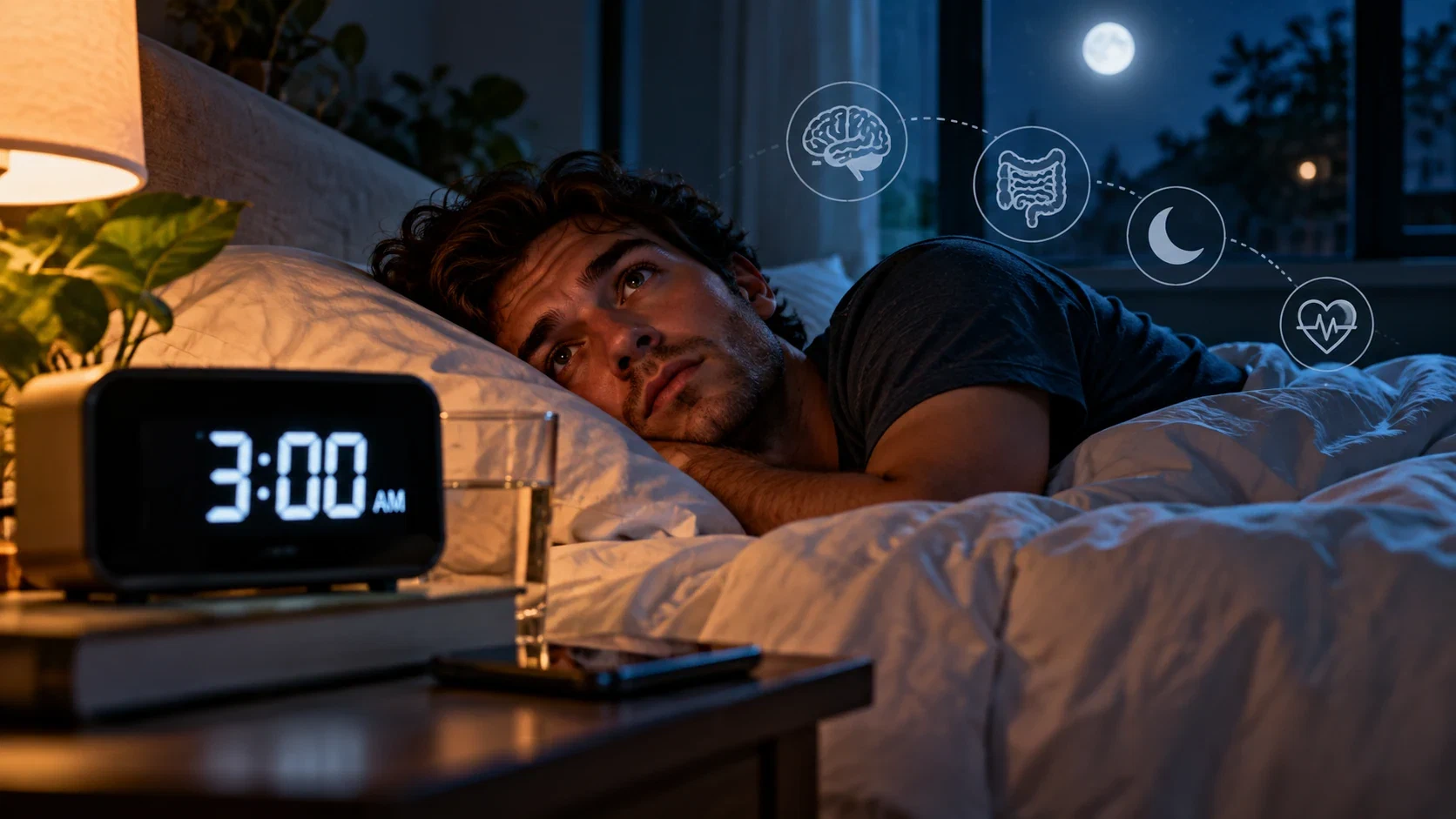
Waking in the Night Is Normal. Staying Awake Is the Problem.
Sleep is not one long stretch. It runs in cycles of roughly 90 minutes, moving between lighter and deeper stages. Most of your deepest sleep happens early in the night. By the small hours, your sleep is lighter and your body has already recovered much of what it needed.
Brief awakenings between cycles are completely normal. Most people have several a night and never remember them. At the same time, cortisol, the hormone that helps you get up and going, naturally starts to rise in the early hours to prepare you for the morning.
So around 3am, many people are already close to the surface. Waking up is not the problem in itself. The problem is when a normal, brief waking flips into full alertness and you cannot switch back off. The reasons that happens differ from person to person, and often more than one is at play.
Lighter sleep and a natural rise in cortisol make the early hours an easy time to surface. In long-term insomnia, research finds the body's stress system running higher across the whole day and night. Waking briefly is normal. The full alertness that follows is the part you can retrain.
The Stress Connection
Researchers have found that people with long-term insomnia tend to produce more of the stress hormones cortisol and ACTH across the whole day and night, while keeping a normal daily rhythm. The researchers described this as a state of hyperarousal: the brain's alert system running too high, rather than simply a lack of sleep.
A smaller study of people with severe insomnia found raised cortisol in the evening and overnight, and higher evening cortisol went along with more awakenings during the night. In plain terms, when your stress system is running hot as you go to bed, you may be more likely to be pulled out of sleep later on.
Then the 3am mind takes over. In the dark, with nothing to distract you, worries feel bigger and more urgent than they do in daylight. Checking the clock and calculating how much sleep you have left adds pressure, which keeps you awake, which confirms the fear. It becomes a loop.
What About the Liver Clock and the Spiritual Wake-Up Theories?
Search for 3am waking and you will quickly find two popular explanations. One comes from the traditional Chinese medicine organ clock, which links 1am to 3am with the liver. The other says waking at 3am is a sign of spiritual awakening.
These ideas mean a lot to many people, and we are not here to mock them. But there is no research showing that the liver has a timed shift that wakes you, or that a particular hour carries a special message.
There is, however, one real link between your liver and the small hours, and it is alcohol. Your body processes alcohol during the first part of the night. As the sedating effect wears off, sleep in the second half of the night tends to become lighter and more broken. If you drink in the evening, your 3am waking may genuinely be connected to your liver at work, just not in the way the organ clock suggests.
Other common contributors are worth ruling out too: needing the toilet, acid reflux, night sweats around menopause, some medications, and sleep apnoea, especially if you snore loudly or wake gasping. Waking very early and being unable to get back to sleep can also be a sign of low mood, so if that sounds like you, please talk to your GP.
What Actually Helps
The approach with the strongest evidence is cognitive behavioural therapy for insomnia, known as CBT-I. Major guidelines in the US and Europe recommend it as the first option for long-term insomnia, ahead of sleeping pills. It works on the habits and thought patterns that keep the 3am loop going, and many of its core ideas are simple to start with.
If you have been awake for what feels like 20 minutes or so, get up and go somewhere dim and quiet. Do something calm and unstimulating, then go back to bed when you feel sleepy. This teaches your brain that bed is for sleeping, not for worrying.
Turn the clock away from you, and keep your phone out of reach. Knowing the time rarely helps you sleep. Get up at the same time every day, even after a bad night, which strengthens your body clock. Keep evenings dim, because bright light and screens late at night can delay the release of melatonin, the hormone that signals it is time to sleep. Cut back on alcohol and caffeine, especially later in the day. And give your worries somewhere to go earlier in the evening: ten minutes writing down what is on your mind and your next step for each item can make a real difference.
Some people also explore supplements. The evidence varies a lot from one to another, and some interact with medication, so it is worth talking to a pharmacist or doctor before adding anything. See your GP if poor sleep happens three or more nights a week for several months, if you snore heavily or stop breathing in your sleep, or if you feel dangerously sleepy during the day.
Waking at 3am does not mean something is wrong with you, and it does not have to become a nightly battle. Your body is doing something normal. The habit of switching fully awake is often what keeps it going, and habits can change. Be patient with yourself. Small, consistent changes usually work better than dramatic ones.
- Vgontzas, A.N., Bixler, E.O., Lin, H.M., Prolo, P., Mastorakos, G., Vela-Bueno, A., Kales, A. and Chrousos, G.P., 2001. Chronic insomnia is associated with nyctohemeral activation of the hypothalamic-pituitary-adrenal axis: clinical implications. Journal of Clinical Endocrinology and Metabolism, 86(8), 3787–3794. https://doi.org/10.1210/jcem.86.8.7778
- Rodenbeck, A., Huether, G., Rüther, E. and Hajak, G., 2002. Interactions between evening and nocturnal cortisol secretion and sleep parameters in patients with severe chronic primary insomnia. Neuroscience Letters, 324(2), 159–163. https://doi.org/10.1016/S0304-3940(02)00192-1
- Qaseem, A., Kansagara, D., Forciea, M.A., Cooke, M. and Denberg, T.D., 2016. Management of chronic insomnia disorder in adults: a clinical practice guideline from the American College of Physicians. Annals of Internal Medicine, 165(2), 125–133. https://doi.org/10.7326/M15-2175
- Riemann, D., Baglioni, C., Bassetti, C. et al., 2017. European guideline for the diagnosis and treatment of insomnia. Journal of Sleep Research, 26(6), 675–700. https://doi.org/10.1111/jsr.12594
- Ebrahim, I.O., Shapiro, C.M., Williams, A.J. and Fenwick, P.B., 2013. Alcohol and sleep I: effects on normal sleep. Alcoholism: Clinical and Experimental Research, 37(4), 539–549. https://doi.org/10.1111/acer.12006
This article is intended for informational and educational purposes only and is not medical advice. Persistent insomnia, loud snoring, pauses in breathing during sleep or early waking with low mood are all worth discussing with your GP.