
Why Sleep Support Felt Different: Serotonin & Cortisol
I've struggled with sleep for as long as I can remember. Since childhood, bedtime has never felt simple, and for years I thought it was a discipline problem — just the way I was wired. What finally changed things wasn't forcing myself harder, but understanding that poor sleep can be shaped by biochemistry: especially serotonin, cortisol and nervous-system activation. This is where sleep support started to make real sense to me.
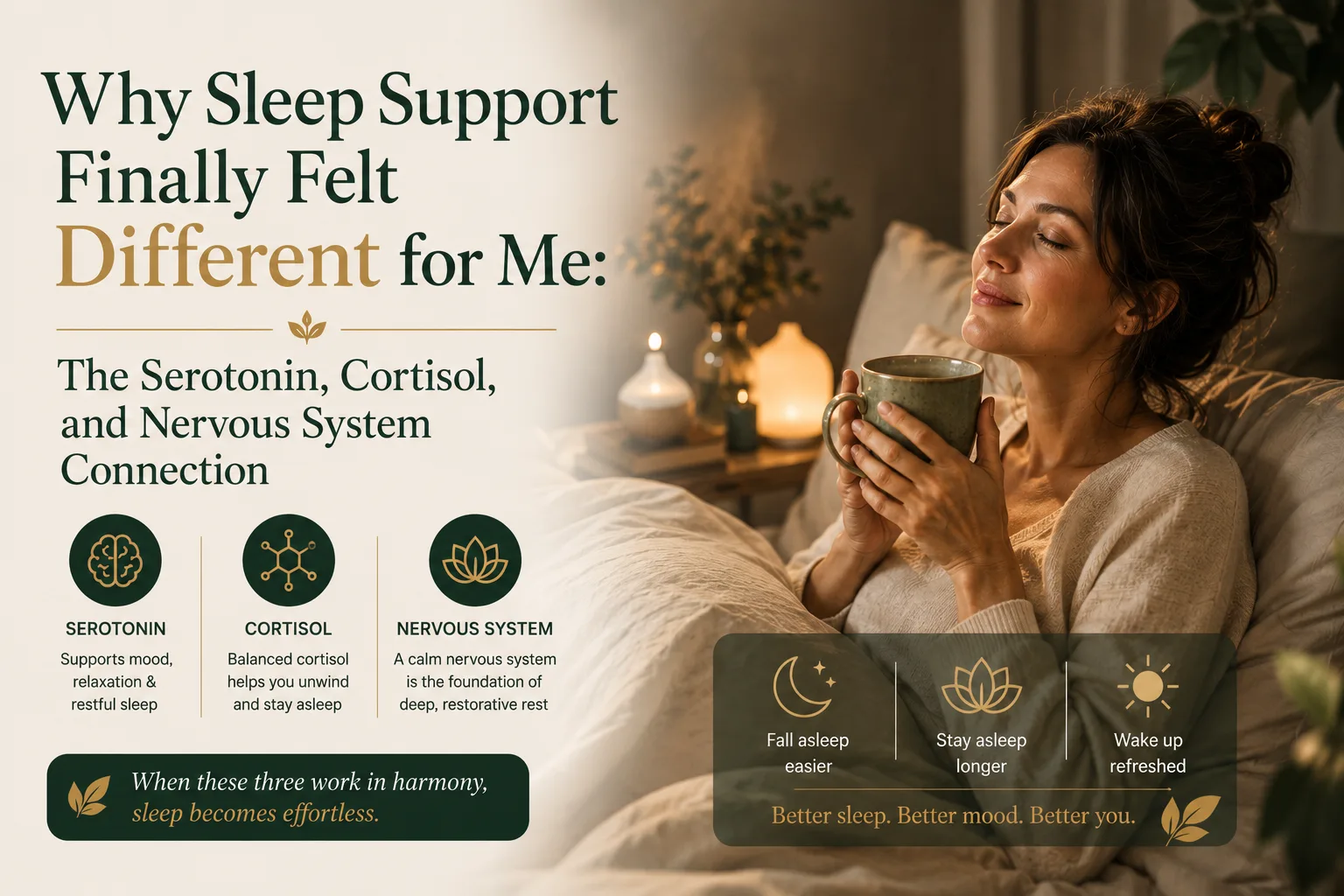
What follows is one person's genuine experience, shared as a personal story rather than a promise of results. Everyone's sleep is different, and this is not medical advice.
My sleep problem was never just about being tired
For a long time I assumed sleep should come naturally if I was exhausted enough. That was never my experience. I could feel drained all day and still lie awake at night with a mind that wouldn't settle.
Looking back, that pattern makes more sense now. Research on insomnia consistently points to hyperarousal — a plain-English way of saying the brain and stress system can stay too switched on, even when the body is desperate for rest. Elevated ACTH and cortisol (stress hormones) have been linked with insomnia, especially when sleep feels light, fragmented or hard to start.
That shift in understanding mattered to me emotionally as much as physically. It helped me stop seeing sleep as a personal failure. If your body is still receiving strong wakefulness signals at night, willpower isn't the missing ingredient — the problem may be further upstream.
Insomnia is often linked with hyperarousal, not just a lack of tiredness. Research has associated poor sleep with higher ACTH and cortisol secretion — which helps explain why so many people feel exhausted but still can't settle at night.
Why serotonin and cortisol kept coming up for me
One of the most useful things I learned is that sleep isn't only about melatonin. Melatonin helps signal darkness and sleep timing, but serotonin sits earlier in that pathway and matters too, because it's the precursor your body uses to make melatonin. In simple terms, if the serotonin side of the picture is off, the downstream sleep signal can feel off as well. That helps explain why low mood and poor sleep so often seem to travel together.
At the same time, cortisol kept showing up in everything I read about restless nights. Cortisol should gradually fall as the day goes on. When stress keeps that system activated into the evening, you can feel exactly what I used to feel all the time: tired but still alert, sleepy in theory but not actually able to drift off. The sleep literature describes that as part of stress-related insomnia and hyperarousal.
This was the first time sleep support started to make sense to me as a layered issue rather than a single missing fix. It wasn't just about knocking myself out. It was about supporting neurotransmitters, calming the stress response, and helping the nervous system step out of high alert.
The first approach that actually felt more complete
What finally felt different for me was a more complete support picture. Instead of thinking about one ingredient, I started paying attention to three connected areas: serotonin support, stress resilience, and nervous-system downregulation (helping the body shift out of "alert" mode).
That's why the Sleep & Mood category at Harmover stood out to me — it's built around those same layers rather than treating sleep as a one-note problem. The current collection centres on 5-HTP, the Sleep Formula and an Ayurvedic Complex, positioned around serotonin support, cortisol balance and non-habit-forming sleep architecture support.
The ingredient that felt most personally relevant to me was 5-HTP. It's a direct precursor to serotonin, and a 2024 randomised controlled trial reported improvements in some sleep-quality measures, especially in poorer sleepers. Older review literature has also described 5-HTP as clinically useful because of its role in serotonin production. That doesn't make it a magic answer for everyone — and it needs real care if you take serotonergic medication — but it helped me understand why sleep and mood support are so often discussed together.
5-HTP raises serotonin, so it should not be combined with SSRIs, MAOIs or other serotonergic medications without medical supervision — doing so carries a real risk of serotonin excess. If you take any antidepressant or mood medication, speak with your practitioner before considering 5-HTP. This article is not medical advice.
The second piece was the stress side. I was especially interested in adaptogenic herbs because I didn't just want something to make me sleepy for one night — I wanted support for the pattern underneath the problem. Clinical and government summaries suggest that ashwagandha may help with stress, anxiety and sleep in some adults, which made the adaptogen angle feel worth taking seriously.
The third piece was accepting that the nervous system needs help transitioning into rest. That's where a broader sleep formula can make more sense than relying only on melatonin. Harmover describes its Sleep Formula as a multi-pathway approach — calming herbs, GABA-pathway support and sleep-cycle nutrients rather than only sleep-onset timing. That matched my lived experience more closely than the idea that one compound should handle everything.
- 5-HTP 100 mg A direct precursor to serotonin, which makes it relevant to both mood and sleep — serotonin is used by the body to help produce melatonin, so this pathway matters when sleep onset feels difficult or sleep quality feels fragile. Clinical and more recent research suggest 5-HTP may support some aspects of sleep quality, especially in people already struggling. It should be approached carefully, and never combined with SSRIs, MAOIs or other serotonergic medications without medical supervision.
- Sleep Formula A multi-pathway approach rather than a single compound — combining GABA-pathway support, calming herbs and sleep-cycle nutrients to support deeper, more restorative sleep. The broader idea is that sleep quality often depends on nervous-system state as much as sleep timing, which makes it a better fit for people who feel tired but still struggle to downshift.
- Ayurvedic Complex Relevant because stress and cortisol rhythm are often part of the sleep picture. Positioned around adaptogenic herbs and HPA-axis (stress-response) support, it fits the broader literature on stress-related sleep disruption. Adaptogens such as ashwagandha have been studied for their effects on stress, anxiety and sleep — which makes this style of support especially interesting when evening alertness or stress reactivity seems to be part of the problem.
What I'd want someone else to know
If you've had sleep struggles since childhood, I know how easy it is to start believing this is just your personality, your stress tolerance, or your own fault. I carried that for years. What I wish I'd understood earlier is that better sleep often starts with asking better questions. Is serotonin support part of the picture? Is evening cortisol staying too high? Is the nervous system failing to shift into rest mode?
I'm careful not to pretend there's one formula that works for everyone. Sleep is complicated, and medication, mental health, hormones and lifestyle all matter. But personally, the only thing that ever felt meaningfully different was moving away from the idea of a single sleep fix and toward a more thoughtful, layered approach. That changed the way I think about rest — and honestly, the way I think about health in general.
Common questions about sleep support
A few questions come up often once people start looking past melatonin. The answers below stay within what this article and its references support.
Why do I feel exhausted but still can't sleep?
Research points to hyperarousal — the brain and stress system staying too switched on even when you're tired. Elevated ACTH and cortisol have been linked with insomnia, particularly when sleep is light, fragmented or hard to start. That's the tired-but-wired feeling, and it's physiological, not a character flaw.
How are serotonin and sleep connected?
Sleep isn't only about melatonin. Serotonin sits earlier in the pathway, because it's the precursor your body uses to make melatonin — so if the serotonin side is off, the downstream sleep signal can feel off too. It's part of why low mood and poor sleep so often go together.
Is 5-HTP safe to take for sleep?
Some research suggests 5-HTP may support aspects of sleep quality, especially in poorer sleepers. But because it raises serotonin, it must not be combined with SSRIs, MAOIs or other serotonergic medications without medical supervision. If you take any antidepressant or mood medication, speak with your practitioner before considering it.
Why a multi-pathway approach instead of just melatonin?
Melatonin mainly signals timing, but sleep quality often depends on nervous-system state and the stress response as much as timing. A layered approach aims to support serotonin, calm the stress response with adaptogens, and help the nervous system shift into rest — which fits people who feel tired but can't downshift.
What to take away
If there's one thing I'd want you to take away, it's this: poor sleep isn't always a character issue, and it isn't always a simple melatonin issue either. Sometimes the real shift comes from understanding the chemistry underneath the pattern.
For me, that meant finally looking at serotonin, cortisol and nervous-system support together — and realising that sleep had never been a willpower problem in the first place.
A layered approach to rest
Serotonin support, cortisol balance and nervous-system calm — explore the Sleep & Mood collection built around the whole picture, not a single fix.
Explore Sleep & MoodEducational content, not medical advice.
- Maffei, M.E., 2020. 5-Hydroxytryptophan (5-HTP): Natural Occurrence, Analysis, Biosynthesis, Biotechnology, Physiology and Toxicology. International Journal of Molecular Sciences, 22(1), 181. DOI: 10.3390/ijms22010181
- Sutanto, C.N., Vicinanza, R., Frumento, P. et al., 2024. The impact of 5-hydroxytryptophan supplementation on sleep quality in older adults: a randomised controlled trial. Clinical Nutrition. PMID: 38309227
- Nicolaides, N.C., Chrousos, G.P. and Charmandari, E., 2020. HPA Axis and Sleep. Endotext, MDText.com, Inc. (NCBI Bookshelf).
- Cheah, K.L., Norhayati, M.N., Husni, M. et al., 2021. Effect of Ashwagandha (Withania somnifera) extract on sleep: a systematic review and meta-analysis. PLoS One, 16(9), e0257843. PMID: 34559859
- Arendt, J., 2022. Physiology of the Pineal Gland and Melatonin. Endotext, MDText.com, Inc. (NCBI Bookshelf).
- Basta, M., Chrousos, G.P., Vela-Bueno, A. and Vgontzas, A.N., 2007. Chronic insomnia and stress system. Sleep Medicine Clinics, 2(2), pp. 279–291.
This article is intended for informational and educational purposes only. It reflects one individual's personal experience, which is not a promise of results and not a substitute for guidance from a qualified healthcare professional. 5-HTP raises serotonin and must not be combined with SSRIs, MAOIs or other serotonergic medications without medical supervision. Persistent insomnia, or sleep problems alongside low mood, deserve proper assessment. If you are pregnant, breastfeeding, taking medication or managing a health condition, speak with your practitioner before starting any new supplement.