
Sleep Is the One Thing We All Need: Harmover's Natural Sleep Formula
At Harmover, we talk a lot about how wellness is personal. The food that nourishes someone in coastal Portugal isn't the same as what serves a desk worker through a Helsinki winter — your microbiome, your hormones, the sunshine, the people around you — all shaping what your body needs. But after years of looking at this from every angle, we keep coming back to one thing that doesn't change: wherever you are, whoever you are, you need to sleep. Real, restful, restorative sleep — the one universal need our natural sleep formula was built to protect.
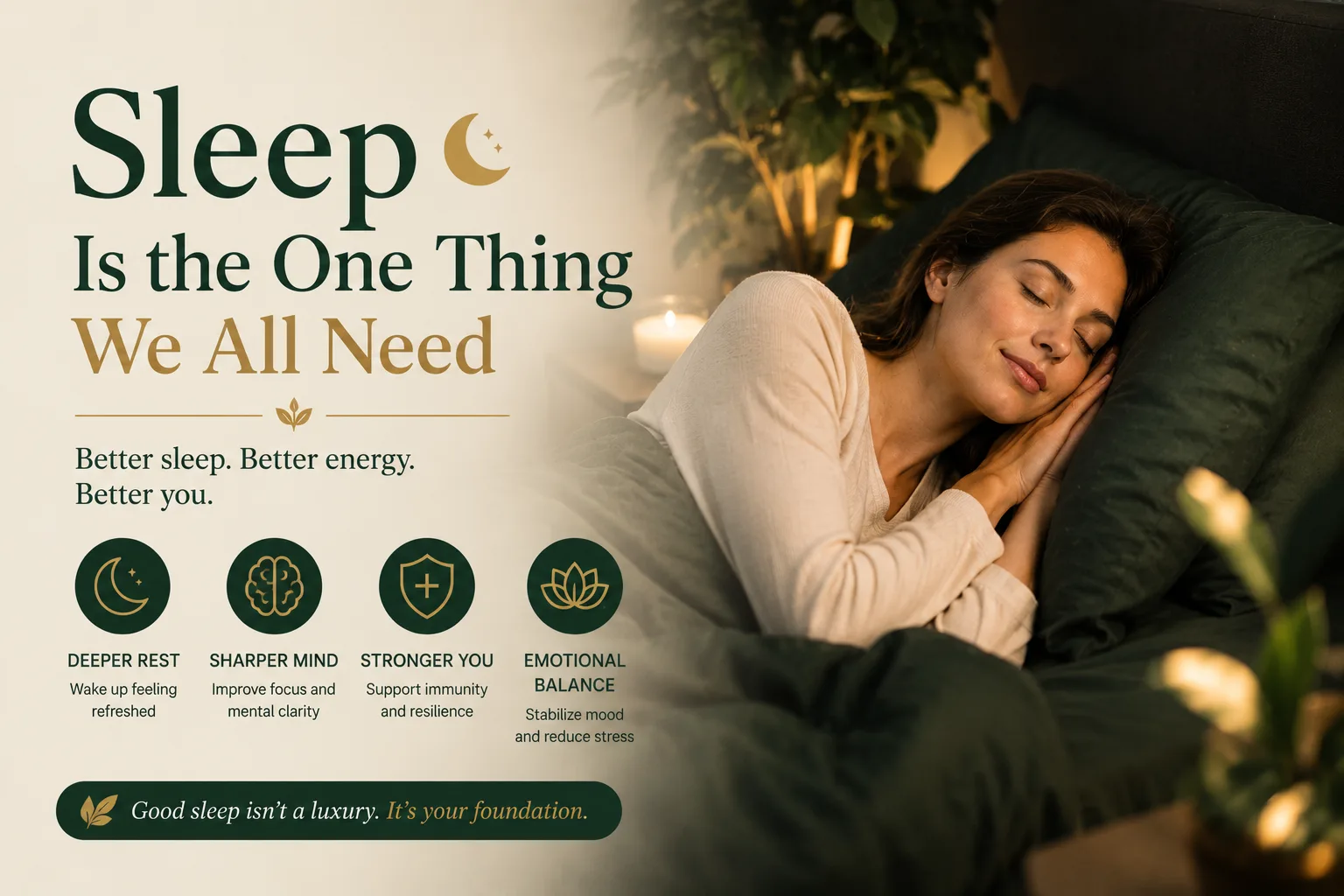
Why sleep is the one constant in a personalised world
Most of what we recommend comes with an "it depends". It depends on your latitude, your gut, your stress load, your stage of life. We build protocols around the individual because that's what actually works — a single template applied to every human being is how the wellness industry has failed people for decades.
Sleep is the exception. Or rather, it's the one thing where the need is identical even if the obstacles differ. A new mother in Lagos, a night-shift nurse in Berlin, a retiree in rural Wales — they all need their brain to cycle through deep sleep and REM. They all need the glymphatic system (the brain's overnight waste-clearance process) to flush metabolic by-products. They all need the small-hours repair work that happens during proper rest. The plumbing is the same. Only the leaks are different.
What changes from person to person is why sleep goes wrong. For some it's a racing mind; for others a body that won't switch off, or hormones that have shifted with age, or a circadian rhythm thrown out by screens, shift work and travel. This is where a thoughtfully built formula can do real work — not by forcing sleep, but by gently supporting the systems that already know how to do it. None of this is medical advice, and persistent sleep problems are always worth raising with a practitioner.
Adults consistently sleeping fewer than seven hours a night show measurable differences in cardiovascular health, glucose regulation, immune response and cognitive function — regardless of diet, exercise or genetics. Sleep isn't a luxury you earn after the work is done. It's part of the work.
What's actually inside Harmover's sleep formula
We didn't want to make another melatonin pill. There are plenty of those, and most dose melatonin so aggressively that they override your own rhythm instead of supporting it. Our natural sleep formula is built around a low, sensible dose of melatonin paired with botanicals and amino acids that work on the calming side of your nervous system — the GABA pathway, the serotonin pathway, and herbs used for this purpose across cultures for hundreds of years.
Each serving (two capsules) gives you 150 mg of valerian root, 100 mg each of chamomile, GABA, L-tryptophan, lemon balm and passionflower, and just 2 mg of melatonin. That ratio matters: the herbs do the wind-down work, melatonin gives your body the timing signal, and tryptophan supplies the raw material your brain uses to make serotonin and, eventually, more melatonin of its own.
There are no artificial additives, no proprietary blends hiding the doses, and no stimulating extras dressed up as "energy support". Sleep is meant to be a slowing-down, and the formula reflects that.
How each ingredient helps you wind down
Valerian root is the most-studied herb on this list. It appears to support GABA, the calming neurotransmitter (a brain chemical) that quiets neural chatter at the end of the day. A 2020 systematic review of valerian for sleep and anxiety found it generally supports sleep quality and is well tolerated, though effects vary by preparation and person. It's the classic "old herbal" for a reason.
Chamomile, lemon balm and passionflower form a gentle trio that has appeared in traditional sleep teas across Europe and the Americas for centuries. Modern research suggests they each interact with the GABA system in different ways — chamomile through a compound called apigenin, lemon balm through its calming effect on a busy mind, and passionflower through its support of sleep onset. They're the herbs you'd reach for when it's less a sleep problem than a not-being-able-to-stop-thinking problem.
GABA itself is included directly. Whether oral GABA reaches the brain is a long-running debate in research, but many people report a clear sense of calm from it, and it works alongside the herbs in the formula that support the same pathway.
L-tryptophan is an amino acid you'd normally get from food — turkey, eggs, oats, seeds. Your body converts it into serotonin, and serotonin into melatonin. Including it means the formula isn't only handing you melatonin; it's supporting your body's own ability to make it.
Melatonin at 2 mg is a moderate, considered dose — enough to signal "night-time" to your body clock without flooding the system. For most adults this supports natural rhythm rather than overriding it, which is particularly useful if you travel, work irregular hours, or simply find your internal clock has drifted.
- Valerian Root — 150 mg The most-researched herbal sleep aid in Western herbalism. Its active compounds, including valerenic acid, appear to support GABA, the brain's main calming neurotransmitter. People typically use it for general sleep quality and the feeling of "switching off". It's the cornerstone ingredient of the formula.
- Chamomile — 100 mg A wind-down herb across European traditions for centuries. Its calming reputation is linked to a flavonoid called apigenin, which binds to receptors in the brain associated with relaxation. Most people know it as a tea; in capsule form you get a more reliable dose.
- GABA — 100 mg The brain's primary inhibitory neurotransmitter — the chemical that tells overactive neurons to settle. Supplemental GABA is widely used for relaxation and sleep onset, and works alongside the herbs in this formula that support the same pathway.
- L-Tryptophan — 100 mg An essential amino acid found in foods like turkey, oats and seeds. The body converts L-tryptophan into serotonin (the mood-stabilising neurotransmitter) and then into melatonin, so including it supports your own melatonin production rather than only delivering it directly.
- Lemon Balm — 100 mg A bright, citrusy member of the mint family used traditionally for nervous tension and a restless mind. Research suggests it gently supports the GABA system and pairs well with chamomile and valerian — particularly suited to people whose sleep problem is really an overactive-mind problem.
- Passionflower — 100 mg Originally from the Americas, passionflower has been studied specifically for sleep onset — the time it takes to actually fall asleep — and for easing the kind of low-grade restlessness that keeps people lying awake. Another GABA-supportive herb that works well in combination.
- Melatonin — 2 mg The hormone your pineal gland releases as light fades, telling your body it's night. A 2 mg dose is moderate and supportive — enough to give the circadian system a clear signal without overwhelming it, which makes it useful for travel, shift work, or any time your sleep timing has drifted.
Sleep as the foundation underneath everything else
You can take every supplement on our shelf, eat beautifully, walk in the sunshine and surround yourself with the right people — but if your sleep is broken, the foundation under all of it is cracked. Poor sleep is associated with raised inflammatory markers, a blunted insulin response, and knock-on effects on memory, mood and immunity. It makes every other piece of your wellness picture harder.
This is why we keep coming back to sleep first: before the nootropics, before the longevity stack, before the gut work. If you can get your nights right, everything else you do has somewhere solid to land. And if you can't — for whatever reason your life is giving you right now — a thoughtful formula like this one can help carry you through until the rest of the picture catches up.
Common questions about natural sleep support
A few questions come up whenever people look at a combined sleep supplement. The answers below stay within what this article and its references support.
What is a natural sleep formula?
It's a blend of botanicals and nutrients that work on the calming side of the nervous system rather than sedating you. Ours pairs a low 2 mg dose of melatonin with valerian, chamomile, GABA, L-tryptophan, lemon balm and passionflower — the herbs doing the wind-down work while melatonin provides the timing signal.
Why use a low dose of melatonin?
Because many products dose it so heavily they override your own rhythm. A moderate 2 mg dose is enough to signal night-time to your body clock without flooding the system, which for most adults supports natural rhythm rather than overriding it — useful for travel, shift work or a drifted schedule.
How do the herbs work?
Valerian, chamomile, lemon balm and passionflower are all associated with the GABA system — the calming pathway that quiets an overactive mind. Research suggests they interact with it in different ways, which is why they're combined. Valerian is the most-studied of the group and generally supports sleep quality, though effects vary by person and preparation.
Why include L-tryptophan?
Because the body converts it into serotonin and then into melatonin. Including it means the formula supports your own melatonin production, rather than only delivering melatonin directly.
What to take away
If you take one thing from this piece, let it be this: be as personalised as you like with everything else — your food, your movement, your supplements, your community — but be uncompromising about your sleep. It's the one universal need, and it deserves your attention before anything else on the list.
Our Sleep Formula was built to help you protect that, gently and without the heavy hand of synthetic sleep aids. Sleep well, and the rest of your wellness story has somewhere to begin.
Protect the foundation
A low-dose melatonin paired with six calming botanicals and amino acids — built to support restful nights, gently. Explore natural sleep support.
Try the Sleep FormulaEducational content, not medical advice.
- Shinjyo, N., Waddell, G. and Green, J., 2020. Valerian Root in Treating Sleep Problems and Associated Disorders — A Systematic Review and Meta-Analysis. Journal of Evidence-Based Integrative Medicine, 25, 2515690X20967323. DOI: 10.1177/2515690X20967323
- Bent, S., Padula, A., Moore, D., Patterson, M. and Mehling, W., 2006. Valerian for Sleep: A Systematic Review and Meta-Analysis. The American Journal of Medicine, 119(12), pp. 1005–1012. DOI: 10.1016/j.amjmed.2006.02.026
- Ferracioli-Oda, E., Qawasmi, A. and Bloch, M.H., 2013. Meta-Analysis: Melatonin for the Treatment of Primary Sleep Disorders. PLOS ONE, 8(5), e63773. DOI: 10.1371/journal.pone.0063773
- Ngan, A. and Conduit, R., 2011. A Double-Blind, Placebo-Controlled Investigation of the Effects of Passiflora incarnata (Passionflower) Herbal Tea on Subjective Sleep Quality. Phytotherapy Research, 25(8), pp. 1153–1159. DOI: 10.1002/ptr.3400
- Bruni, O., Ferini-Strambi, L., Giacomoni, E. and Pellegrino, P., 2021. Herbal Remedies and Their Possible Effect on the GABAergic System and Sleep. Nutrients, 13(2), 530. DOI: 10.3390/nu13020530
- Salehi, B., Mihaylova, P. et al., 2021. Medicinal Plants for Insomnia Related to Anxiety: An Updated Review. Planta Medica, 87(10–11), pp. 738–753. DOI: 10.1055/a-1510-9826
This article is intended for informational and educational purposes only. It does not constitute medical advice and should not be used as a substitute for guidance from a qualified healthcare professional. Persistent sleep problems, or sleep changes alongside low mood, are worth discussing with a practitioner. If you are pregnant, breastfeeding, taking medication (including sedatives or antidepressants) or managing a health condition, speak with your practitioner before starting any new supplement, including melatonin.