What Is NAD+ and Why Does It Decline With Age?
You eat well, sleep enough, and do most things right — but somewhere after 35, your energy starts feeling less reliable. Recovery takes longer. Focus drifts. What if part of the explanation is a molecule your body has quietly been running low on for years?
So What Exactly Is NAD+?
NAD+ stands for nicotinamide adenine dinucleotide — a mouthful, but the concept is straightforward. It's a coenzyme (a small helper molecule) present in every single cell in your body, and it's involved in hundreds of processes that keep you functioning at your best. Think of it less as a nutrient and more as an essential piece of cellular infrastructure. Without enough of it, your cells struggle to produce energy efficiently, repair damage properly, or communicate the way they should.
The two things NAD+ is most recognised for are energy metabolism and DNA repair. On the energy side, it's a critical player in cellular respiration — the process by which your cells convert food into usable fuel. On the repair side, it activates a family of proteins called sirtuins and PARPs, which are responsible for patching DNA damage and maintaining cellular health as we age.
Beyond these two core roles, researchers are increasingly interested in NAD+'s involvement in immune regulation, inflammation control, and circadian rhythm — your body's internal 24-hour clock. The more closely scientists examine it, the more central to overall health it appears to be.
Why Does NAD+ Decline — And When Does It Start?
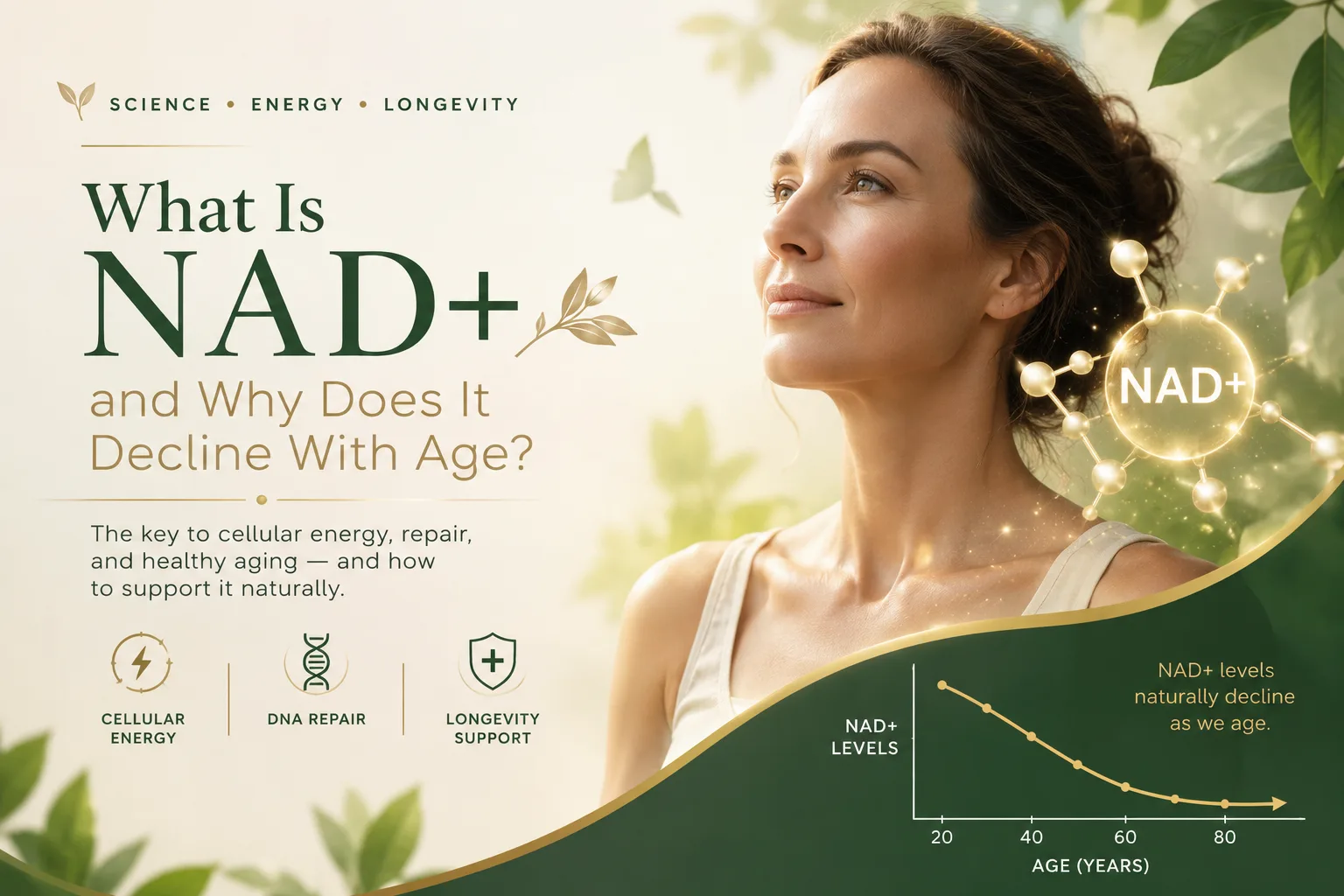
This is where things get genuinely surprising. NAD+ levels decline significantly with age — and the slide begins earlier than most people expect. Research suggests that by the time you're in your 60s, your NAD+ levels may be roughly half what they were in your 40s. But the decline often starts in your mid-30s, long before most people would think to pay attention to it.
Two forces drive this. First, your body naturally produces less NAD+ as you get older. Second, the demand for it increases at the same time — because more DNA damage accumulates with age, requiring more repair activity, which consumes more NAD+. It's a compounding pressure: production falls while consumption rises.
Lifestyle factors accelerate the decline further. Alcohol, poor sleep, a sedentary routine, UV exposure, and chronic low-grade inflammation all deplete NAD+ at a faster rate. If your daily life includes any of those pressures — and most people's does — your NAD+ levels may be lower than your age alone would suggest.
A 2021 review in Nature Reviews Molecular Cell Biology described NAD+ as a key regulator of cellular ageing processes. Interest from the longevity research community has accelerated sharply — with ongoing studies examining NAD+ in the context of metabolic health, cognitive function, cardiovascular resilience, and post-viral recovery. This is no longer a fringe area of science.
What Does Low NAD+ Actually Feel Like?
NAD+ decline rarely announces itself clearly. It's more like a gradual dimming — easy to attribute to ageing, a busy season, or just not sleeping well enough. That ambiguity is exactly why it tends to go unaddressed for so long.
The signs commonly associated with declining NAD+ include persistent fatigue that sleep doesn't fully resolve, reduced mental clarity and focus, slower recovery after physical exertion, a heightened sensitivity to stress, disrupted sleep quality, and a general sense of running below your usual capacity.
None of these symptoms are definitive on their own — they overlap with many other things. But if several of them resonate and you're in your mid-30s or beyond, NAD+ is a legitimate and well-researched piece of the picture worth understanding. This article isn't medical advice, and if you're concerned about your health, it's always worth speaking with a doctor.
Can You Actually Raise NAD+ Levels?
Yes — and this is where the science has become genuinely compelling. The most studied approach is supplementing with NAD+ precursors: compounds your body can readily convert into NAD+. The two most researched are NMN (nicotinamide mononucleotide) and NR (nicotinamide riboside), both of which have demonstrated the ability to raise NAD+ levels in human clinical trials.
NMN in particular has drawn significant attention. A 2022 clinical trial published in Endocrine Journal showed that NMN supplementation raised NAD+ levels in blood and improved muscle function in middle-aged and older adults. Longevity researchers including David Sinclair at Harvard have been vocal about its potential — though it's worth noting that human research is still developing, and no supplement should be seen as a guaranteed fix.
Lifestyle factors make a meaningful difference too. Regular exercise — particularly resistance training and high-intensity intervals — has been shown to boost NAD+ production. Time-restricted eating and caloric moderation appear to have similar effects. And reducing alcohol intake while improving sleep quality both help slow the rate of depletion.
For most people, the most effective approach combines a well-formulated precursor supplement with the lifestyle habits that support NAD+ production naturally — and reduce the unnecessary drain on it.
- NMN
(Nicotinamide Mononucleotide) A direct precursor to NAD+, NMN is efficiently converted by the body once absorbed. It's the most extensively studied NAD+ precursor in human clinical trials, and while it's found in small amounts in foods like edamame, broccoli, and avocado, dietary sources alone aren't sufficient to meaningfully raise NAD+ levels — supplementation is the practical route for most people.
NAD+ isn't a magic bullet — nothing is. But it is a real, well-researched molecule that sits at the centre of how your cells produce energy, repair themselves, and age. Understanding it is the first step. The second is deciding whether actively supporting your levels makes sense for where you are right now. For most people in their 30s and beyond, it's a question worth taking seriously.
Support Your Levels with NAD+ Longevity
Formulated with NMN as its core active ingredient, designed for daily use from your mid-30s onwards.
Explore NAD+ Longevity- Yoshino, J., Baur, J.A., & Imai, S. (2018). NAD+ Intermediates: The Biology and Therapeutic Potential of NMN and NR. Cell Metabolism, 27(3), 513–528. https://doi.org/10.1016/j.cmet.2017.11.002
- Imai, S., & Guarente, L. (2014). NAD+ and sirtuins in aging and disease. Trends in Cell Biology, 24(8), 464–471. https://doi.org/10.1016/j.tcb.2014.04.002
- Yasuda, I. et al. (2022). Effects of oral NMN supplementation on NAD+ metabolomics and muscle function in middle-aged and older adults. Endocrine Journal, 69(5), 545–553.
- Covarrubias, A.J. et al. (2021). NAD+ metabolism and its roles in cellular processes during ageing. Nature Reviews Molecular Cell Biology, 22, 119–141. https://doi.org/10.1038/s41580-020-00313-x
- Verdin, E. (2015). NAD+ in aging, metabolism, and neurodegeneration. Science, 350(6265), 1208–1213. https://doi.org/10.1126/science.aac4854
This article is for informational and educational purposes only. It does not constitute medical advice and is not intended to diagnose, treat, cure, or prevent any condition. Always consult a qualified healthcare professional before making changes to your supplement routine or health plan.