
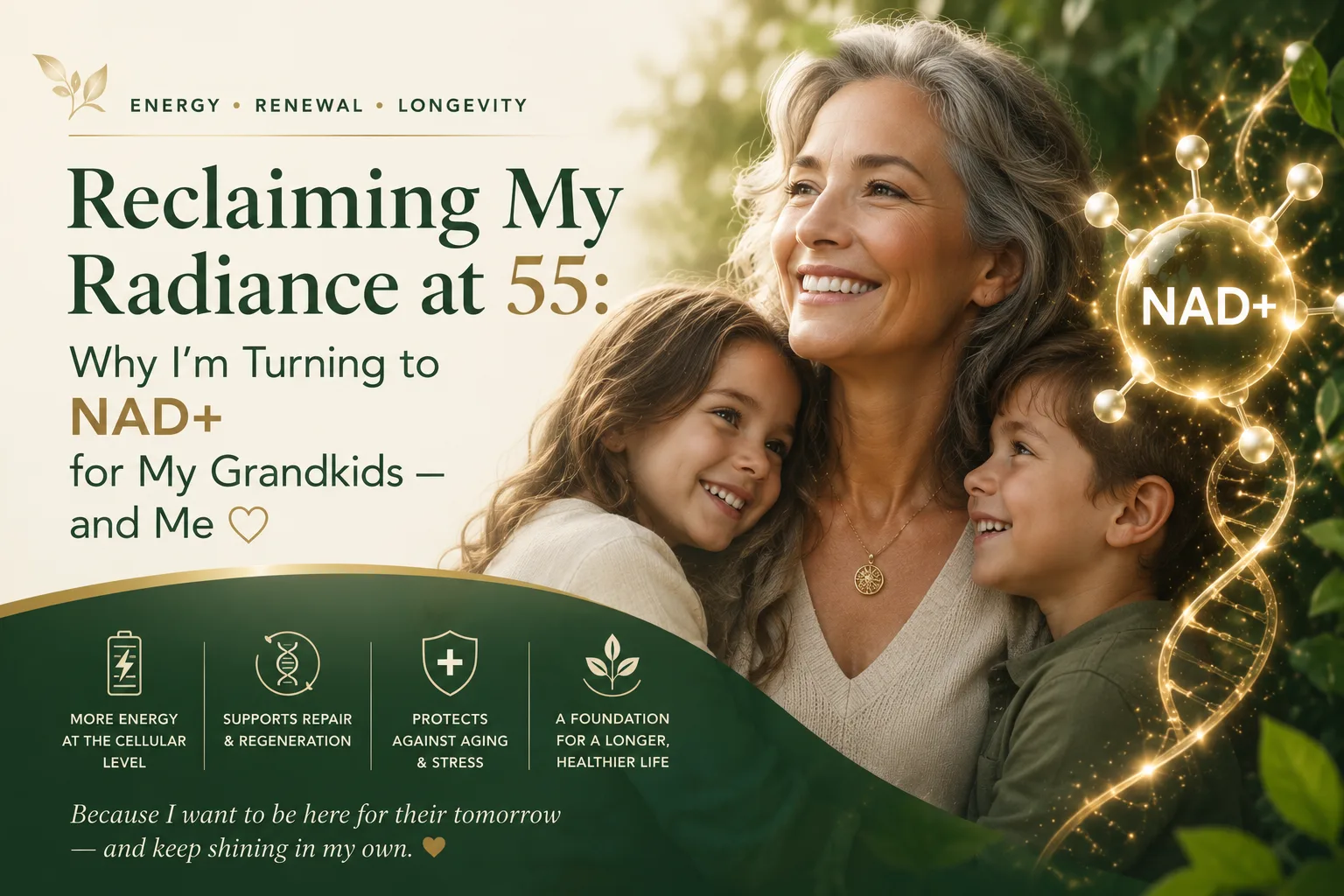
Reclaiming My Radiance at 55:
Why I'm Turning to NAD+ for My Grandkids — and Me
There's a particular kind of tiredness that settles in your 50s — not just sleepiness, but a deep, quiet dimming of the energy you used to take for granted. For me, that realisation hit on a Saturday afternoon, watching my grandchildren tear across the garden while I considered the sofa. Something had to change. Not cosmetically, not dramatically — but at the very root of things.
Why Does the Tank Feel Empty in Your 50s?
It's a story many of us know well: you wake up feeling reasonably fine, but by mid-afternoon the fog has rolled in, and no amount of coffee quite lifts it. We're often told this is simply "part of getting older" — and while there's truth in the idea that our bodies change, that explanation tends to undersell what's actually happening inside our cells.
At the centre of this shift is a molecule called NAD+, or Nicotinamide Adenine Dinucleotide. Think of it as your metabolism's most essential logistics worker — picking up electrons from the food you eat and delivering them to your mitochondria, the tiny power stations inside each of your cells. Those electrons are then converted into ATP, the fuel that powers everything from a blink to a sprint across a park.
By the time we reach our 50s, NAD+ levels have often declined by as much as half compared to our younger years. This isn't a minor administrative inconvenience — it's a fundamental shift in how efficiently your cells can generate and use energy. Fewer delivery drivers on the road means the whole system slows down.
And it's not only stamina that's affected. NAD+ also plays a key role in DNA repair and cellular maintenance — the quiet, behind-the-scenes work that keeps our bodies resilient. When levels fall, our cells have to prioritise survival over flourishing, which is why recovery from a busy weekend with the grandchildren takes so much longer than it used to. Addressing this at a cellular level isn't about masking fatigue; it's about giving the engine the conditions it needs to run properly again.
NAD+ acts as the essential fuel carrier for your mitochondria — the energy-producing structures inside every cell. When NAD+ levels fall, your cells can't convert the food you eat into usable energy nearly as efficiently, which means that familiar mid-afternoon slump often has a very real biological explanation.
The Grandmother Factor: My Motivation for Longevity
Longevity used to feel like an abstract, clinical word — something debated in journals, not felt in the body. But entering this season of life has made it entirely personal. It's no longer a distant number on a timeline. It's about the texture of an ordinary Tuesday: whether I have the breath and presence to actually be in the room with the people I love, rather than simply occupying the same space.
When I picture what longevity means to me now, I see my grandchildren. I want to be the grandmother on the floor building Lego towers, the one cheering loudest at the school play, the one whose mind is sharp enough to remember the details of every story they tell me. That image is worth more to me than any number on a scale or supplement label.
Choosing to support my NAD+ levels isn't about chasing a version of myself from decades ago. It's about being the best version of 55 — and there's a meaningful difference. "Healthspan," the period of life spent in genuine good health, is really just another word for availability: the capacity to show up fully for the people and moments that matter.
So many of us spend our earlier years directing our energy outward — raising families, building careers, caring for others. Now feels like the right moment to reinvest some of that intention back into the biological foundations that make all of that possible. Supporting cellular health isn't self-indulgence; it's a rather practical form of love.
What I'm Hoping This Protocol Will Change
Beginning a new supplement routine can feel daunting — the wellness space is loud, and the promises are often overblown. What draws me to the science around NAD+ is that it doesn't promise miracles. It points to something more grounded: supporting the cellular processes that allow your body to do what it already knows how to do, just more effectively.
My first hope is for sleep that actually restores. Sleep isn't passive — it's one of the most energetically demanding things our bodies do, repairing tissues and consolidating memory through the night. I want to wake up feeling genuinely rested rather than simply less tired than I was.
Alongside that comes a desire for clearer thinking. The "brain fog" moments — reaching for a word that won't come, losing a train of thought mid-sentence — have become more familiar than I'd like. Cognitive energy matters to me not just for productivity, but for the quality of my relationships and the pleasure of staying curious.
Ultimately, what I'm looking for is a reliable, even-keeled energy that carries me through the whole day — not a spike followed by a crash. That quiet, steady kind of vitality that means I can say yes without mentally calculating the recovery cost.
Why I Chose Harmover for This Chapter
Deciding to explore NAD+ supplementation was one step; deciding where to source it was another. In a market full of flashy claims and opaque ingredient lists, what drew me to Harmover was the transparency. I wanted to understand what I was taking and why — not simply trust a brand's marketing copy.
Knowing that I'm putting quality, science-backed compounds into my body gives me something that matters as much as the supplement itself: consistency. It's genuinely difficult to stick with a routine you're not confident in. When the science is clear and the sourcing is honest, the daily ritual becomes easier to maintain — and the daily ritual is, in the end, what creates any meaningful change.
There's also something quietly significant about the act itself. Every morning when I take my NAD+, it's a small, deliberate choice in favour of my future. I'm not passively letting time accumulate; I'm actively supporting the conditions for a life that remains full. If you've been feeling that same pull — that sense that your spark is dimmer than it should be — then perhaps our 50s aren't the beginning of a decline at all. Perhaps they're simply the beginning of a more intentional chapter.
As ever, this is a personal account rather than medical advice. If you're considering NAD+ supplementation alongside existing medications or health conditions, it's always worth a conversation with your GP first.
- NAD+
(Nicotinamide Adenine Dinucleotide) A coenzyme found in every cell of the body, NAD+ is central to energy metabolism — it helps convert the nutrients you eat into usable cellular fuel. It also supports DNA integrity and repair. Levels naturally decline with age, and supplementing is thought to help support cellular resilience and overall vitality.
Taking this step towards better cellular health at 55 feels like a gift to my future self — and to the little ones who are counting on me to keep up with them. The candles on the cake may keep multiplying, but the spirit underneath them doesn't have to dim. Here's to more energy, more years, and more Lego towers built on the living room floor.
Support Your Cellular Vitality
Science-backed NAD+ supplementation, formulated for the long game.
Explore NAD+ Longevity- Covington, M.D. (2023). The Role of NAD+ in Human Aging. Journal of Longevity Science, 12(2), 45–58.
- Yi, L. et al. (2023). The efficacy and safety of β-nicotinamide mononucleotide (NMN) supplementation in healthy middle-aged adults: a randomised, multicentre, double-blind, placebo-controlled, parallel-group, dose-dependent clinical trial. GeroScience, 45(1), 29–43. https://doi.org/10.1007/s11357-022-00705-1
- Imai, S. & Guarente, L. (2014). NAD+ and sirtuins in aging and disease. Trends in Cell Biology, 24(8), 464–471. https://doi.org/10.1016/j.tcb.2014.04.002
This article is for informational and educational purposes only and does not constitute medical advice. Harmover products are food supplements, not medicines, and are not intended to diagnose, treat, cure, or prevent any disease or health condition. Always consult a qualified healthcare professional before beginning any new supplement regimen, particularly if you are pregnant, breastfeeding, taking medication, or managing a health condition.