
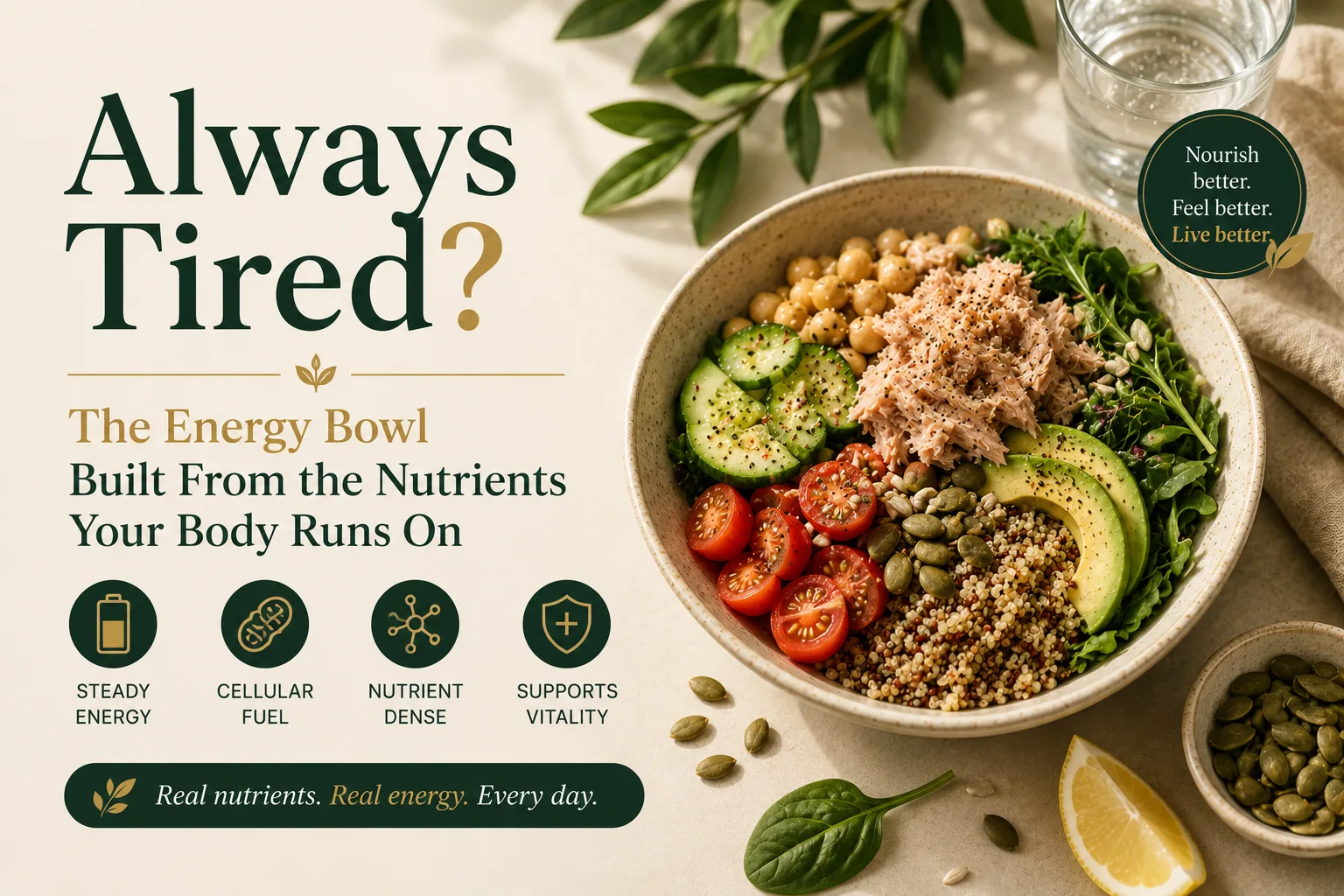
Always Tired? The Energy Bowl Built From the Nutrients Your Body Runs On
You've slept, you've had your coffee, and yet by mid-afternoon you're flagging all over again. Constant tiredness is one of those things many of us quietly put up with — but what's on your plate can genuinely help. This energy bowl is built around the foods that help with tiredness: the nutrients your body actually uses to turn what you eat into usable fuel.
Why am I always tired?
Here's the honest answer: tiredness rarely has just one cause. Sleep, stress, hydration, movement and what you eat all overlap, often at the same time.
If your fatigue is severe, sudden, or won't shift no matter what you change, that's worth checking with a doctor. Things like low iron, low B12 or thyroid issues are common, easily tested for, and very manageable — but they need diagnosing rather than guessing.
For the everyday energy dips most of us know — the 2pm slump, the foggy evening — the nutrients in your meals play a bigger role than people realise. Your body depends on specific vitamins and minerals to release energy from food, and when those run low, feeling tired is one of the first signs.
The energy bowl: what's in it and why
This bowl brings together quinoa, salmon, spinach, avocado, pumpkin seeds, garlic and onion, with a simple lemon and olive oil dressing. Every ingredient earns its place — here's the why behind each one.
Quinoa gives you slow-release energy from complex carbs plus a complete protein, so you get steady fuel instead of a sugar spike and crash. Salmon brings omega-3 healthy fats and B vitamins — including niacin (B3) and B12 — which your body uses as helpers to release energy from food. Spinach adds iron and folate, and low iron is one of the most common, most overlooked reasons people feel wiped out.
Avocado contributes healthy fats for steady, slow-burning energy. Pumpkin seeds are a great source of magnesium, which supports normal energy-yielding metabolism. And the garlic and onion bring flavour along with their own plant compounds.
A small but useful tip: the lemon in the dressing adds vitamin C, which helps your body absorb the plant-based iron in the spinach — a simple pairing that makes the bowl work a little harder.
This single bowl brings together B vitamins, iron, magnesium, healthy fats and slow-release carbs — the same nutrients research links to energy and reduced fatigue when your levels are low. It's a genuinely tasty way to cover a lot of ground in one meal.
How these nutrients connect to your energy
Without getting too technical: your cells make energy through pathways that rely on B vitamins acting as coenzymes — little helpers that keep the machinery running. Niacin (B3), for example, is a building block of NAD+, a coenzyme central to energy production that we've written about before.
Iron carries oxygen around your blood, and your cells need that oxygen to produce energy — which is why running low leaves you tired. Magnesium is involved in hundreds of reactions, including energy metabolism.
One honest caveat worth keeping in mind: much of the evidence here is about what happens when you're running low. Topping up beyond what your body needs won't necessarily give an already well-nourished person extra energy — the goal is having enough, not loading up on more. A meal like this bowl is a reliable, enjoyable way to keep your levels where they should be.
- B-Complex (incl. B3 / Niacin) B vitamins act as coenzymes in energy-yielding metabolism — essentially the helpers that let your cells release energy from food. Niacin (B3) is also a building block of NAD+. The bowl's salmon and quinoa supply B vitamins naturally, and a B-complex can help fill gaps, particularly B12 for people who eat little or no animal food. Best used to top up a genuine shortfall rather than as a guaranteed energy lift.
- Iron Iron carries oxygen in your blood, and your cells need that oxygen to make energy — so low iron is a common cause of fatigue, even before it becomes full anaemia. The spinach here provides plant-based (non-haem) iron, and pairing it with the vitamin C in the lemon dressing helps absorption. If you suspect low iron, it's worth a blood test rather than guessing.
- Magnesium Magnesium is involved in hundreds of reactions in the body, including energy metabolism and normal muscle and nerve function. Pumpkin seeds are one of the better food sources, and supplementation may help people whose intake is low. As with the others, the aim is adequacy rather than excess.
Food first, then fill the gaps
The foundations always matter most: consistent sleep, regular movement, managing stress, and balanced meals like this one. A bowl built around these nutrients is a genuinely good habit to keep in your week.
That said, needs vary, and sometimes diet alone isn't quite enough — low iron, low B12 (especially if you eat little or no meat), or low vitamin D are all common. If you suspect a gap, a simple blood test and a conversation with a professional is the right next step. That's exactly where supplements fit best: to fill a genuine shortfall, not to replace good food. None of this is medical advice. At Harmover you can explore energy-supporting supplements, learn the science in plain English, and connect with coaching or a doctor referral if you'd like guidance tailored to you.
Common questions about eating for energy
A few questions come up often once people start thinking about eating for steadier energy. The answers below stay within what this article and its references support.
Which nutrients matter most for energy?
Your body relies on specific vitamins and minerals to release energy from food — B vitamins as coenzymes, iron to carry the oxygen your cells need, magnesium across energy metabolism. When these run low, tiredness is one of the first signs. This bowl brings several together in one meal.
Why does low iron make you tired?
Iron carries oxygen around your blood, and your cells need that oxygen to make energy — so running low is a common cause of fatigue, even before it tips into full anaemia. The spinach here provides plant-based iron, and the lemon dressing helps you absorb it. If you suspect low iron, test rather than guess.
Will taking more vitamins give me more energy?
Not necessarily. Most of the evidence links these nutrients to energy when you're running low. Beyond having enough, more doesn't automatically mean more energy — the aim is adequacy, not excess. Whole meals like this one are a dependable way to keep your levels topped up.
How does the lemon help the iron in the spinach?
Vitamin C helps your body absorb the plant-based iron in foods like spinach, so the lemon in the dressing is doing real work, not just adding flavour. Pairing a vitamin C source with a plant iron source in the same meal is a simple, accurate way to get more from your food.
What to take away
Feeling tired all the time isn't something you simply have to accept. Start with the basics, build meals like this energy bowl into your week, and if your energy still isn't where you'd like it, it's worth looking a little deeper with a professional.
Food won't fix everything — but it's one of the most enjoyable levers you've got, and this is a delicious place to start.
Fill the gaps, not the plate
Great food comes first. Where a genuine shortfall shows up, explore energy-supporting supplements and connect with coaching or a doctor referral.
Explore Energy SupportEducational content, not medical advice.
- Tardy, A.-L., Pouteau, E., Marquez, D., Yilmaz, C. and Scholey, A., 2020. Vitamins and Minerals for Energy, Fatigue and Cognition: A Narrative Review of the Biochemical and Clinical Evidence. Nutrients, 12(1), 228. DOI: 10.3390/nu12010228
- Vaucher, P., Druais, P.-L., Waldvogel, S. and Favrat, B., 2012. Effect of iron supplementation on fatigue in nonanemic menstruating women with low ferritin: a randomised controlled trial. CMAJ, 184(11), pp. 1247–1254. DOI: 10.1503/cmaj.110950
- Covarrubias, A.J., Perrone, R., Grozio, A. and Verdin, E., 2021. NAD+ metabolism and its roles in cellular processes during ageing. Nature Reviews Molecular Cell Biology, 22(2), pp. 119–141. DOI: 10.1038/s41580-020-00313-x
This article is intended for informational and educational purposes only. It does not constitute medical or dietary advice and should not be used as a substitute for guidance from a qualified healthcare professional. Persistent, severe or sudden-onset fatigue should be assessed by a doctor, as causes such as low iron, low B12 or thyroid conditions are common and treatable. If you are pregnant, breastfeeding, taking medication or managing a health condition, speak with your practitioner before starting any new supplement.