
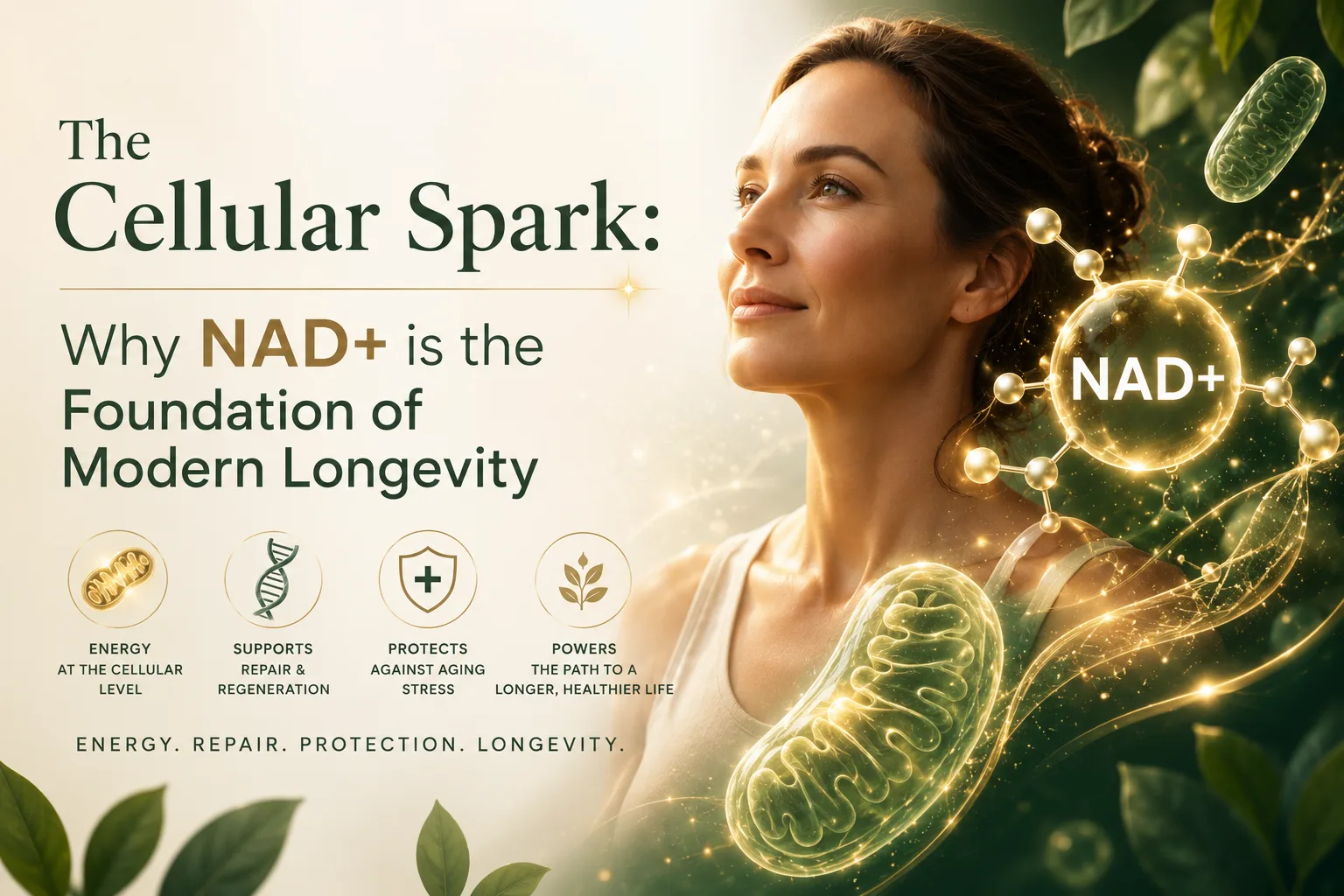
The Cellular Spark: Why NAD+ is the Foundation of Modern Longevity
Have you noticed that your energy just doesn't replenish the way it once did? That familiar sense of running on a slightly flatter battery — even after a good night's sleep — isn't purely a lifestyle problem. For many people, it comes down to something happening deep inside their cells, and a single molecule called NAD+ is at the heart of it.
What Is NAD+ and Why Does Your Body Need It?
NAD+ — short for Nicotinamide Adenine Dinucleotide — is a coenzyme present in every cell of your body. If that sounds technical, think of it this way: it acts like a molecular delivery driver, shuttling electrons from the food you eat to the parts of your cells that actually generate power. Without a steady supply of it, your mitochondria — the small structures inside each cell responsible for producing energy — simply cannot do their job efficiently.
But NAD+ does far more than keep the lights on. It's also the primary fuel source for a family of proteins called sirtuins, which are essentially your body's cellular maintenance crew. Sirtuins help regulate DNA integrity, manage inflammation, and keep a watchful eye on the overall health of your cellular systems. In short, NAD+ is less a single switch and more a master regulator — one your body depends on quietly, constantly, and completely.
NAD+ is the sole fuel source for PARPs — the enzymes responsible for detecting and repairing damaged DNA. When your levels are healthy, your cellular repair systems can work around the clock. When they drop, that repair capacity diminishes with them.
The Great Decline: Why Energy Fades Over Time
Here is the part that tends to surprise people: NAD+ levels are not fixed. They fall — often dramatically — as we age. Research suggests that by the time most of us reach middle age, our circulating NAD+ may have dropped to roughly half of what it was in our twenties. That's not a subtle shift. It's a significant change in your cellular environment, and it has real consequences.
When NAD+ declines, your cells lose some of their capacity to repair low-level DNA damage — the kind of everyday wear that accumulates simply from living. Your metabolism becomes less flexible, less responsive. And for many people, this shows up as the things we tend to chalk up to "just getting older": the brain fog that lingers past morning, the longer recovery time after exercise, the sense that your body is working harder than it used to for the same results. It isn't imagined. It has a biological basis.
Supporting Your Cellular Intelligence
The decline in NAD+ is a natural part of ageing — but natural doesn't mean inevitable, and it certainly doesn't mean you have to sit with it passively. Emerging research points to several practical ways to support your body's ability to maintain healthier NAD+ levels over time.
On the lifestyle side, high-intensity interval training (HIIT), intermittent fasting, and a diet containing NAD+ precursor-rich foods — things like edamame, avocado, and mushrooms — have all been shown to stimulate the body's own production pathways. The logic is straightforward: certain kinds of metabolic stress signal to your cells that they need to be more efficient, and NAD+ production is one of the ways they respond.
For those looking for additional support, targeted supplementation with precursor compounds has become an increasingly popular approach. The goal isn't to replace what your body does naturally, but to give it more of the raw materials it needs to do it well. This is not medical advice, and anyone with an existing health condition should speak with their doctor before starting a new supplement regimen — but for many people, supporting NAD+ is simply a matter of informed, consistent choices.
- NAD+
(Nicotinamide Adenine Dinucleotide) The foundational coenzyme at the centre of this article. It facilitates the transfer of electrons within the mitochondria to produce ATP — the energy currency your cells run on — whilst simultaneously acting as the essential substrate for sirtuins and DNA-repair enzymes. Maintaining healthy NAD+ levels is central to what researchers now call cellular resilience. - NMN
(Nicotinamide Mononucleotide) A direct precursor to NAD+, meaning the body converts it into NAD+ once it has been absorbed. NMN is notable for its stability and bioavailability, which makes it a practical choice for those looking to support their systemic NAD+ levels through supplementation. It is one of the most widely researched NAD+ precursors currently available.
Longevity, when you strip away the noise, isn't about chasing some elusive biological perfection. It's about understanding the quiet signals your body is sending — and responding to them thoughtfully. Replenishing the conditions your cells need to function well is less about turning back the clock and more about giving yourself the best possible foundation to live clearly, energetically, and with resilience. Your cells have remarkable intelligence. The question is simply whether you're giving them what they need to use it.
Give Your Cells the Support They're Asking For
Formulated around the science of cellular energy and NAD+ precursor nutrition.
Explore NAD+ Longevity- Covarrubias, A.J. et al. (2021). NAD+ metabolism and its roles in cellular processes during ageing. Nature Reviews Molecular Cell Biology, 22(2), 119–141. https://doi.org/10.1038/s41580-020-00313-x
- Schultz, M.B., & Sinclair, D.A. (2016). Why NAD+ Declines during Aging: It's Destroyed. Cell Metabolism, 23(6), 965–966. https://doi.org/10.1016/j.cmet.2016.05.022
- Rajman, L. et al. (2018). Therapeutic Potential of NAD-Boosting Molecules: The In Vivo Evidence. Cell Metabolism, 27(3), 529–547. https://doi.org/10.1016/j.cmet.2018.02.011
This article is for informational and educational purposes only. It does not constitute medical advice, diagnosis, or treatment. Always consult a qualified healthcare professional before making changes to your diet, lifestyle, or supplement routine. Harmover products are food supplements and are not intended to diagnose, treat, cure, or prevent any disease.