
Why Am I Always Tired? The Science of NAD+ and Your Cellular Energy
You slept eight hours. You had your coffee. And yet by mid-afternoon you're running on empty again. If "I'm always tired" has quietly become your default setting, you're not imagining it — and you're far from alone. Persistent tiredness is one of the most common signs that something feels a little off, and increasingly the conversation is turning to a molecule working behind the scenes in every one of your cells: NAD+.
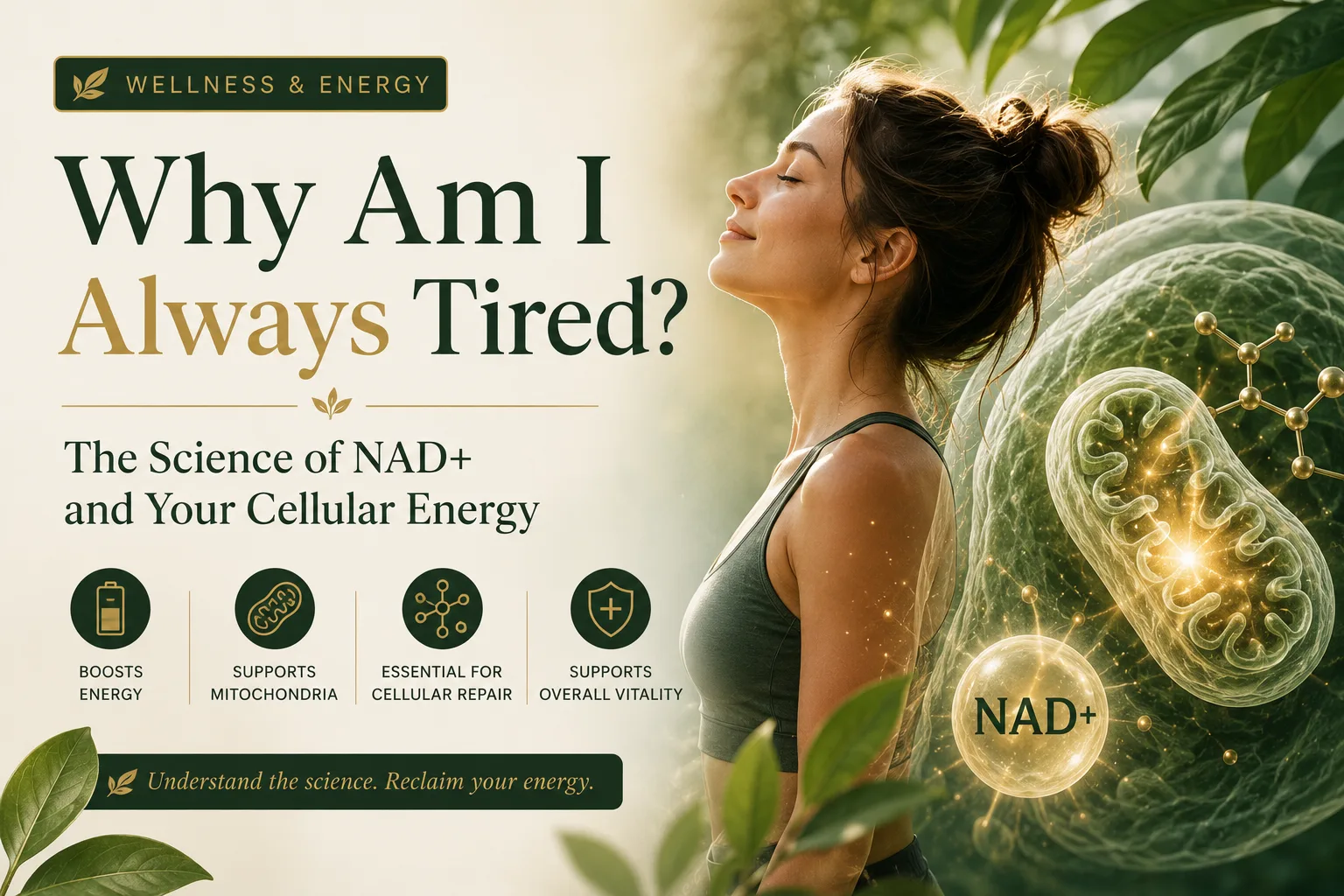
Why am I tired all the time?
Here's the honest starting point: when you ask why am I always tired, the answer is rarely a single cause. Sleep quality, stress, nutrition, movement, hydration, screen time and underlying health conditions all play a part, and usually several overlap at once.
If your fatigue is severe, came on suddenly, or won't budge no matter what you change, that's a conversation to have with a doctor — not something to pin on any one supplement. Persistent fatigue can have causes worth ruling out properly.
But for a lot of people, everyday tiredness — the kind that creeps in around 2pm, makes the gym feel impossible and leaves you foggy by evening — is partly a story about energy at the cellular level. Your body produces energy inside tiny structures called mitochondria, and that process leans on a handful of essential helper molecules. One of the most important is NAD+.
What is NAD+, and why does it matter for energy?
NAD+ (nicotinamide adenine dinucleotide) is a coenzyme found in every living cell. In plain English, it's a molecular middleman: it helps move the energy locked inside your food into a form your cells can actually use. Researchers describe NAD+ as central to energy metabolism — without enough of it, the machinery that keeps you feeling energised simply can't run smoothly.
Here's the catch. NAD+ levels don't hold steady across a lifetime. A large body of research shows that NAD+ gradually declines with age across many tissues, and that decline has been associated with several features of ageing, from lower energy to changes in muscle and metabolism. It's one of the main reasons scientists are so interested in whether topping NAD+ back up could support healthy ageing — including how energetic we feel day to day.
A quick note on terms. You'll often see NAD+ "precursors" mentioned. These are the building blocks your body uses to make NAD+. The best-studied are nicotinamide mononucleotide (NMN), nicotinamide riboside (NR) and NADH. So when people talk about "taking NAD+", they usually mean taking one of these precursors.
NAD+ levels gradually fall as we age, and fatigue is strikingly common — affecting an estimated 40–74% of older adults in everyday life. That overlap is exactly why researchers are asking whether restoring NAD+ could help us feel more energetic.
What does the research say about NAD+ and fatigue?
This is where honesty matters. The science is genuinely promising, but it's still early, and good wellness content shouldn't oversell it. Here's a fair picture of where things stand.
Researchers broadly agree on the foundation: NAD+ is essential to how your cells produce energy, and its decline with age is well documented. What's still being worked out is exactly how much taking NAD+ precursors translates into actually feeling more energetic.
On that question, several human trials offer encouraging early signals. In one randomised, placebo-controlled study, older adults who took NMN for 12 weeks showed improvements in lower-body physical function and reductions in drowsiness, with the researchers pointing to potential benefits for fatigue. In another randomised, double-blind trial involving people with chronic fatigue syndrome, a combination of CoQ10 and NADH was associated with a meaningful reduction in perceived cognitive fatigue and better quality of life. And a 2025 trial exploring nicotinamide riboside in people with long COVID found that, while overall differences versus placebo were limited, some participants showed within-group improvements in fatigue and sleep after around ten weeks.
The honest takeaway: NAD+ precursors reliably raise NAD+ levels in the body, and early research points toward possible benefits for energy, fatigue and sleep — but the evidence is still emerging, results vary from person to person, and larger studies are needed before anyone can speak in absolutes.
- NMN Nicotinamide mononucleotide — a direct precursor your body converts into NAD+, and one of the most-studied NAD+ boosters in humans. Clinical trials confirm NMN reliably raises blood NAD+ levels. Early research associates it with improvements in physical function, reduced drowsiness and lower fatigue in older adults, though results vary and more study is needed.
- NR Nicotinamide riboside — another NAD+ precursor, and a form of vitamin B3. Trials confirm NR raises NAD+ levels and is generally well tolerated. Research into its effects on fatigue and recovery, including in long COVID, is ongoing and currently exploratory rather than settled.
- NADH The "reduced", active form of NAD+, playing a key role in cellular energy production. In research it is frequently paired with CoQ10, and that combination has been associated with reduced cognitive fatigue and improved quality of life in people with chronic fatigue syndrome.
My own experience
What follows is one person's genuine experience, shared as a personal story rather than a promise of results. Everyone's body is different, and individual results vary.
About two months ago I started taking NAD+ support every day. I genuinely didn't expect to notice much. But the change in how I feel has been hard to ignore. My energy is steadier right through the day, and that familiar 2pm slump — the one that used to send me reaching for a third coffee — has largely faded. I'm sleeping more deeply, which I suspect is doing a lot of the heavy lifting. And in my yoga practice I feel noticeably stronger and more present; poses that once left me shaky feel grounded now.
Could some of that be down to better sleep, or simply paying closer attention to my health overall? Almost certainly — and I'd never claim NAD+ alone is responsible. But two months in, it has become a part of my routine I'm not keen to give up.
How to support your NAD+ (and your energy)
Supplements are only one piece of the puzzle. The foundations still matter most: consistent, good-quality sleep; regular movement, especially anything that challenges your muscles; managing stress; and eating in a way that keeps your energy steady. These have the strongest evidence behind them — and they also happen to support your body's own NAD+ production.
If you're curious about adding NAD+ support on top of those basics, it's worth doing thoughtfully: choosing a quality product, having realistic expectations, and ideally checking in with a professional, especially if you have a health condition or take medication. At Harmover you can explore NAD+ support, learn the science in plain English, and connect with coaching or a doctor referral if you'd like guidance tailored to you.
Common questions: why am I always tired?
These are the questions that come up most often. The answers below stay within what this article and its references actually support — which, on this topic, means being clear about what is still uncertain.
Why am I always tired even when I get enough sleep?
Because tiredness rarely has one cause. Sleep quality, stress, nutrition, movement, hydration, screen time and underlying health conditions all contribute, and usually several overlap. For some people there's also a cellular-energy element, since your body makes energy inside mitochondria using a handful of essential helper molecules. If your fatigue is severe, sudden or stubborn, see a doctor rather than reaching for a supplement.
What is NAD+ and what does it do?
NAD+ (nicotinamide adenine dinucleotide) is a coenzyme found in every living cell. It works as a molecular middleman, helping move the energy locked inside your food into a form your cells can actually use. Researchers describe it as central to energy metabolism.
Does NAD+ decline with age?
Yes — this part is well documented. A large body of research shows NAD+ gradually declines with age across many tissues, and that decline has been associated with several features of ageing, from lower energy to changes in muscle and metabolism. It's the main reason researchers are asking whether restoring NAD+ could support healthy ageing.
Do NAD+ supplements help with fatigue?
This is the honest bit: the evidence is still emerging. NAD+ precursors such as NMN, NR and NADH reliably raise NAD+ levels in the body, and early human trials point toward possible benefits for energy, fatigue and sleep. But results vary from person to person, and larger studies are needed before anyone can speak in absolutes. Supplements also sit alongside the foundations — sleep, movement, stress and nutrition — rather than replacing them.
When should tiredness be checked by a doctor?
If your fatigue is severe, came on suddenly, or won't budge no matter what you change. That's a conversation to have with a doctor rather than something to pin on any one supplement — persistent fatigue can have causes worth ruling out properly.
What to take away
Feeling tired all the time isn't simply "part of getting older", and it isn't something you have to accept. Sometimes the answer is more sleep or less stress; sometimes it's worth looking deeper, right down to the energy your cells are making.
NAD+ won't be a magic switch — nothing honest ever is — but understanding it hands you one more informed, science-backed lever to pull. Start with the basics, stay curious, and if you want to explore NAD+ support, we're here to help you do it the right way.
Start with the basics
Explore NAD+ support, learn the science in plain English, and connect with coaching or a doctor referral if you'd like guidance tailored to you.
Explore NAD+ SupportEducational content, not medical advice.
- Covarrubias, A.J., Perrone, R., Grozio, A. and Verdin, E., 2021. NAD+ metabolism and its roles in cellular processes during ageing. Nature Reviews Molecular Cell Biology, 22(2), pp. 119–141. DOI: 10.1038/s41580-020-00313-x
- Kim, M., Seol, J., Sato, T., Fukamizu, Y., Sakurai, T. and Okura, T., 2022. Effect of 12-Week Intake of Nicotinamide Mononucleotide on Sleep Quality, Fatigue, and Physical Performance in Older Japanese Adults: A Randomized, Double-Blind, Placebo-Controlled Study. Nutrients, 14(4), 755. DOI: 10.3390/nu14040755
- Castro-Marrero, J., Segundo, M.J., Lacasa, M., Martinez-Martinez, A., Sanmartin Sentañes, R. and Alegre-Martin, J., 2021. Effect of Dietary Coenzyme Q10 Plus NADH Supplementation on Fatigue Perception and Health-Related Quality of Life in Individuals with ME/CFS: A Prospective, Randomized, Double-Blind, Placebo-Controlled Trial. Nutrients, 13(8), 2658. DOI: 10.3390/nu13082658
- 2025. Effects of nicotinamide riboside on NAD+ levels, cognition, and symptom recovery in long-COVID: a randomized controlled trial. eClinicalMedicine (The Lancet Discovery Science). Available at: https://www.thelancet.com/journals/eclinm/article/PIIS2589-5370(25)00567-X/fulltext
- 2023. Evaluation of safety and effectiveness of NAD in different clinical conditions: a systematic review. American Journal of Physiology-Endocrinology and Metabolism. DOI: 10.1152/ajpendo.00242.2023
This article is intended for informational and educational purposes only. It does not constitute medical advice and should not be used as a substitute for guidance from a qualified healthcare professional. The personal account above reflects one individual's experience; individual results vary and are not guaranteed. Persistent, severe or sudden-onset fatigue should be assessed by a doctor. If you are pregnant, breastfeeding, taking medication or managing a health condition, speak with your practitioner before starting any new supplement.