
What Does 20:1 Mushroom Extract Mean? How to Read Functional Mushroom Labels
Lion's Mane 10:1. Chaga 20:1. 30% polysaccharides. Dual extracted. Mushroom labels are full of numbers and phrases that sound precise. Which of them actually tells you one product is better than another? Less than you might think, and the answer starts with what a ratio really measures.
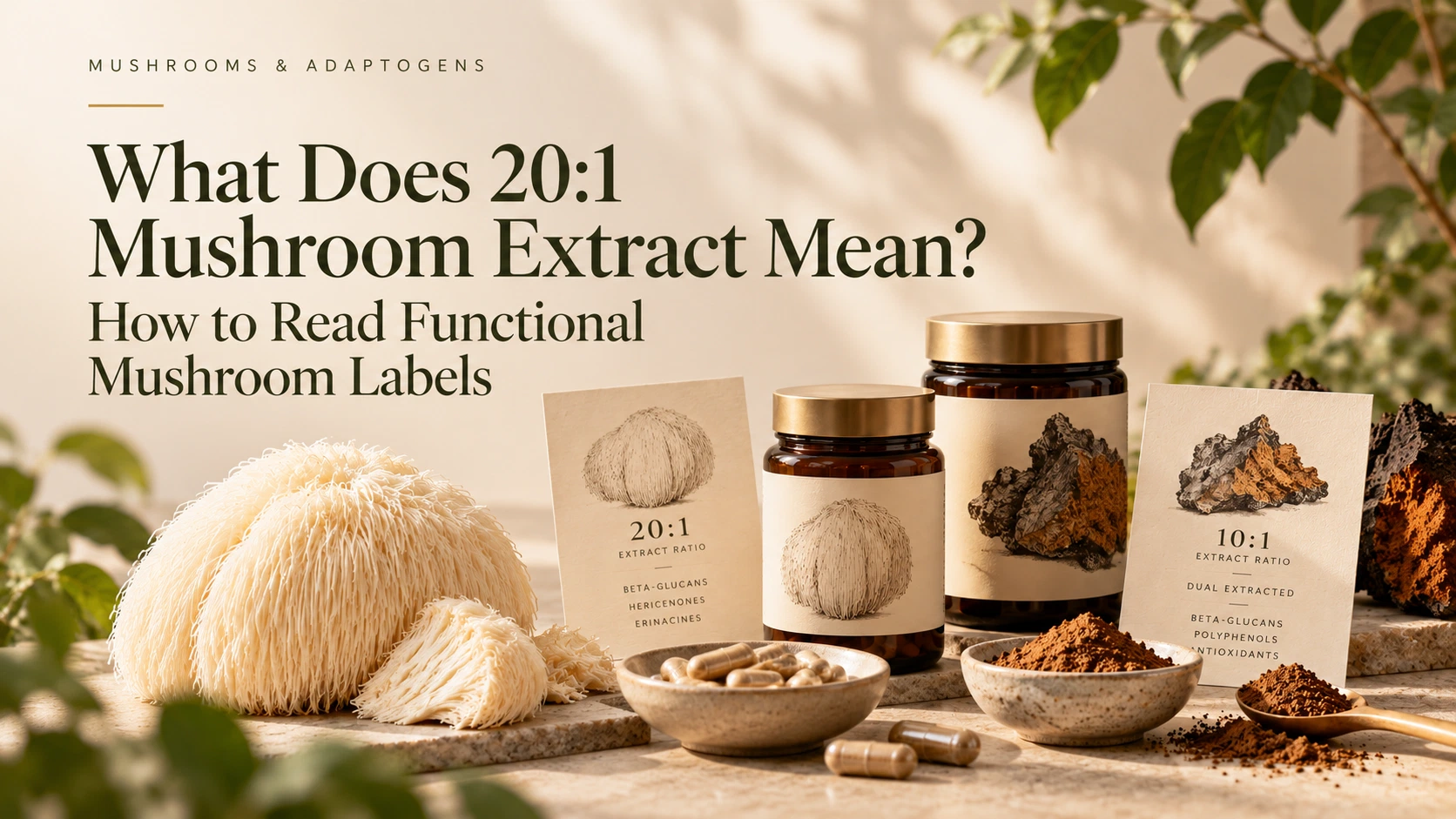
What Does 20:1 Mushroom Extract Mean?
A 20:1 mushroom extract means roughly 20 units of starting mushroom, usually dried, were used to make 1 unit of finished extract. That is an extraction ratio: it compares what went in with what came out. A 10:1 extract has a yield of about 10 percent, and a 20:1 extract about 5 percent.
Does that make it twenty times stronger? Not necessarily. A ratio describes raw-material equivalence, meaning how much mushroom the extract represents, not what is inside it. By itself it doesn't tell you how much of any compound you are getting, how pure the extract is, how well your body absorbs it, or whether the product is well made.
The number can also be fuzzier than it looks. Makers can calculate it differently, and it may or may not count carriers such as maltodextrin added afterward. For European herbal medicines, regulators ask for the genuine ratio, the solvent used and a range, with later additives left out (European Medicines Agency, 2023). Supplement labels aren't generally held to that definition, so a bare "20:1" often arrives without context.
Is 20:1 Better Than 10:1?
Not automatically. If everything else were equal, a 20:1 extract would be more concentrated than a 10:1. Everything else is rarely equal, and four things usually matter more than the ratio.
The starting material comes first: species, which part of the mushroom, even where it grew. One analysis found that Chaga from France, Canada and Ukraine differed in key compounds (Géry et al., 2018). The extraction process matters too, including the solvent, temperature and whether the extract was dried onto a carrier. Then there are the measured compounds: what a lab actually found, and by which method. Two beta-glucan methods gave different results on the same wild mushrooms (Mirończuk-Chodakowska and Witkowska, 2020). Finally, the serving amount: 250 mg of a 20:1 extract and 500 mg of a 10:1 extract both represent the same nominal 5,000 mg of mushroom, so compare per serving, not per ratio.
To our knowledge, extraction ratios have not been compared head to head in human trials, so the idea that 20:1 outperforms 10:1 in people is unproven.
A ratio says how much mushroom went into the extract, not what the extract contains. Species, extraction, measured compounds, serving size and testing tell you more.
Hot Water, Alcohol and Dual Extraction: What Do They Mean?
Hot-water extraction simmers the mushroom and keeps the liquid. Most polysaccharides dissolve well in water, so hot water is the classic way to extract them (Lu et al., 2021). Alcohol extraction uses ethanol, the solvent in a tincture, which dissolves lipids, phenolics and other compounds that water leaves behind (Beltrame et al., 2021). Dual extraction uses both and combines the results.
So what does "dual extracted" tell you? That more than one solvent was involved, which can broaden the range of compounds captured when both water-soluble and alcohol-soluble constituents matter. By itself it doesn't show that a product is stronger or better absorbed, and because the term doesn't appear to have a single, universally adopted definition, it may not reveal the temperatures, solvent strength or how much of each fraction made it into the product. Dual extraction isn't automatically superior for every mushroom or purpose: if the compounds of interest are water-soluble, a well-made hot-water extract can do the same job.
Fruiting Body, Mycelium and Beta-Glucans
The fruiting body is the mushroom you would recognize. Mycelium is the thread-like network that forms the fungus's main body. Myceliated grain is mycelium grown on rice or oats, then dried and ground, often with the grain left in. They can differ chemically: in Chaga, polysaccharides from cultivated mycelium contained both alpha- and beta-glucans, while those from the harvested conk were mainly beta-glucan (Beltrame et al., 2021), and Lion's Mane research has examined compounds such as hericenones and erinacines in both fruiting bodies and mycelia (Friedman, 2015). Different profiles are not a ranking, and neither form is automatically better. A standardized mycelium product has been tested in a human trial (Li et al., 2020), and fruiting body still needs to be identified and measured. Fruiting body, mycelium and myceliated substrate are different materials, best judged by what they contain and how they are tested, and the label should say which one you are buying.
Then there is the number that adds specificity. Polysaccharides are a broad family of sugar chains that includes starch, and polysaccharide standardization is a common, legitimate way to specify a mushroom product. Beta-glucans are one specific type, and the one mushroom research focuses on. Depending on the method, a total-polysaccharide figure can also include starch-type glucans. The lab method developed for mushroom products measures total glucan, subtracts alpha-glucan (starch and glycogen), and reports beta-glucan by difference (McCleary and Draga, 2016). A stated beta-glucan percentage, with its test method, therefore adds specificity and transparency alongside a polysaccharide figure. There is no universal ideal figure, and the number measures content rather than effect, so compare grams per serving measured the same way.
How to Read a Mushroom Supplement Label
Here is a short checklist, roughly in order of usefulness. Not every good product will tick every box, but the more it ticks, the more you can verify for yourself.
Species and material. The Latin name, and whether it is fruiting body, mycelium or grain-based.
Extraction method. Hot water, alcohol or both.
Extract ratio. Useful as a clue, ideally with the basis (dried mushroom) and any carriers disclosed.
Serving amount. How much extract, not "mushroom equivalent," you get per serving.
Beta-glucans. Ideally a measured percentage and the test method, alongside any polysaccharide figure.
Testing and transparency. A batch certificate of analysis from an independent lab, covering contaminants such as microbes and heavy metals, and a company willing to share it.
Lion's Mane and Chaga: A Quick Example
These two mushrooms show why a ratio can't carry a label. Lion's Mane is studied mostly for cognition, in small human trials. In one, 30 older adults with mild cognitive impairment took about 3 grams of dried fruiting body daily for 16 weeks and scored higher than placebo on a cognitive scale (Mori et al., 2009). Chaga is the sterile conk that grows on birch, with polysaccharides that are mainly beta-glucans (Beltrame et al., 2021). Much of its published research is laboratory work on cells and animals (Lu et al., 2021), which tells us less about effects in people. Isolated case reports have linked very large daily amounts of Chaga powder to oxalate-related kidney problems (Kwon et al., 2022), so check with your doctor first if you have kidney disease or stones.
So a 20:1 on each bottle means different material, different compounds and different evidence, and neither ratio would have told you any of that. Claims that the two work synergistically in a blend would need direct evidence, so treat a blend as two ingredients until that exists.
- Lion's Mane (Hericium erinaceus) An edible mushroom with shaggy spines, studied for compounds such as hericenones and erinacines. Human trials are small and mostly look at cognition.
- Chaga (Inonotus obliquus) A hard, dark sterile conk that grows on birch, containing beta-glucans and triterpenoids. Much of the research is laboratory-based.
- Beta-glucans Chains of glucose found in the cell walls of mushrooms. Unlike a general polysaccharide figure, a beta-glucan value is measured separately from starch, which makes it more informative.
A 20:1 ratio is useful information, and it hints at how concentrated an extract is. But it is not a quality score. The rest of the label matters more: what the material is, how it was extracted, what was measured, how much you get per serving and whether anyone independent checked. Choose the product that tells you more, not the one with the biggest number. This is educational, not medical advice, so speak with your doctor or pharmacist before adding a supplement if you are pregnant, take medication or have a health condition.
Read any label with the checklist in hand
Explore Harmover's Lion's Mane and Chaga, and use the checklist above to compare any mushroom supplement you consider.
Explore Mushrooms & AdaptogensEducational content, not medical advice.
- Committee on Herbal Medicinal Products (HMPC), European Medicines Agency, 2023. Questions & answers on quality of herbal medicinal products/traditional herbal medicinal products. EMA/HMPC/41500/2010 Rev.7, 22 November 2023. Declaration of the active substance, Q1 (drug extract ratio and extraction solvent). https://www.ema.europa.eu/en/documents/other/questions-answers-quality-herbal-medicinal-products-traditional-herbal-medicinal-products-revision-7_en.pdf Evidence type: Regulatory guidance (EU herbal medicines).
- McCleary BV, Draga A., 2016. Measurement of β-glucan in mushrooms and mycelial products. Journal of AOAC International, 99(2), 364–373. DOI: 10.5740/jaoacint.15-0289. PMID: 26957216. https://doi.org/10.5740/jaoacint.15-0289 Evidence type: Analytical method paper.
- Mirończuk-Chodakowska I, Witkowska AM., 2020. Evaluation of Polish wild mushrooms as beta-glucan sources. International Journal of Environmental Research and Public Health, 17(19), 7299. DOI: 10.3390/ijerph17197299. PMID: 33036263. https://doi.org/10.3390/ijerph17197299 Evidence type: Laboratory/analytical study.
- Lu Y, Jia Y, Xue Z, Li N, Liu J, Chen H., 2021. Recent developments in Inonotus obliquus (Chaga mushroom) polysaccharides: isolation, structural characteristics, biological activities and application. Polymers, 13(9), 1441. DOI: 10.3390/polym13091441. PMID: 33947037. https://doi.org/10.3390/polym13091441 Evidence type: Scientific review (laboratory and animal findings).
- Friedman M., 2015. Chemistry, nutrition, and health-promoting properties of Hericium erinaceus (Lion's Mane) mushroom fruiting bodies and mycelia and their bioactive compounds. Journal of Agricultural and Food Chemistry, 63(32), 7108–7123. DOI: 10.1021/acs.jafc.5b02914. PMID: 26244378. https://doi.org/10.1021/acs.jafc.5b02914 Evidence type: Scientific review.
- Beltrame G, Trygg J, Hemming J, Han Z, Yang B., 2021. Comparison of polysaccharides extracted from cultivated mycelium of Inonotus obliquus with polysaccharide fractions obtained from sterile conk (Chaga) and birch heart rot. Journal of Fungi, 7(3), 189. DOI: 10.3390/jof7030189. PMID: 33800424. https://doi.org/10.3390/jof7030189 Evidence type: Laboratory/analytical study.
- Géry A, Dubreule C, André V, Rioult JP, Bouchart V, Heutte N, Eldin de Pécoulas P, Krivomaz T, Garon D., 2018. Chaga (Inonotus obliquus), a future potential medicinal fungus in oncology? A chemical study and a comparison of the cytotoxicity against human lung adenocarcinoma cells (A549) and human bronchial epithelial cells (BEAS-2B). Integrative Cancer Therapies, 17(3), 832–843. DOI: 10.1177/1534735418757912. PMID: 29484963. https://doi.org/10.1177/1534735418757912 Evidence type: Laboratory/cell study.
- Mori K, Inatomi S, Ouchi K, Azumi Y, Tuchida T., 2009. Improving effects of the mushroom Yamabushitake (Hericium erinaceus) on mild cognitive impairment: a double-blind placebo-controlled clinical trial. Phytotherapy Research, 23(3), 367–372. DOI: 10.1002/ptr.2634. PMID: 18844328. https://doi.org/10.1002/ptr.2634 Evidence type: Human randomized trial (n = 30).
- Li IC, Chang HH, Lin CH, Chen WP, Lu TH, Lee LY, Chen YW, Chen YP, Chen CC, Lin DP., 2020. Prevention of early Alzheimer's disease by erinacine A-enriched Hericium erinaceus mycelia: pilot double-blind placebo-controlled study. Frontiers in Aging Neuroscience, 12, 155. DOI: 10.3389/fnagi.2020.00155. PMID: 32581767. https://doi.org/10.3389/fnagi.2020.00155 Evidence type: Human randomized pilot trial.
- Kwon O, Kim Y, Paek JH, Park WY, Han S, Sin H, Jin K., 2022. Chaga mushroom-induced oxalate nephropathy that clinically manifested as nephrotic syndrome: a case report. Medicine (Baltimore), 101(10), e28997. DOI: 10.1097/MD.0000000000028997. PMID: 35451393. https://doi.org/10.1097/MD.0000000000028997 Evidence type: Human case report.
This article is intended for informational and educational purposes only. It does not constitute medical advice and should not be used as a substitute for guidance from a qualified healthcare professional. Functional mushrooms and their extracts are food supplements, not treatments for any medical condition. If you are pregnant, breastfeeding, taking medication or managing a health condition, speak with your doctor or pharmacist before adding a new supplement to your routine.