What Is Bee Bread? Inside the Hive's Winter Pantry (No Toaster Required)
The clocks have gone back, or are about to, it is dark by teatime, and somewhere near you a colony of honey bees has stopped foraging and started eating into its pantry. That pantry is bee bread: pollen the bees pack, preserve and store in the comb to get through winter. Until recently, almost nobody outside beekeeping circles had heard of it.
So What Actually Is Bee Bread?
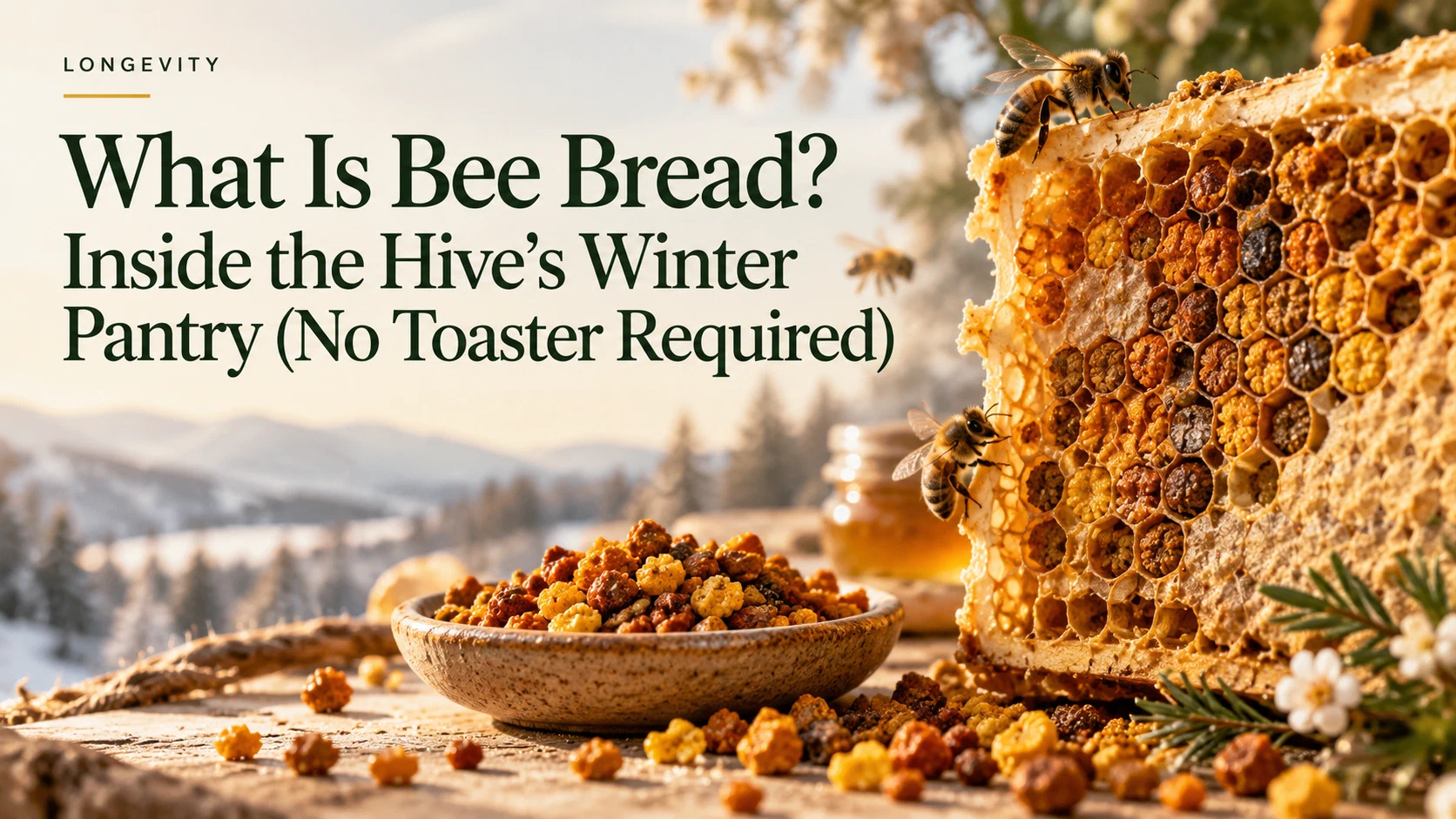
A forager bee collects pollen from flowers, moistens it with a little nectar and saliva, and carries it home on her back legs. Back at the hive the pellets are tamped into honeycomb cells (the bees use their heads, which is as charming as it sounds) and sealed under a thin layer of honey. Beekeepers call the result bee bread. Bees call it dinner. Stored pollen is sugary and acidic, with simple sugars making up 40 to 50 percent of it (Anderson et al., 2014), which is part of why it keeps.
This is where the confusion with bee pollen comes from. Bee pollen is the raw pellet, usually knocked off the bees' legs by a trap at the hive entrance. Bee bread is what the bees do with it afterward. If bee pollen is flour, bee bread is the loaf, except you cannot toast it and it is not, in any baking sense, bread. We are sorry about the name. It was not our idea.
What is in it is where things get interesting. More than 300 compounds have been identified in bee bread from around the world, including free amino acids, fatty acids, minerals, organic acids, vitamins and polyphenols (Bakour et al., 2022; Khalifa et al., 2020; Kieliszek et al., 2018). The mix changes with the flowers the bees visited, the season and the region, so think of it less as one ingredient and more as a snapshot of what was in bloom near the hive.
Is Bee Bread Really Fermented?
Fermentation is having a moment: sourdough starters with names, kimchi in the fridge door, kombucha on tap in the office kitchen. So it was only a matter of time before someone pointed at the hive. Bee bread is widely described as a fermented product, and stored pollen does contain acid-tolerant bacteria such as Lactobacillus kunkeei (Anderson et al., 2014). The bees were running a starter long before anyone gave theirs a name.
The popular story goes further: that fermentation "pre-digests" the pollen and makes everything dramatically easier for you to absorb. It is a lovely story, but when USDA bee researchers tested it inside real hives, they found something different. Bees preferred pollen stored for about four days, microbes were vanishingly few compared with the pollen, and the honey, acid and enzymes looked more like a preservation system than a slow cooker. Their conclusion is in the title: the evidence is consistent with pollen preservation, not nutrient conversion (Anderson et al., 2014). A follow-up found that young bees raised on one-, five- or ten-day-old stored pollen showed no difference in body mass or other measures (Carroll et al., 2017).
So is it a superfood? It is a nutrient-dense, naturally preserved pollen product, and that is interesting enough. But most of the health research on bee bread comes from laboratory and animal studies, and well-run human trials are scarce (Mărgăoan et al., 2019). The "pre-digested miracle" framing is overcooked, and the people quietly asking everyone to calm down are the bee scientists. None of this makes bee bread worthless. It means the interesting questions are the plain ones: what is in it, how was it processed, and how much of it is in a serving.
Researchers have identified more than 300 compounds in bee bread from around the world, from amino acids and fatty acids to minerals, vitamins and polyphenols. The mix depends on the flowers, season and region, so bee bread is never quite the same twice.
Why Winter Is Bee Bread's Moment
In late autumn the colony pulls into a tight cluster around the queen and lives off its stores. Honey covers the carbohydrates. Stored pollen is the nutritionally rich currency the colony uses for growth (Anderson et al., 2014), which is why nurse bees lean on it when they start raising the next generation while it is still cold outside. No bee bread, no spring.
Humans are less organized. The season when routines quietly fall apart is the season they matter most: darker mornings, more time indoors, the long run-up to the holidays and the annual question of whether that is a cold coming on or just November. We are not going to tell you a capsule fixes any of that, because no supplement should stand in for a varied diet, daylight and sleep. If you like the idea of a daily routine with a backstory, though, few have a better one than this.
Bee Pearl pairs a freeze dried extract of bee bread with vitamin C. Vitamin C is one of the few nutrients with authorized health-claim wording in the UK and EU: it contributes to the normal function of the immune system and to the reduction of tiredness and fatigue (Regulation (EU) No 432/2012; EFSA, 2010). It also plays several roles in immune defense (Carr and Maggini, 2017). That is why we describe Bee Pearl modestly: formulated to support daily immune health and natural energy levels, as part of a balanced diet.
How Bee Pearl Fits In, and Who Should Skip It
Bee Pearl is made in Latvia and comes as 30 vegetarian capsules, one a day. The bee bread is a freeze dried extract, a gentle way of removing water, concentrated into a capsule so you get the pantry without the chew. Form matters here: raw bee bread, dried powder and a freeze dried extract are different products, so it helps to know which one is on the label. (Raw bee bread is dense, sour and faintly floral. Some people love it. Some would rather take a capsule.)
Take one capsule a day with your main meal or straight after it, with a glass of water. Not on an empty stomach, and not more than one a day. It is gluten free and suitable for vegetarians and for long-term use, and thirty capsules is a month, which is long enough to find out whether a daily winter ritual suits you.
Now the important bit. Bees make bee bread. Bees also make honey, propolis, royal jelly and, when provoked, a very persuasive argument. If you are allergic to any bee product, Bee Pearl is not for you. If you are prone to allergic reactions, talk to a doctor or pharmacist first, and the same goes if you are pregnant or breastfeeding. A supplement is an addition to a balanced diet, never a replacement for one. The bees would want you to eat your vegetables too. They are, after all, the ones pollinating them.
- Bee Pearl (Harmover) Harmover's bee bread supplement: 30 vegetarian capsules, each with a freeze dried extract of bee bread and vitamin C, made in Latvia. Take one a day with your main meal. Not suitable for anyone allergic to bee products.
- Bee bread (freeze dried extract) Pollen that bees pack into honeycomb cells with nectar or honey and their own secretions. More than 300 compounds have been identified in it, and the mix varies with the flowers, season and region.
- Vitamin C (ascorbic acid) A water-soluble vitamin your body cannot make and does not store in large amounts. In the UK and EU it carries authorized wording on normal immune function and reducing tiredness and fatigue. In Bee Pearl it sits alongside the bee bread extract.
If you take one thing away, make it this: bee bread is a real, nutrient-dense food that bees preserve in the dark, and the honest version of its story is more interesting than the hyped one. It will not pre-digest your problems. Bee Pearl is a simple one capsule routine built on bee bread and vitamin C, offered as a modest addition to a balanced diet. The lights are going off earlier and the bees have closed the door for the season, so take a leaf out of their book: keep the pantry stocked and the routine simple.
A simple winter routine, one capsule a day
Bee Pearl pairs a freeze dried bee bread extract with vitamin C, as a modest addition to a balanced diet.
Explore Bee PearlNot suitable for anyone allergic to bee products. Educational content, not medical advice.
- Bakour M, Laaroussi H, Ousaaid D, El Ghouizi A, Es-Safi I, Mechchate H, Lyoussi B., 2022. Bee bread as a promising source of bioactive molecules and functional properties: an up-to-date review. Antibiotics, 11(2), 203. DOI: 10.3390/antibiotics11020203. PMID: 35203806. https://doi.org/10.3390/antibiotics11020203 Evidence type: Scientific review (mostly laboratory and animal findings).
- Khalifa SAM, Elashal M, Kieliszek M, Ghazala NE, Farag MA, Saeed A, Xiao J, Zou X, Khatib A, Göransson U, El-Seedi HR., 2020. Recent insights into chemical and pharmacological studies of bee bread. Trends in Food Science & Technology, 97, 300–316. DOI: 10.1016/j.tifs.2019.08.021. https://doi.org/10.1016/j.tifs.2019.08.021 Evidence type: Scientific review.
- Kieliszek M, Piwowarek K, Kot AM, Błażejak S, Chlebowska-Śmigiel A, Wolska I., 2018. Pollen and bee bread as new health-oriented products: a review. Trends in Food Science & Technology, 71, 170–180. DOI: 10.1016/j.tifs.2017.10.021. https://doi.org/10.1016/j.tifs.2017.10.021 Evidence type: Scientific review.
- Mărgăoan R, Stranț M, Varadi A, Topal E, Yücel B, Cornea-Cipcigan M, Campos MG, Vodnar DC., 2019. Bee collected pollen and bee bread: bioactive constituents and health benefits. Antioxidants, 8(12), 568. DOI: 10.3390/antiox8120568. PMID: 31756937. https://doi.org/10.3390/antiox8120568 Evidence type: Scientific review (laboratory and animal findings).
- Anderson KE, Carroll MJ, Sheehan T, Lanan MC, Mott BM, Maes P, Corby-Harris V., 2014. Hive-stored pollen of honey bees: many lines of evidence are consistent with pollen preservation, not nutrient conversion. Molecular Ecology, 23(23), 5904–5917. DOI: 10.1111/mec.12966. PMID: 25319366. https://doi.org/10.1111/mec.12966 Evidence type: Bee research (hive study).
- Carroll MJ, Brown N, Goodall C, Downs AM, Sheenan TH, Anderson KE., 2017. Honey bees preferentially consume freshly-stored pollen. PLoS ONE, 12(4), e0175933. DOI: 10.1371/journal.pone.0175933. PMID: 28430801. https://doi.org/10.1371/journal.pone.0175933 Evidence type: Bee research (hive study).
- Carr AC, Maggini S., 2017. Vitamin C and immune function. Nutrients, 9(11), 1211. DOI: 10.3390/nu9111211. PMID: 29099763. https://doi.org/10.3390/nu9111211 Evidence type: Scientific review.
- European Commission, 2012. Commission Regulation (EU) No 432/2012 of 16 May 2012 establishing a list of permitted health claims made on foods, other than those referring to the reduction of disease risk and to children's development and health. Official Journal of the European Union, L 136. https://eur-lex.europa.eu/eli/reg/2012/432/oj/eng Evidence type: Regulatory source.
- EFSA Panel on Dietetic Products, Nutrition and Allergies (NDA), 2010. Scientific opinion on the substantiation of health claims related to vitamin C and reduction of tiredness and fatigue. EFSA Journal, 8(10), 1815. DOI: 10.2903/j.efsa.2010.1815. https://doi.org/10.2903/j.efsa.2010.1815 Evidence type: Regulatory scientific opinion.
This article is intended for informational and educational purposes only. It does not constitute medical advice and should not be used as a substitute for guidance from a qualified healthcare professional. Bee Pearl is a food supplement and is not suitable for anyone allergic to bee products. If you are prone to allergic reactions, pregnant, breastfeeding, taking medication or managing a health condition, speak with your doctor or pharmacist before adding a new supplement to your routine. Bee Pearl is not intended to diagnose, treat, cure or prevent any disease.