
Want More Say Over What's on Your Plate? Grow Some of It Yourself
Every year, food regulators in the US, UK, EU and Canada test thousands of food samples for pesticide residues. Every year the headline is much the same: most food is within legal limits, and a large share still carries something detectable. If that leaves you wanting a little more say over what ends up on your plate, you are not alone. Here is what those reports actually measure, what you can do with the food you buy, and how growing even a small amount of your own puts some of that choice back in your hands.

What the Residue Reports Actually Measure
Each region runs its own monitoring programme: the FDA in the US, the Expert Committee on Pesticide Residues in Food (PRiF) in the UK, the European Food Safety Authority (EFSA) across the EU, and the Canadian Food Inspection Agency (CFIA) in Canada. Their reports answer one main question: does the residue in each sample stay under the legal limit for that pesticide on that food?
That legal limit is called a maximum residue level, or MRL (in the US, a tolerance). It is worth knowing how these are set. An MRL is based on the lowest level that can be achieved when a pesticide is used correctly on a crop, and regulators must also check that it sits below the levels considered safe for people to eat. So an MRL is partly a safety check and partly a farming and trading standard. A sample that goes over the limit is not automatically unsafe, and a sample under the limit is not the same as a sample with nothing on it.
Why is the limit not zero? Because when an approved pesticide is used, tiny traces can remain, and modern lab equipment can detect extremely small amounts. Regulators set a limit they consider acceptable rather than one that would rule out almost all conventionally grown food.
There is one question many people do ask: what about eating small amounts of several different residues, every day, over a lifetime? Routine monitoring checks each residue against its own limit, one at a time. Assessing how combinations add up is far more complex. EU law requires cumulative effects to be taken into account, EFSA has published its first cumulative risk assessments, and in the US the law requires the EPA to consider some pesticides together. But the science is still developing, and it is reasonable to want to keep your own exposure as low as is practical.
Monitoring reports check whether residues stay under legal limits, one pesticide at a time. How several residues add up over a lifetime is still being studied. Washing, variety and growing a little of your own are simple ways to take more control in the meantime.
Simple Steps With the Food You Buy
You do not need to change everything at once. A few everyday habits make a difference.
Wash fruit and vegetables under running water. Food safety agencies recommend rinsing produce under running water and rubbing firm items, like apples and potatoes, with your hands or a clean brush. Soap and commercial produce washes are not recommended. One laboratory study on apples found that soaking them in a baking soda and water solution removed more surface residue than plain water, although residues that had moved into the peel were not fully removed.
Peel where it makes sense. Peeling can remove residues on the skin, but it also removes fibre and nutrients, so it is a trade-off. Removing the outer leaves of lettuce and cabbage is a simple middle ground.
Eat a wide variety. Rotating the fruit and vegetables you eat spreads your exposure rather than concentrating it on a few foods, and it is good for your diet anyway.
Consider organic for the foods you eat most. Organic standards restrict which pesticides can be used, though organic food is not always residue-free. If budget is tight, focusing on the few items you eat every day can be more practical than switching everything. Above all, keep eating plenty of fruit and vegetables. The benefits of a diet rich in plants are well established, and worry about residues should never be a reason to eat fewer of them.
Grow a Little of Your Own, Even Without a Garden
When you grow food yourself, you decide exactly what goes on it. You do not need land to start.
On a windowsill: herbs like basil, parsley, chives, coriander, thyme and mint grow well in pots in a sunny spot. Splitting a potted supermarket herb into two or three smaller pots helps it last much longer.
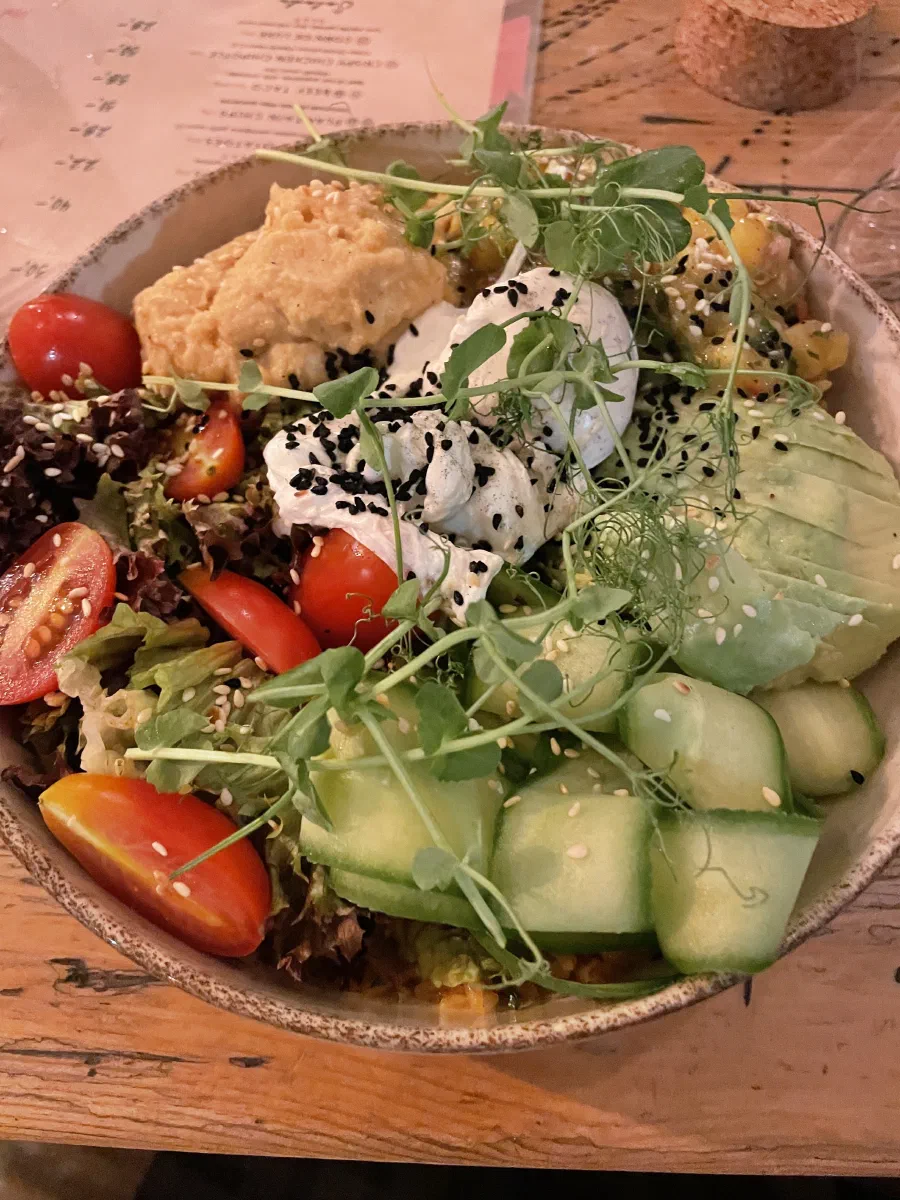
In a tray: microgreens, such as pea shoots, radish, broccoli and sunflower, grow in a shallow tray of compost in one to three weeks. A 2012 study of 25 varieties found many microgreens held higher concentrations of certain vitamins and carotenoids than the mature leaves of the same plant. (Jar-grown sprouts are different: food safety agencies advise cooking them unless sold as ready to eat, and vulnerable groups should avoid them raw.)
On a balcony or patio: cherry tomatoes, cut-and-come-again salad leaves, chard, chillies, dwarf beans and strawberries all do well in containers. Fruiting crops need around six hours of sun a day; leafy greens cope with less. Use the largest pots you can and fresh compost.
In a garden: a raised bed or two filled with fresh soil and compost is an easy start, and also a simple way around older urban soils that may contain lead or other contaminants. Grow what you actually eat, and add fruit bushes for low-effort harvests year after year.
No outdoor space at all? Look for an allotment or community garden. A 2023 randomised trial in the US found that adults who took up community gardening ate more fibre and became more physically active.
Keeping Pests Away Without the Spray
Growing your own only gives you more control if you think about how you deal with pests. The good news is that many small-scale methods need no chemicals at all.
Use barriers. Fine mesh netting keeps out butterflies, carrot fly and birds. Copper tape and grit around pots can deter slugs.
Pick off pests by hand. On a few plants, checking leaves every couple of days and removing caterpillars or aphids is often enough. A strong spray of water knocks aphids off quickly.
Plant companions and attract helpers. Flowers like marigolds, calendula and nasturtiums draw in ladybirds, hoverflies and other insects that feed on pests.
Keep plants healthy. Good compost, steady watering and not overcrowding plants all reduce problems. If you ever do choose a garden product, read the label and follow it exactly, including the harvest interval.
Backyard Hens: Fresh Eggs, With Responsibilities
If you have outdoor space, a few hens can provide fresh eggs and turn garden waste into compost. Before you commit, a few points matter.
Check the rules. In Great Britain, all poultry keepers, including small backyard flocks, are now required to register with the Animal and Plant Health Agency. In the US and Canada, local zoning rules, bylaws and homeowners' associations decide whether hens are allowed. EU rules vary by country, and bird flu outbreaks can bring legal housing orders.
Feed them properly. In the UK and EU it is illegal to feed kitchen scraps or catering waste to chickens, even pets. Use a proper layer feed.
Plan for their needs. Hens are social, so keep at least three, with a secure, fox-proof coop and run and someone to care for them when you are away.
Practise good hygiene. Backyard poultry can carry Salmonella even when they look healthy. Wash your hands after handling birds, eggs or equipment, and keep chickens and their gear out of the kitchen.
You cannot control everything in the food supply, and you do not need to. But you can choose how you wash and prepare your food, eat a wider variety, and grow a little of what you eat yourself. A pot of herbs, a tray of microgreens or a few tomato plants will not replace the supermarket. They will give you food you know everything about, and the simple satisfaction of having grown it yourself.
- European Parliament and Council, 2005. Regulation (EC) No 396/2005 on maximum residue levels of pesticides in or on food and feed of plant and animal origin. Official Journal of the European Union, L 70, 1–16.
- European Food Safety Authority (EFSA), Craig, P.S., Dujardin, B., Hart, A. et al., 2020. Cumulative dietary risk characterisation of pesticides that have chronic effects on the thyroid. EFSA Journal, 18(4), 6088. doi:10.2903/j.efsa.2020.6088
- U.S. Congress, 1996. Food Quality Protection Act of 1996. Public Law 104-170.
- Yang, T., Doherty, J., Zhao, B. et al., 2017. Effectiveness of commercial and homemade washing agents in removing pesticide residues on and in apples. Journal of Agricultural and Food Chemistry, 65(44), 9744–9752. doi:10.1021/acs.jafc.7b03118
- Xiao, Z., Lester, G.E., Luo, Y. and Wang, Q., 2012. Assessment of vitamin and carotenoid concentrations of emerging food products: edible microgreens. Journal of Agricultural and Food Chemistry, 60(31), 7644–7651. doi:10.1021/jf300459b
- Litt, J.S., Alaimo, K., Harrall, K.K. et al., 2023. Effects of a community gardening intervention on diet, physical activity, and anthropometry outcomes in the USA (CAPS): an observer-blind, randomised controlled trial. The Lancet Planetary Health, 7(1), e23–e32. doi:10.1016/S2542-5196(22)00303-5
- U.S. Food and Drug Administration. Selecting and serving produce safely (washing advice). https://www.fda.gov/food
- Centers for Disease Control and Prevention. Backyard poultry and Salmonella. https://www.cdc.gov/healthy-pets
- Animal and Plant Health Agency / GOV.UK. Poultry registration. https://www.gov.uk/guidance/poultry-registration
This article is intended for informational and educational purposes only and is not medical advice. Food safety rules, residue limits and poultry-keeping regulations differ between countries and change over time, so check your local guidance before acting on anything here.