
Movement for Every Body: What a Paralympic Champion Can Teach Us About Staying Active
If you have ever felt that exercise advice was written for someone else, someone younger, fitter or with fewer aches, you are in good company. The fitness world loves a single picture of what being active looks like. But the evidence tells a far more welcoming story: movement counts in many forms, at many levels, and it is never too late to start.
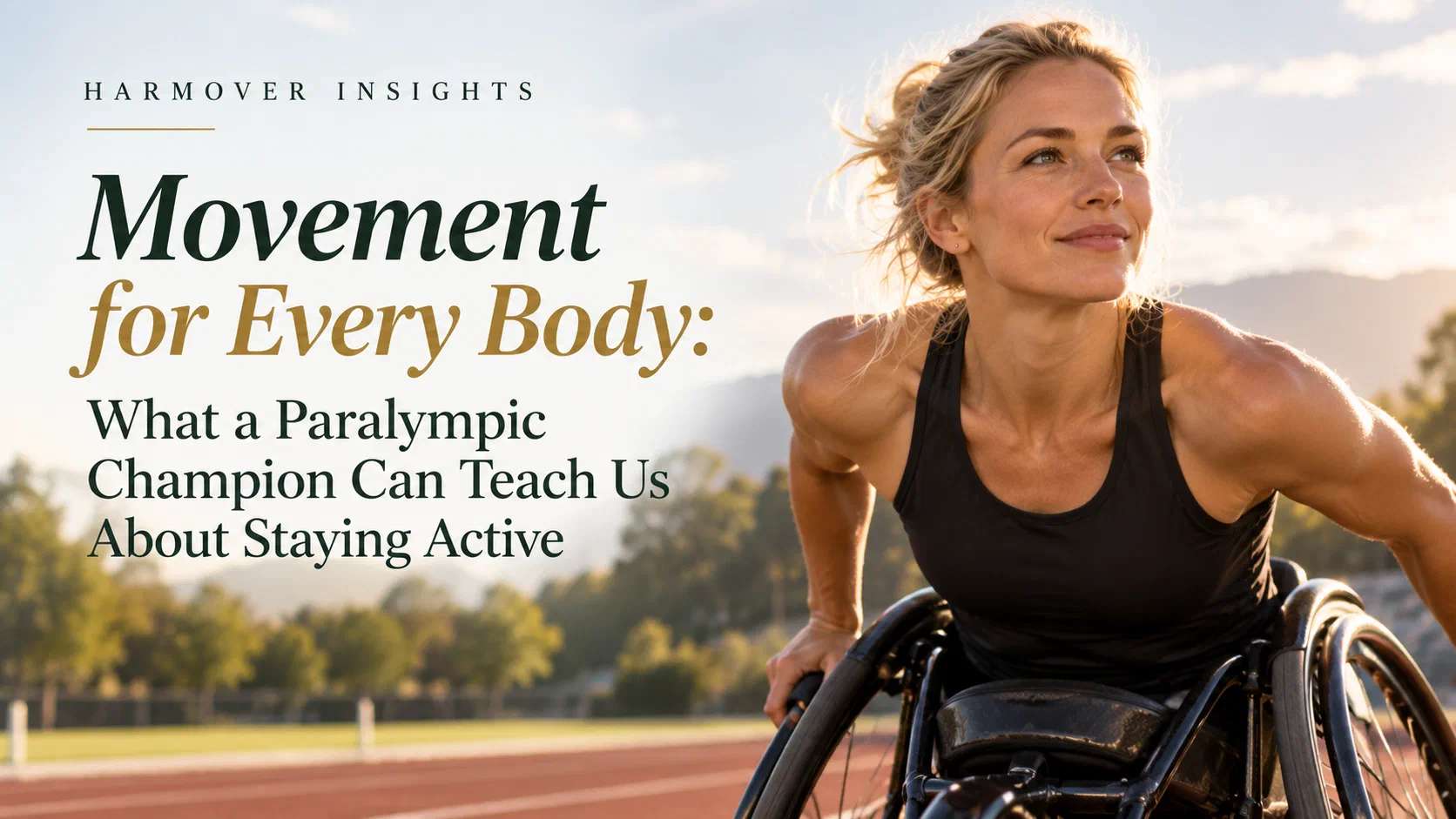
A Champion Who Never Fitted the Picture
Tanni Grey-Thompson was born with spina bifida and uses a wheelchair. She took up wheelchair racing as a teenager and went on to become one of Britain's most successful athletes, winning 16 Paralympic medals, 11 of them gold, and the London Marathon wheelchair race six times between 1992 and 2002.
Her story is extraordinary, and most of us will never race at that level. But it carries a lesson that applies to everyone: the right kind of activity is the kind that works for your body. Being active was never about matching one ideal. It is about finding what you can do, and doing it regularly.
What the Guidelines Actually Say
The official advice is remarkably consistent across the UK, US, Canada and the World Health Organization. For most adults, the target is around 150 minutes a week of moderate activity, the kind that makes you breathe a little faster but still lets you talk, or about 75 minutes of more vigorous activity. On top of that, muscle-strengthening activity on at least two days a week.
The WHO's 2020 guidelines were the first to include adults living with disability explicitly, with the same core recommendations, adapted to the individual. For adults over 65, they add activities that challenge balance and strength, which are linked with a lower risk of falls.
Canada's 24-Hour Movement Guidelines go one step further and look at the whole day. Alongside activity, they suggest limiting time spent sitting to eight hours or less and breaking up long periods of sitting where you can.
These numbers are targets, not entry requirements. Which brings us to the most encouraging part of the research.
Why Some Is Better Than None
The WHO puts it simply: some physical activity is better than none. If 150 minutes feels out of reach, that is not a reason to do nothing. It is a reason to start small.
A large analysis published in the BMJ in 2019 pooled data from studies where people wore activity trackers. Higher levels of activity, of any intensity including light activity like gentle walking or housework, were associated with a lower risk of early death. The biggest differences appeared when people moved from doing very little to doing a bit more.
In other words, the person who goes from almost no movement to a daily 10-minute walk may be making one of the most worthwhile changes of all. You do not need to be an athlete to count.
The World Health Organization's guidelines are clear that some physical activity is better than none, for adults of every age and ability. The largest differences in long-term health outcomes are seen when people go from doing very little to doing a little more.
Building a Routine That Fits You
Start with what you enjoy, or at least what you do not hate. A routine you keep beats a perfect plan you abandon. Walking, swimming, cycling, dancing, gardening, seated exercise and wheelchair-based activity all count.
Do not forget strength. Muscle-strengthening work can be bands, light weights, bodyweight exercises, carrying shopping or seated resistance moves. It matters more as we get older, because muscle naturally declines with age if it is not used.
Break up sitting. If you spend long hours at a desk or on the sofa, set a reminder to stand, stretch or move every half hour or so.
Adapt rather than avoid. People living with a disability or long-term condition often benefit from guidance tailored to them, and specialist guidelines exist for some conditions, such as spinal cord injury. A physiotherapist, GP or qualified coach can help you find a safe starting point, especially if you are new to exercise, have a heart or joint condition, or have been unwell.
Being active is not a club with a dress code. Whether your movement looks like a marathon, a morning walk, a swim or ten minutes of seated strength work, it counts. Start where you are, choose something you will actually keep doing, and build from there. Your body does not need you to be perfect. It just needs you to keep moving.
- Bull, F.C., Al-Ansari, S.S., Biddle, S. et al., 2020. World Health Organization 2020 guidelines on physical activity and sedentary behaviour. British Journal of Sports Medicine, 54(24), 1451–1462. doi:10.1136/bjsports-2020-102955
- UK Chief Medical Officers, 2019. UK Chief Medical Officers' Physical Activity Guidelines. Department of Health and Social Care. https://www.gov.uk/government/publications/physical-activity-guidelines-uk-chief-medical-officers-report
- U.S. Department of Health and Human Services, 2018. Physical Activity Guidelines for Americans, 2nd edition. Washington, DC: HHS. https://health.gov/our-work/physical-activity
- Ross, R., Chaput, J.P., Giangregorio, L.M. et al., 2020. Canadian 24-Hour Movement Guidelines for Adults aged 18–64 years and Adults aged 65 years or older. Applied Physiology, Nutrition, and Metabolism, 45(10 Suppl 2), S57–S102. doi:10.1139/apnm-2020-0467
- Ekelund, U., Tarp, J., Steene-Johannessen, J. et al., 2019. Dose-response associations between accelerometry measured physical activity and sedentary time and all cause mortality: systematic review and harmonised meta-analysis. BMJ, 366, l4570. doi:10.1136/bmj.l4570
- Martin Ginis, K.A., van der Scheer, J.W., Latimer-Cheung, A.E. et al., 2018. Evidence-based scientific exercise guidelines for adults with spinal cord injury: an update and a new guideline. Spinal Cord, 56(4), 308–321. doi:10.1038/s41393-017-0017-3
- Martin Ginis, K.A., van der Ploeg, H.P., Foster, C. et al., 2021. Participation of people living with disabilities in physical activity: a global perspective. The Lancet, 398(10298), 443–455. doi:10.1016/S0140-6736(21)01164-8
This article is intended for informational and educational purposes only and is not medical advice. If you are new to exercise, have a heart or joint condition, a disability or a long-term health condition, or have been unwell, please speak to your GP, physiotherapist or a qualified coach before starting a new activity programme.