
How to Read a Health Headline: Questions to Ask Before You Believe a Study
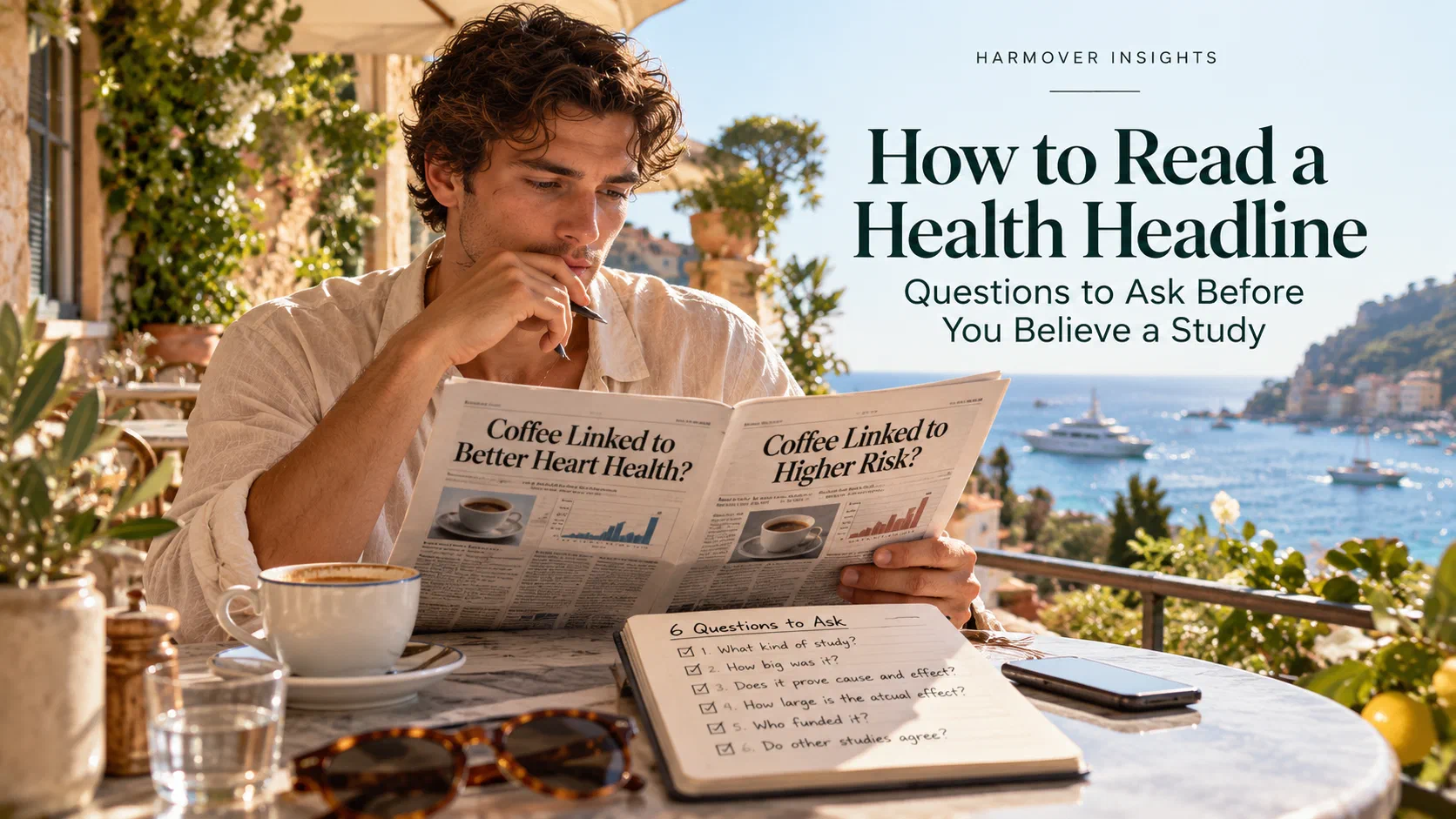
One week coffee protects your heart. The next, it's something to cut back on. Eggs, red wine, chocolate: it can feel as if every food is both a miracle and a menace, depending on which headline you read. If you've ever felt confused, or quietly sceptical, you're not alone, and that instinct to question is a healthy one. Here's how to put it to work.
Why Health Headlines So Often Mislead
Most misleading health stories don't start with anyone setting out to deceive. They start with a long chain of retelling. A researcher publishes a careful study full of caveats. A press office turns it into a short announcement. A journalist turns that into a headline. Then social media turns the headline into a screenshot, and each step removes a little more nuance.
Researchers have studied this chain directly. One analysis of health press releases from UK universities found that around a third to two-fifths contained exaggerations, such as overstating cause and effect or applying animal findings to people. When the press release exaggerated, the news coverage was far more likely to exaggerate too.
The lesson isn't to trust nothing. It's to trust thoughtfully. Whether a claim comes from a health authority, a newspaper, a wellness brand or a viral post, the same few questions will help you judge it.
Questions 1 to 3: What Was Actually Found?
1. Where did this come from? Try to trace the claim back to its original source. Is there a named study, a journal or an official dataset? A screenshot of a headline, or a claim with no source at all, is a starting point for curiosity rather than a conclusion.
2. Was it tested in people? Many exciting findings come from cells in a dish or from mice. These studies are an essential first step, but they often don't hold up in humans. One well-known review found that only around a third of highly cited animal studies were later confirmed in human trials. “Shown to work in mice” is interesting; it isn't proof that it works for you.
3. Is it a link, or a cause? Many studies find that two things tend to happen together, which is called a correlation. That doesn't mean one causes the other. People who drink green tea might be healthier, but they might also exercise more, smoke less or eat more vegetables. Similarly, a report that something happened after an exposure is a signal worth investigating, not proof that the exposure caused it. Look for words like “associated with” or “linked to” in the original study, which usually mean cause hasn't been shown.
Questions 4 to 6: How Big, How Many and Who Paid?
4. Is the risk relative or absolute? This is the single most useful question you can ask. Imagine a headline saying something doubles your risk of a condition. That sounds alarming. But if your risk goes from 1 in 10,000 to 2 in 10,000, the real change is tiny. Doubling is the relative risk; one extra case in 10,000 is the absolute risk. Big percentages with no starting figure deserve a second look, whether they're used to frighten or to sell.
5. How many people, and for how long? A study of 20 people over two weeks tells you much less than one of 20,000 people over ten years. Small studies aren't worthless, but their results are more likely to be due to chance and more likely to change when someone repeats the work.
6. Who paid for it, and does it stand alone? Funding doesn't automatically make a study wrong, but it's worth knowing. A systematic review found that studies funded by pharmaceutical companies were more likely to report results that favour the sponsor's product. And no single study settles a question. The most reliable picture comes from many studies, by different teams, pointing in the same direction.
Researchers picked 50 common ingredients from random recipes in a cookbook and searched the medical literature. Forty of them had been studied for links to cancer, with many showing an increased or decreased risk. Most of those findings rested on weak evidence. It's a striking reminder that a single study is rarely the final word.
Putting It Into Practice
You don't need a science degree to do this. Next time a health claim catches your eye, pause and run through the six questions: Where is it from? Was it in people? Is it a link or a cause? Relative or absolute? How many people? Who paid, and does it stand alone?
If you can't answer most of them, that's useful information in itself. It doesn't mean the claim is false, only that it isn't settled yet. And when you want to go further, bring the claim to a qualified health professional and ask the same questions together. A good practitioner will welcome them. We cover more questions worth asking in Informed Consent: Your Right to Ask Questions About Any Treatment.
This applies to us too. Every Harmover Insights article lists its references so you can check our sources and make up your own mind.
Being sceptical isn't the same as being cynical. The goal is to become a confident reader, someone who can sort strong evidence from weak and stay calm when the next dramatic headline arrives. Ask where it came from, ask how big the effect really is, and ask whether others have found the same thing. Those questions will serve you well for life, and they put you firmly in charge of your own health decisions.
Keep reading, keep asking
Evidence-led articles from the Harmover team, each with its references listed so you can check them yourself.
Explore More Harmover InsightsEducational content, not medical advice.
- Sumner P, Vivian-Griffiths S, Boivin J, et al., 2014. The association between exaggeration in health related science news and academic press releases: retrospective observational study. BMJ, 349, g7015. DOI: 10.1136/bmj.g7015
- Hackam DG, Redelmeier DA, 2006. Translation of research evidence from animals to humans. JAMA, 296(14), 1731–1732. DOI: 10.1001/jama.296.14.1731
- Gigerenzer G, Gaissmaier W, Kurz-Milcke E, Schwartz LM, Woloshin S, 2007. Helping doctors and patients make sense of health statistics. Psychological Science in the Public Interest, 8(2), 53–96. DOI: 10.1111/j.1539-6053.2008.00033.x
- Ioannidis JPA, 2005. Why most published research findings are false. PLoS Medicine, 2(8), e124. DOI: 10.1371/journal.pmed.0020124
- Lexchin J, Bero LA, Djulbegovic B, Clark O, 2003. Pharmaceutical industry sponsorship and research outcome and quality: systematic review. BMJ, 326(7400), 1167–1170. DOI: 10.1136/bmj.326.7400.1167
- Schoenfeld JD, Ioannidis JPA, 2013. Is everything we eat associated with cancer? A systematic cookbook review. American Journal of Clinical Nutrition, 97(1), 127–134. DOI: 10.3945/ajcn.112.047142
This article is intended for informational and educational purposes only and is not medical advice. A health claim that hasn't been settled by the evidence is not necessarily false, and this article is not a reason to ignore advice from your doctor. Discuss any health decision, including any change to prescribed medication, with a qualified healthcare professional.