
What Chinese Healthcare Teaches Us About Everyday Longevity
One of the most striking things about China is how health doesn't always feel separate from daily life. Movement happens in parks. Food is thought about in terms of balance. Tea, walking, stretching, massage and gentle exercises aren't treated like luxury wellness trends, but as ordinary habits woven into the rhythm of the day. There's a lot the rest of us can learn from that view of everyday longevity.
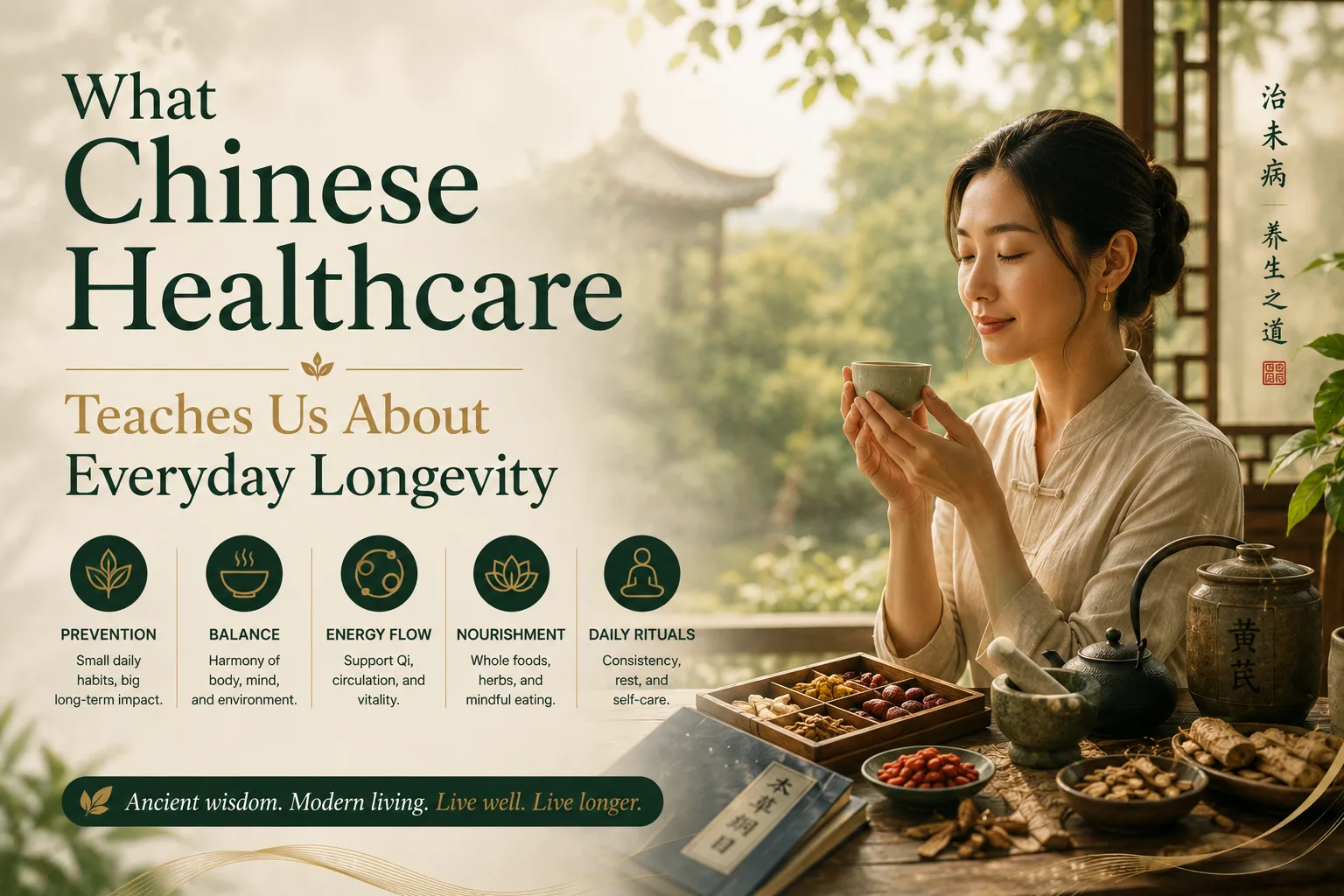
Health in China often starts before someone feels unwell
In many Western countries, healthcare often feels like something you turn to once something has already gone wrong. In China, there's a stronger cultural idea that everyday habits matter before illness appears.
That doesn't mean everyone in China lives perfectly, and it certainly doesn't mean China has solved every modern health problem — busy cities, processed food, stress and sedentary jobs are becoming bigger issues there, just as everywhere. And none of this suggests that traditional habits replace conventional healthcare; they sit alongside it. But there's still something quietly powerful in the way daily life so often includes small, health-supporting rituals.
You see people walking after meals, stretching in public parks, dancing in groups, drinking warm tea, eating soups and cooked vegetables, and using massage or acupressure as part of ordinary self-care. These habits aren't usually framed as biohacking or optimisation. They're just part of life. China's national health strategy reflects that wider focus too: the Healthy China 2030 plan emphasises prevention, healthy lifestyles, physical fitness and stronger primary care, rather than relying only on hospitals once people are already sick.
China's wellness culture shows that health doesn't always need to feel complicated. Walking, stretching, tea, cooked meals, breathing and gentle self-massage can become small daily rituals that support how you feel over time.
Movement and everyday longevity in China
One of the loveliest parts of daily life in China is seeing movement everywhere. In the morning or evening, parks and public squares often become open-air wellness spaces. Older adults practise tai chi. Groups dance together. People walk slowly, stretch, clap their hands, rotate their joints or do breathing exercises.
This matters because movement becomes social, visible and normal. You don't need an expensive gym membership to move your body. You don't need perfect workout clothes. You don't even need to call it a workout.
The official Dietary Guidelines for Chinese Residents connect food and movement too, recommending regular physical activity — at least 150 minutes of moderate activity a week, daily activity equivalent to about 6,000 steps, and avoiding sitting for more than an hour at a time.
Traditional practices such as tai chi and qigong are especially interesting because they combine movement, breath, posture, balance and attention. Research suggests tai chi and qigong may support immune-related markers and inflammation pathways — though the evidence is still developing and shouldn't be overstated.
Food is viewed through balance, warmth and variety
Chinese food culture is incredibly diverse, but one common thread is the idea that food should support balance. Meals often include cooked vegetables, rice or noodles, soups, soy foods, herbs, teas, mushrooms, eggs, fish, lean meats or tofu, depending on the region and household.
The Chinese dietary guidelines recommend a varied, balanced diet — cereals and tubers, fruits and vegetables, soybeans, legumes, nuts, dairy, fish, poultry, eggs and lean meats. They also suggest eating around 12 different types of food daily and at least 25 different foods across a week.
What feels different is that food isn't only treated as calories. It's often discussed in terms of how it makes the body feel. Warm foods, soups, teas and cooked meals are often preferred over cold or heavily processed options, and there's a strong cultural habit of drinking plain water or tea instead of sugary drinks — also reflected in the guidelines.
For a wellness audience, the lesson isn't that everyone needs to copy a Chinese diet exactly. It's that food can be approached with more awareness. You can ask: does this meal give me steady energy? Does it include plants? Does it feel nourishing? Does it help me feel balanced rather than depleted?
Lymphatic habits are often gentle, physical and everyday
Lymphatic health is having a moment in Western wellness, but many of the basic ideas already overlap with older Chinese self-care habits. Gentle movement, stretching, walking, breathwork, massage, tapping and acupressure all encourage you to pay attention to circulation, fluid movement and how the body feels.
The lymphatic system helps move fluid through the body and supports immune function. Unlike the heart, it doesn't have one central pump — movement, muscle contraction, breathing and manual techniques can all play a role in supporting normal lymph flow.
This is where practices like qigong, tai chi, self-massage and gentle neck or face massage become interesting. They're not miracle fixes, and they shouldn't be presented as treatments for medical conditions. But they can form part of a calm daily routine that encourages movement, relaxation and body awareness.
Some research has looked at qigong in relation to lymphoedema and blood flow in specific clinical groups, and broader work has explored manual lymphatic drainage and exercise. The evidence is mixed and context-dependent. The honest message is that gentle movement, breathing and massage may support wellbeing as part of a healthy lifestyle — not that they detox, cure or treat any condition. Anyone with swelling, pain, infection, a cancer history or other medical concerns should speak to a qualified professional. None of this is medical advice.
- Green Tea Deeply woven into everyday Chinese life, and often a simple alternative to sugary drinks. It contains polyphenols, including catechins, which are studied for their antioxidant activity. Here it stands for a gentle daily habit rather than an extreme wellness trend — a supportive lifestyle drink, not a treatment or cure.
- Functional Mushrooms Mushrooms have a long history in Chinese food and traditional wellness culture. Modern wellness often focuses on reishi, lion's mane, cordyceps and shiitake. They're best understood as traditional and nutritional ingredients that may support general wellbeing, depending on the product and the individual — discussed educationally, without disease claims.
- Magnesium Relevant here because the article touches on movement, relaxation and evening routines. It's an essential mineral involved in normal muscle and nerve function. If it fits your routine, it's best positioned as part of a calm daily wind-down rather than a stand-in for any traditional practice.
Common questions about Chinese healthcare and everyday longevity
A few questions come up whenever people look at Chinese wellness habits from the outside. The answers below stay within what this article and its references support.
Does this mean traditional practices replace conventional medicine?
No. These everyday habits — movement, balanced food, tea, gentle self-care — sit alongside conventional healthcare, not in place of it. And it doesn't mean people in China are healthier by default; the same modern pressures apply there too. The useful part is the cultural emphasis on daily habits before illness appears.
What do tai chi and qigong actually do?
They combine movement, breath, posture, balance and attention. Research suggests they may support immune-related markers and inflammation pathways, though the evidence is still developing and shouldn't be overstated. Their most dependable value is simply as gentle, social, everyday movement.
Can gentle massage or qigong help the lymphatic system?
The lymphatic system has no central pump, so movement, breathing and manual techniques can support normal lymph flow. Some research has looked at qigong and manual lymphatic drainage in specific clinical groups, but the evidence is mixed and context-dependent. It may support wellbeing as part of a healthy lifestyle — and anyone with swelling, pain or medical concerns should see a qualified professional.
What's the simplest lesson to take from all this?
That health doesn't have to feel complicated. Walking after meals, stretching, tea instead of sugary drinks, cooked and varied meals, breathing and gentle self-massage. Consistency, more than any single habit, is what supports how you feel over time.
What to take away
Chinese healthcare and wellness culture offers a lovely reminder that longevity isn't only found in clinics, supplements or strict protocols. It's built through daily rhythm.
Move often, eat with balance, drink simply, breathe deeply, and give your body small moments of care every day. None of it is dramatic — and that's rather the point.
Longevity, built daily
Small, consistent habits are where it starts. Explore a calm, everyday approach to longevity support — movement, balance and gentle care.
Explore Everyday Longevity SupportEducational content, not medical advice.
- Chinese Center for Disease Control and Prevention, 2022. Eight key recommendations from Dietary Guidelines for Chinese Residents 2022. China CDC. Available at: https://en.chinacdc.cn/health_topics/nutrition_health/202206/t20220616_259702.html
- World Health Organization, 2016. Healthy China 2030, from vision to action. Available at: https://www.who.int/teams/health-promotion/enhanced-wellbeing/ninth-global-conference/healthy-china
- Oh, B., Bae, K., Lamoury, G. et al., 2020. The Effects of Tai Chi and Qigong on Immune Responses: A Systematic Review and Meta-Analysis. Medicines, 7(7), 39. DOI: 10.3390/medicines7070039
- Fong, S.S.M., Ng, S.S.M., Luk, W.S., Chung, J.W.Y. and Chung, L.M.Y., 2014. Effects of Qigong Exercise on Upper Limb Lymphedema and Blood Flow in Survivors of Breast Cancer: A Pilot Study. Integrative Cancer Therapies, 13(1), pp. 54–61. DOI: 10.1177/1534735413490797
- Vairo, G.L., Miller, S.J., McBrier, N.M. and Buckley, W.E., 2009. Systematic Review of Efficacy for Manual Lymphatic Drainage Techniques in Sports Medicine and Rehabilitation: An Evidence-Based Practice Approach. Journal of Manual and Manipulative Therapy, 17(3), pp. e80–e89. DOI: 10.1179/106698109790824657
This article is intended for informational and educational purposes only. It does not constitute medical advice and should not be used as a substitute for guidance from a qualified healthcare professional. The everyday habits described here sit alongside conventional healthcare rather than replacing it, and are not treatments for any medical condition. Anyone with swelling, pain, infection, a cancer history or other medical concerns — or who is pregnant, breastfeeding or taking medication — should speak with their practitioner before making significant changes.