
What is Chaga Tincture and Why Do People Choose It?
Most people don't arrive at chaga tincture out of curiosity — they arrive because they're tired. Tired of feeling run down, of short-term fixes that don't hold, of supplements that promise everything and quietly deliver nothing. What makes chaga worth your attention isn't a dramatic claim. It's something quieter and steadier than that — and it's worth understanding before you write it off.
What is Chaga?
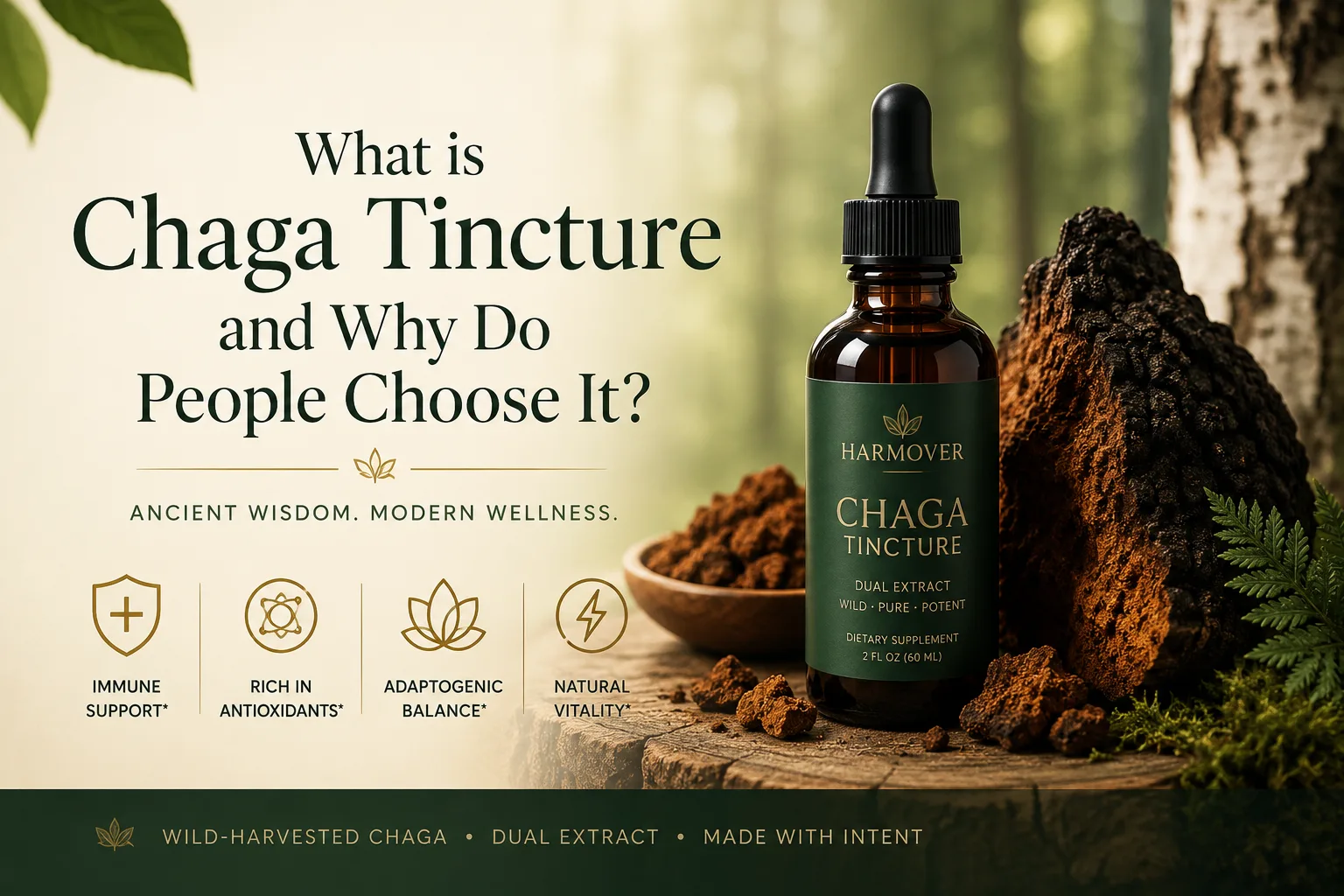
Chaga, known scientifically as Inonotus obliquus, is a fungus that grows primarily on birch trees in cold climates — Siberia, northern Scandinavia, parts of Canada. It doesn't look like most mushrooms. There's no cap or stem — instead, it forms a dense, irregular mass on the bark, dark and cracked on the outside like charcoal, with a softer amber-brown interior. That slow, patient growth — drawing nutrients from the tree over years — is part of why it tends to be so rich in natural compounds.
Traditionally, chaga was prepared as a tea. Foragers would dry it, break it into rough chunks, and simmer it in hot water for hours. Today you'll find it in powders, capsules, and increasingly, tinctures. A tincture is a concentrated liquid extract produced by soaking plant or fungal material — typically in a combination of alcohol and water. Chaga tinctures are often dual-extracted for a specific reason: water draws out the beta-glucans (polysaccharides linked to immune support), while alcohol is required to release the triterpenes (compounds associated with anti-inflammatory activity). The idea is to capture the full range of active compounds rather than just what a simple hot-water brew can reach.
In terms of how it's usually talked about, chaga sits firmly in the general wellness category rather than in the territory of targeted treatments. Some of its compounds are connected to immune system regulation — meaning they may support the body's capacity to respond appropriately, rather than simply "boosting" it, a distinction that matters. Others are antioxidants, which help the body manage the kind of ordinary cellular stress that accumulates over time. The evidence base is still largely built on laboratory and animal studies rather than large-scale human trials, but chaga's long history of traditional use and its well-characterised nutrient profile are what continue to make it relevant today.
Why Choose a Tincture?
The case for tincture over tea comes down to chemistry and convenience in roughly equal measure. As touched on above, the compounds in chaga don't all respond to the same extraction method. Beta-glucans dissolve readily in hot water, which is why traditional preparations work to a point. Triterpenes, however, require alcohol to be released effectively. A dual-extracted tincture aims to bridge that gap — offering a more complete range of compounds in a much smaller volume than a simmered pot of chaga tea.
There's also the practical side. Brewing chaga tea properly isn't quick: you need to simmer the material for a long time, often reusing the same pieces across several batches. A tincture collapses that process into a few drops you can take directly or stir into a drink. For anyone trying to build a consistent daily habit — which is how chaga tends to work best — that difference in friction matters more than it might first appear.
That said, keeping expectations honest is equally important. Chaga isn't something you take and feel shift within the hour. Its effects, where they occur, are subtle and accumulate over time. Some people feel a little more settled in their energy, a little more resilient through a stressful week. Others take it consistently and notice very little — which is normal, and not necessarily a sign it isn't doing anything. The human research is still limited, and individual responses vary considerably. Chaga belongs in the category of steady, background support rather than noticeable, rapid-onset results.
Chaga is natural, but that doesn't make it without consideration. It contains oxalates — compounds that, in high amounts, can place stress on the kidneys. It may also interact with blood sugar regulation and clotting processes. For most healthy people this goes unnoticed, but if you're managing a health condition or taking medication, it's worth a conversation with your GP first.
What You Can Expect
The most common expectation when starting chaga tincture is that something noticeable will happen fairly quickly — a lift in energy, a clear change in how you feel day to day. In most cases, that isn't how it works. What chaga does tends to happen beneath the surface: supporting immune balance, helping the body handle everyday oxidative stress, working in the background rather than announcing itself.
Some people, after several weeks of consistent use, feel a little more stable — less run down during high-pressure periods, a general sense of steadiness that's hard to pin down but real enough to notice. Others feel little discernible difference. Both experiences are valid, and neither is unusual. The science behind chaga's active compounds is promising — particularly in lab and animal models — but large, well-controlled human trials are still in short supply. It's more accurate, and more useful, to frame chaga as a supportive addition rather than a transformative one.
Things to Consider Before You Begin
"Natural" and "risk-free" are not the same thing, and chaga is a good illustration of why. The oxalates it contains — naturally occurring compounds found in many plants and fungi — can contribute to kidney stress when consumed in large quantities over long periods. Moderate, sensible use is a different matter entirely, but it does mean that doubling your dose won't double your benefit, and may not be wise.
Beyond oxalates, chaga may also influence blood sugar regulation and blood clotting processes. For most people in good health, this is unlikely to be significant — but for anyone already managing a condition or taking medication that touches on these pathways, it warrants some awareness and a word with a healthcare professional before starting.
Quality is another variable that often gets overlooked when people are drawn in by an attractive label. Not all chaga products are made the same way. Extraction method, sourcing, and concentration all affect what you're actually getting. A responsibly sourced, dual-extracted tincture from a reputable producer is meaningfully different from a hastily blended powder — and that difference matters when you're expecting consistent results.
Chaga tincture works best as a considered, modest addition to a broader approach to health — not a shortcut, and not a substitute for sleep, nutrition, or professional care. Used in that spirit, it's a supplement that earns its place quietly and reliably over time.
- Chaga
(Inonotus obliquus) A slow-growing medicinal fungus rich in beta-glucans, triterpenes, and antioxidants. Works primarily as background support — helping the body manage immune balance and everyday cellular stress rather than producing acute, noticeable effects. Most beneficial when extracted using both water and alcohol to maximise the range of bioavailable compounds.
Chaga tincture has never been about quick fixes or dramatic transformations. If there's a single thing worth carrying away from this, it's that it makes the most sense as part of a bigger picture — a small, steady piece of a broader commitment to looking after yourself. When expectations are grounded and the approach is balanced, it stops being about chasing benefits and starts being about something more sustainable: supporting your health quietly, consistently, and for the long term.
This article is for informational purposes only and does not constitute medical advice. If you have a health condition or take medication, please consult a qualified healthcare professional before adding any new supplement to your routine.
Discover Mushrooms & Adaptogens
Dual-extracted, responsibly sourced, formulated for steady daily support.
Explore Mushrooms & Adaptogens- Ern, P. T. Y., Quan, T. Y., Yee, F. S., & Yin, A. C. Y. (2023). Therapeutic properties of Inonotus obliquus (chaga mushroom): A review. Mycology, 15(2), 144–161.
- Peng, H., & Shahidi, F. (2020). Bioactive compounds and bioactive properties of chaga (Inonotus obliquus) mushroom: A review. Journal of Food Bioactives, 12.
- Chugh, R. M., Mittal, P., N., M., Arora, T., Bhattacharya, T., Chopra, H., Cavalu, S., & Gautam, R. K. (2022). Fungal mushrooms: A natural compound with therapeutic applications. Frontiers in Pharmacology, 13, 925387.
- Docherty, S., Doughty, F. L., & Smith, E. F. (2023). The acute and chronic effects of lion's mane mushroom supplementation on cognitive function, stress and mood in young adults: A double-blind, parallel groups, pilot study. Nutrients, 15(22), 4842.
This article is intended for general informational and educational purposes only. It does not constitute medical advice, diagnosis, or treatment. Always consult a qualified healthcare professional before making changes to your diet, lifestyle, or supplement routine. Harmover products are food supplements and are not intended to diagnose, treat, cure, or prevent any disease.