
The Diamond of the Forest: Chaga Health Benefits, Explained
If you've ever spotted a blackened, charcoal-like growth on the side of a birch tree, you've met the "Diamond of the Forest". It looks rugged and unrefined, but chaga is one of the more intriguing organisms in the functional-mushroom world. If you're curious about chaga health benefits — and cautious about the hype around them — here's a calm look at what the research actually explores.
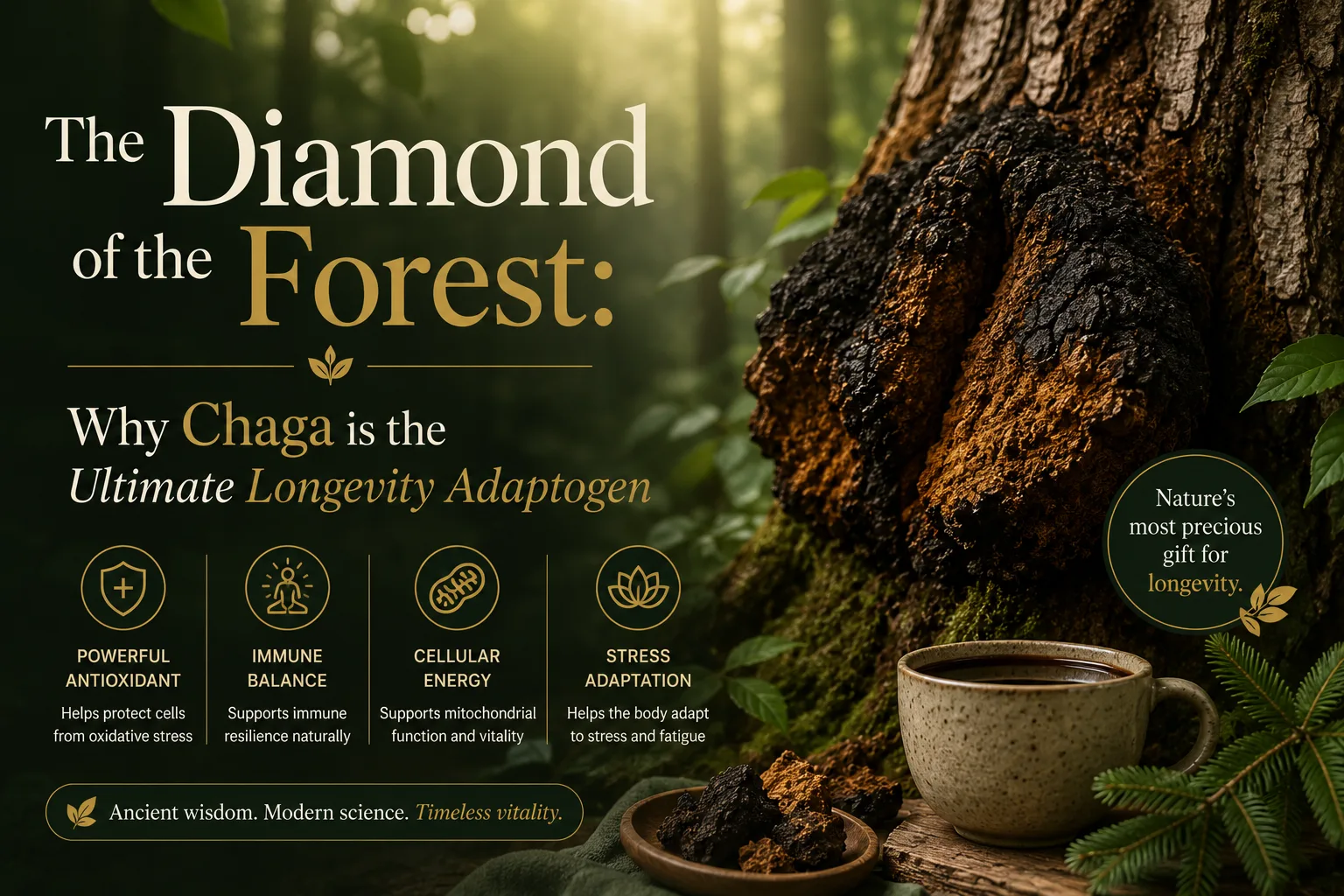
More than an "immune booster": the idea of modulation
We often talk about "boosting" the immune system, but what the body tends to need is balance. Chaga is studied in the context of what researchers call immune modulation — supporting a measured response rather than simply revving the engine.
Much of that interest centres on beta-glucans: complex polysaccharides (large sugar molecules) that researchers describe as interacting with immune cells such as natural killer (NK) cells, macrophages and dendritic cells — the white blood cells that patrol for threats. The idea being explored is that this interaction may help the immune system stay vigilant without tipping into the kind of over-reaction associated with chronic inflammation. It's early science rather than settled fact, but it's a more interesting story than "boosting".
Some laboratory research suggests chaga polysaccharides may enhance the activity of natural killer cells — the idea being less about making more immune cells and more about the ones you have working more effectively. This is early, mostly preclinical evidence, not a promise of results.
Betulinic acid and why extraction matters
One of the more distinctive things about chaga is its relationship with the birch tree. As it grows, chaga absorbs and concentrates a compound called betulin. Through the alcohol stage of a dual-extract tincture, some of this converts to betulinic acid, a naturally occurring triterpenoid that early laboratory research has explored for anti-inflammatory and antiviral activity.
The practical, non-hyped takeaway is about chemistry, not miracles: betulinic acid isn't water-soluble, so you can't get at it through a standard cup of chaga tea. It takes a dual-extraction method — hot water for the beta-glucans, alcohol for the compounds like betulinic acid — to capture both sides of the mushroom. That's the real reason format matters here.
Antioxidants and the ORAC score
Oxidative stress — the everyday cellular wear that comes from normal living — is one of the processes researchers link to visible ageing. To gauge how well a substance can neutralise the reactive molecules involved (free radicals), scientists sometimes use a lab measure called the ORAC score (Oxygen Radical Absorbance Capacity).
Chaga consistently posts high ORAC ratings among natural foods and supplements. It's worth a note of honesty here: ORAC is a test-tube measurement, and a high score in the lab doesn't automatically translate into a specific effect in the body. What it does tell you is that chaga is unusually rich in antioxidant compounds — which is part of why it keeps the attention of researchers interested in cellular ageing.
The adaptogenic angle: stress and recovery
In wellness, an "adaptogen" is a substance traditionally described as helping the body maintain balance — homeostasis — under stress. Chaga is often discussed in this frame, in connection with cortisol balance and the body's response to physical or environmental strain.
Whether you're recovering from a hard workout or navigating a high-pressure week, the adaptogenic idea is about supporting a steadier response rather than an "alarm" one — the sort of thing that leaves you feeling "wired but tired". As with everything here, it's a supportive, everyday framing, not a treatment for any condition, and none of it is medical advice.
- MagicMedicinal Chaga Tincture A dual-extract tincture designed to capture both the water-soluble beta-glucans and the alcohol-soluble compounds like betulinic acid. The liquid format allows for sublingual (under-the-tongue) use, which some prefer to capsules. It's positioned for people interested in both immune modulation and antioxidant support — as an everyday wellness choice, not a medicine.
- Betulinic Acid A naturally occurring triterpenoid concentrated from birch bark and found in chaga. It has drawn scientific interest for potential anti-inflammatory and antiviral properties in early research. It needs an ethanol-based extraction to be made available to the body — which is why it isn't present in ordinary chaga tea.
- Polysaccharides (Beta-Glucans) The main immunomodulating compounds in chaga. Research describes them binding to receptors on immune cells and appearing to help those cells respond more effectively — a cornerstone of the functional-mushroom conversation. They're best extracted using hot water.
Common questions about chaga
A few questions come up whenever chaga enters the conversation. The answers below stay within what this article and its references actually support.
What are the main health benefits people associate with chaga?
Most of the interest sits around three ideas: immune modulation (a balanced response rather than a simple "boost"), antioxidant content, and the adaptogenic framing around stress and recovery. It's worth being honest that much of the supporting evidence is early and mostly from laboratory studies — these are areas of genuine interest, not proven outcomes.
Why does chaga need to be dual-extracted?
Because it holds both water-soluble compounds (the beta-glucans) and alcohol-soluble ones (like betulinic acid). Hot water captures only part of the mushroom, so a dual-extraction method — water and alcohol — is what captures both sides. It's the reason a standard cup of chaga tea doesn't deliver everything the mushroom contains.
Does a high ORAC score guarantee benefits?
No — and it's worth being clear about that. ORAC is a test-tube measure of antioxidant capacity. Chaga scores highly, which tells you it's rich in antioxidant compounds, but a high lab score doesn't automatically translate into a specific effect in the body.
What does it mean to call chaga an adaptogen?
An adaptogen is a substance traditionally described as helping the body stay in balance under stress. Chaga is often discussed this way, in connection with cortisol balance and the response to physical or environmental strain — a supportive, everyday framing rather than a treatment for anything.
What to take away
Chaga is a reminder that some of the more interesting things in nature grow slowly, over decades, in harsh conditions. The honest picture is a mushroom that's rich in antioxidant compounds, studied for immune modulation, and traditionally valued as an adaptogen — with much of the science still early rather than settled.
If you'd like to bring the "forest diamond" into your routine, do it as one considered part of a wider approach to wellness — and, as always, with good information and a practitioner's guidance where it helps.
The forest diamond, done properly
A dual-extract tincture built to capture both sides of the mushroom — the water-soluble beta-glucans and the alcohol-soluble compounds. Explore chaga as part of a considered routine.
Shop Liver & Immune SupportEducational content, not medical advice.
- Kim, Y.O. et al., 2010. Immuno-stimulating effect of the endo-polysaccharide produced by submerged culture of Inonotus obliquus. International Immunopharmacology, 10(1), pp. 10–17.
- Géry, A. et al., 2018. Chaga Mushroom (Inonotus obliquus), a Potential Pharmaceutical Supplement in Oncology; a Review. International Journal of Medicinal Mushrooms, 20(11), pp. 1075–1091.
- Szychowski, K.A. et al., 2021. In vitro biological properties of Chaga mushroom (Inonotus obliquus) extracts. Molecules, 26(11), 3467.
- Zheng, W. et al., 2011. Fractionation and characterization of antineoplastic proteoglycans from Chaga mushroom. Methods in Enzymology, 480, pp. 253–274.
This article is intended for informational and educational purposes only. It does not constitute medical advice and should not be used as a substitute for guidance from a qualified healthcare professional. Chaga is discussed here in general, educational terms; much of the research referenced is early-stage or preclinical, and none of it should be read as a claim to treat, prevent or cure any condition. If you are pregnant, breastfeeding, taking medication (including blood thinners) or managing a health condition, speak with your practitioner before starting any new supplement.