
Ayurveda: Ancient Wisdom for Modern Wellness
Friday 6 November is Dhanteras, the first day of Diwali and, by tradition, the day Dhanvantari, physician to the gods and patron of Ayurveda, is honored. It is a good season to look at one of the world's oldest continuously practiced systems of wellness, and at a year in which its most famous plant, ashwagandha, has been in the headlines for reasons worth understanding.
What Is Ayurveda?
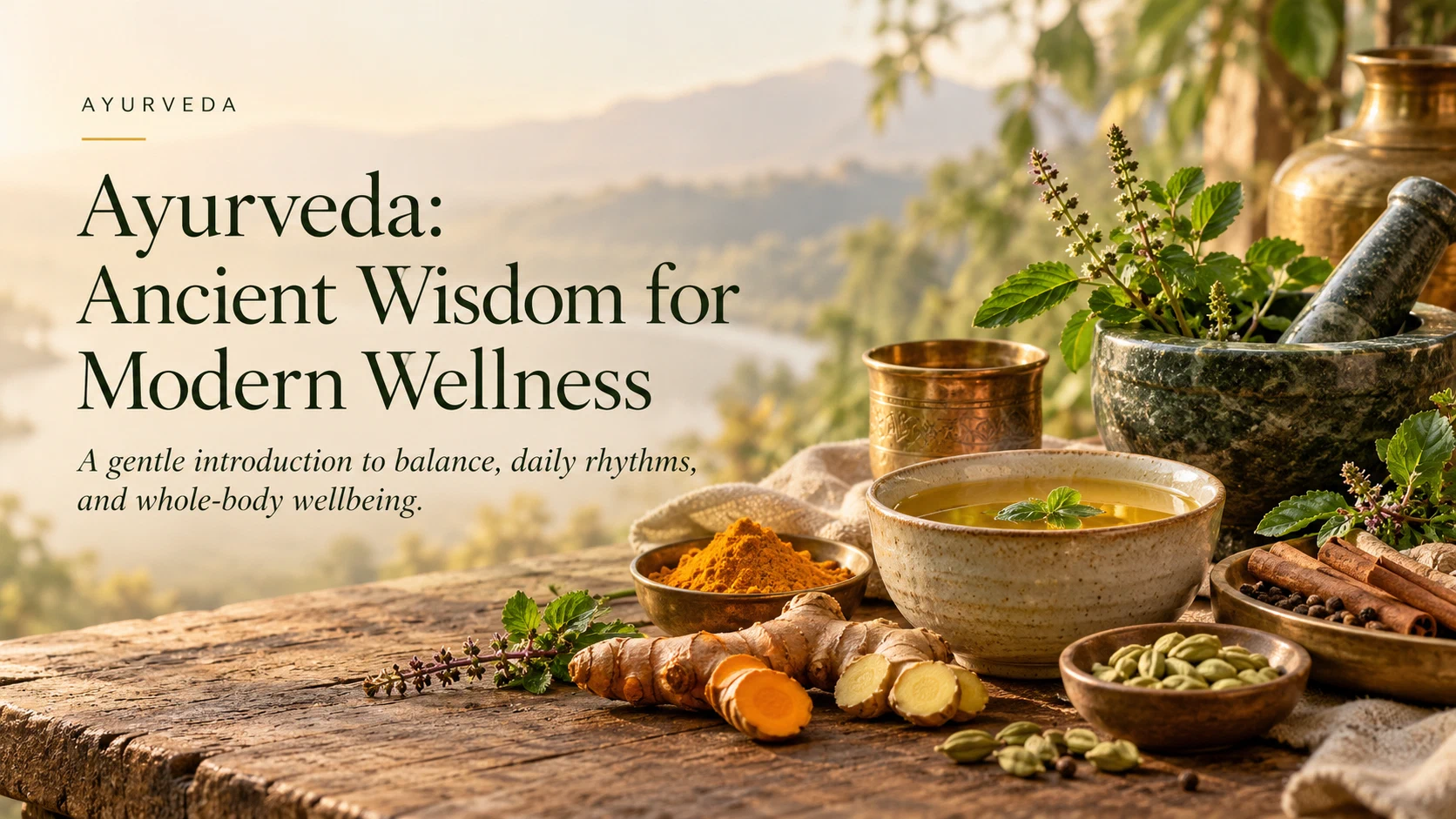
Ayurveda translates roughly as "the knowledge of life". It is a traditional system of health practiced across India and beyond, built on texts more than two thousand years old. Its central idea is balance: three constitutional types, or doshas (vata, pitta and kapha), seasons that push them one way or another, and food, daily routine and herbs that nudge them back.
Late autumn and early winter are traditionally considered vata season, described as cold, dry, light and erratic, which is a fair description of both the weather and most people's November. The classical advice is warmth, regular routines, cooked food and warming spices. Soup, basically. Soup, and going to bed on time.
It helps to be clear about what kind of knowledge this is. Ayurveda is a traditional framework, built over centuries of practice and observation. Some of its herbs have been studied in modern clinical trials and many have not, and traditional use is not the same thing as clinical proof. Both deserve respect: tradition tells us what people have used and how, and trials tell us what has been tested in people. This article tries to keep the two apart.
Ashwagandha in the Headlines: Is It Being Banned?
Short answer: no. Longer answer: it has been asked for identification. Three things happened this year. In April, India's food regulator, the FSSAI, advised that ashwagandha leaves cannot be used in food products in any form, with only the roots and their extracts permitted (FSSAI, 2026). In July, Australia's medicines regulator updated its advisory on a very rare risk of liver injury, noting 11 possible cases in total, most of which resolved once the product was stopped (TGA, 2026). And in October, the Netherlands published a draft decree that would ban ashwagandha leaf, permit root with a caution statement, and require warning statements on products containing turmeric, garlic and several other botanicals (NutraIngredients, 2026). That proposal is open for comment until 7 December, so it is not law yet and may change.
Notice that India's rule and the Dutch draft draw the same line: leaf on one side, root on the other. The root is the part most associated with traditional use and with most of the clinical research. In one 60-day placebo-controlled trial of 64 adults under chronic stress, a root extract reduced stress scores compared with placebo (Chandrasekhar et al., 2012), and the U.S. National Center for Complementary and Integrative Health says some ashwagandha preparations may be effective for stress and insomnia (NCCIH, 2023).
The liver reports are real and very rare, and the reasons are not yet well understood. A 2020 case series of five people from Iceland and the U.S. liver injury network found that liver tests returned to normal within one to five months in four of them, while one was lost to follow-up (Björnsson et al., 2020). The TGA advises that products containing ashwagandha should be avoided by people with existing liver disorders, and NCCIH advises avoiding ashwagandha in pregnancy and notes that it may interact with some medicines, including diabetes, blood pressure, thyroid hormone and sedative medicines. The grown-up response is the one Ayurveda itself recommends: pay attention to your body. If you notice yellowing of the skin or eyes, dark urine, pale stools, persistent itching or pain under the right ribs, stop taking the product and see a doctor.
India's 2026 advisory and the Dutch draft both draw the same line: ashwagandha leaf restricted, root permitted. Ayurvedic Complex lists ashwagandha root extract, the part traditionally used and most often studied.
Turmeric, Black Pepper and the 2,000% Figure
You may have heard that turmeric should be taken with black pepper. The number usually quoted is 2,000%, and unusually for a wellness statistic it is real: in a small 1998 study, adding 20 mg of piperine, the pungent compound in black pepper, to 2 g of curcumin raised the amount of curcumin in volunteers' blood by about 2,000% (Shoba et al., 1998). Curcumin on its own is poorly absorbed, which is why so many products pair the two.
More absorbed is not automatically better, though. In 2023, the U.S. Drug-Induced Liver Injury Network described ten cases of turmeric-associated liver injury, all since 2011. Seven of the ten carried a gene variant (HLA-B*35:01), three of the seven products tested also contained piperine, and the authors suggested the rise might partly reflect people combining turmeric with black pepper (Halegoua-DeMarzio et al., 2023). These are case reports from a registry, which cannot tell us how common the problem is, but they are a reminder that traditional and natural do not mean harmless for everyone. If you already take a high-dose curcumin product, check with your pharmacist before adding another turmeric product.
Triphala, Trikatu and a Capsule That Reads Like a Spice Drawer
Two classic Ayurvedic combinations are worth decoding. Triphala means "three fruits": amla, bibhitaki and haritaki, a cornerstone of Ayurvedic digestive care that modern reviews describe as promising but in need of more research (Peterson et al., 2017). Trikatu means "three pungents": black pepper, long pepper and ginger, traditionally used to "kindle the digestive fire", which is the Ayurvedic way of saying it is meant to help you deal with your dinner. If you are sensing a pattern, Ayurveda loves a trio.
Both appear in Ayurvedic Complex, Harmover's herbal blend inspired by the principles of Ayurveda. Its ingredient list reads like a census of a well-stocked Indian kitchen: ashwagandha root extract, turmeric root extract, holy basil, brahmi, garlic, cinnamon, cloves, amla, licorice, celery seed, peppermint, shilajit, cordyceps and lavender, alongside Triphala and Trikatu. (Lavender is not classically Ayurvedic and appears to have wandered in from a Provençal farmhouse, though we are not going to be the ones to ask it to leave.) The routine is simple: one capsule a day, preferably with a meal, which is when Ayurveda would want warming, pungent herbs taken anyway. Sixty capsules is two months, long enough to decide whether a daily ritual with a few thousand years of backstory is one you want to keep.
Who Should Check First
If you are pregnant or breastfeeding, under 18, living with a medical condition or taking regular medication, talk to your doctor or pharmacist before starting. Several of the herbs in a blend like this have interaction questions of their own, so it is worth a short conversation. The capsules are made in a facility that also handles milk, soy, wheat, egg, peanuts, tree nuts, fish and shellfish, and they contain celery seed. And if you already take other ashwagandha, turmeric or curcumin products, there is no need to stack them. Ayurveda is a system built on balance, and doubling up is not balance. It is just more.
- Ayurvedic Complex (Harmover) A traditional herbal blend inspired by Ayurveda: 60 capsules, one a day with a meal, made in the USA. It includes ashwagandha root extract, turmeric root extract, Triphala and Trikatu, and contains celery seed.
- Ashwagandha root (Withania somnifera) Ashwagandha is the best-known adaptogen in Ayurveda. The root is the traditional part and the one used in most clinical research. Liver injury has been reported very rarely.
- Triphala and Trikatu Two classic Ayurvedic trios. Triphala is amla, bibhitaki and haritaki. Trikatu is black pepper, long pepper and ginger. Both are traditionally used to support digestion.
Ayurveda's founding story is worth a thought this season. According to tradition, Dhanvantari emerged from the churning of the ocean carrying a pot of nectar and the knowledge of how to live well. Balance, in other words, was hard won. Ayurvedic Complex is a convenient once-a-day way to bring a little of that tradition into a modern routine, alongside what the tradition itself emphasizes: warm food, regular sleep and noticing how you feel. It is the easy part. To everyone celebrating, a very happy Diwali.
A little tradition, one capsule a day
Ayurvedic Complex is a traditional herbal blend inspired by Ayurveda, designed to sit alongside balanced food, routine and rest.
Explore Ayurvedic ComplexEducational content, not medical advice.
- Food Safety and Standards Authority of India (FSSAI), 2026. Advisory regarding non-use of Ashwagandha (Withania somnifera) leaves in crude or extract or any other form in food products. F. No. RCD-15001/11/2021-Regulatory-FSSAI, 16 April 2026. https://www.fssai.gov.in/upload/advisories/2026/04/69e0d84fcac2fAdvisory%20on%20non%20use%20of%20ashwagandha%20leaves%20in%20crude%20or%20extract%20or%20any%20other%20form%20in%20food%20products-%20reg.pdf Evidence type: Regulatory source.
- Therapeutic Goods Administration (Australia), 2026. Withania somnifera (ashwagandha) and very rare risk of liver injury. Medicine Safety Update, published 7 July 2026. Accessed 26 October 2026. https://www.tga.gov.au/news/safety-updates/withania-somnifera-ashwagandha-and-very-rare-risk-liver-injury Evidence type: Regulatory source.
- Haslam O., 2026. Proposed Dutch supplement rule changes could force product reformulation. NutraIngredients, 6 October 2026. https://www.nutraingredients.com/Article/2026/10/06/ashwagandha-huperzia-targeted-under-proposed-dutch-supplement-rules/ Evidence type: Trade press report of a draft regulation.
- National Center for Complementary and Integrative Health (NCCIH), 2023. Ashwagandha. National Institutes of Health. https://www.nccih.nih.gov/health/ashwagandha Evidence type: Government source.
- Chandrasekhar K, Kapoor J, Anishetty S., 2012. A prospective, randomized double-blind, placebo-controlled study of safety and efficacy of a high-concentration full-spectrum extract of ashwagandha root in reducing stress and anxiety in adults. Indian Journal of Psychological Medicine, 34(3), 255–262. DOI: 10.4103/0253-7176.106022. PMID: 23439798. https://doi.org/10.4103/0253-7176.106022 Evidence type: Human randomized trial (n = 64).
- Björnsson HK, Björnsson ES, Avula B, Khan IA, Jonasson JG, Ghabril M, Hayashi PH, Navarro V., 2020. Ashwagandha-induced liver injury: a case series from Iceland and the US Drug-Induced Liver Injury Network. Liver International, 40(4), 825–829. DOI: 10.1111/liv.14393. PMID: 31991029. https://doi.org/10.1111/liv.14393 Evidence type: Human case series (n = 5).
- Halegoua-DeMarzio D, Navarro V, Ahmad J, et al., 2023. Liver injury associated with turmeric: a growing problem. Ten cases from the Drug-Induced Liver Injury Network (DILIN). The American Journal of Medicine, 136(2), 200–206. DOI: 10.1016/j.amjmed.2022.09.026. PMID: 36252717. https://doi.org/10.1016/j.amjmed.2022.09.026 Evidence type: Human case series (n = 10).
- Shoba G, Joy D, Joseph T, Majeed M, Rajendran R, Srinivas PS., 1998. Influence of piperine on the pharmacokinetics of curcumin in animals and human volunteers. Planta Medica, 64(4), 353–356. DOI: 10.1055/s-2006-957450. PMID: 9619120. https://doi.org/10.1055/s-2006-957450 Evidence type: Animal and small human pharmacokinetic study.
- Peterson CT, Denniston K, Chopra D., 2017. Therapeutic uses of Triphala in Ayurvedic medicine. Journal of Alternative and Complementary Medicine, 23(8), 607–614. DOI: 10.1089/acm.2017.0083. PMID: 28696777. https://doi.org/10.1089/acm.2017.0083 Evidence type: Scientific review.
This article is intended for informational and educational purposes only. It does not constitute medical advice and should not be used as a substitute for guidance from a qualified healthcare professional. Ayurveda is a traditional system of health; traditional use is not the same as clinical evidence. Herbal supplements are not suitable for everyone. If you are pregnant, breastfeeding, under 18, taking medication or living with a medical condition, speak with your doctor or pharmacist before adding a new supplement to your routine. Harmover Ayurvedic Complex is a food supplement and is not intended to diagnose, treat, cure or prevent any disease.