
Liver Support: What It Means and Why It Matters
Between Thanksgiving, the office parties and the leftovers, the busiest stretch of the year for your liver is about to begin. It will handle all of it without complaint, because it is a kilo and a half of chemistry department that works nights, weekends and public holidays. "Liver support" is a phrase you see everywhere, so here is what it honestly means and where a daily botanical blend fits.
What Does Your Liver Actually Do?
Your liver is the largest internal organ you own, weighing around a kilo and a half, and it handles hundreds of jobs. It makes bile so you can digest fat. It stores glucose as glycogen and releases it when you skip lunch. It stockpiles vitamins A, D and B12 and iron, and it manufactures most of the proteins in your blood, including the ones that make it clot.
It is also your body's main processing plant for hormones, medicines, alcohol and the everyday by-products of being alive. It works in two phases: first enzymes make a molecule reactive, then other enzymes attach something that makes it water soluble, so your kidneys and your bile can carry it out. That is natural detoxification, and it runs around the clock. It is even the one solid organ that can restore its own size after part of it is removed (Michalopoulos and Bhushan, 2021). The ancient Greeks seem to have known something about this: Prometheus was punished by having an eagle eat his liver every day, and every night it grew back. Whoever wrote that myth had either an excellent anatomist on hand or a very specific grudge.
So What Does "Supporting" Your Liver Mean?
Because your liver already detoxifies continuously, supporting it is less about doing something dramatic and more about giving it what it uses and not adding avoidable load. Sleep, water, enough protein, plenty of plants and less alcohol do more than any single product. The most supportive thing most people can do over the holidays is the drink they do not have.
Party-season basics help too: eat before you drink, alternate alcohol with water, keep a few alcohol-free days in the week, and protect your sleep, because that is when much of your body's routine maintenance gets done. None of it is glamorous, and all of it is on the list for a reason.
Nutrition matters at the chemistry level too. The liver builds its own antioxidant, glutathione, from amino acids, and the availability of cysteine is one of the key factors in how much it can make (Lu, 2013). Bitter plants such as artichoke have been used in traditional European medicine to encourage bile flow and relieve digestive discomfort (European Medicines Agency, 2018).
You will also see detox plans of every kind, and they vary enormously. A critical review found very little clinical evidence for commercial detox diets as a category, with no randomized trials in humans, while calling for more research (Klein and Kiat, 2015). That is not a verdict on every approach. It is a good reason to ask what a product is meant to do, and how, rather than relying on slogans.
Liver Support is a daily routine to sit alongside good habits, not a rescue after a big night. Your liver does its natural detoxification work all day, and sleep, water, plants and less alcohol still do the heavy lifting.
What's in Liver Support?
Liver Support is a blend of seven botanicals and one amino acid, taken as two capsules a day. Think of it as a team rather than a single hero: bitters for digestion, a leaf for hydration, kitchen roots and an amino acid for the liver's own chemistry. Here is the cast list, with the honest version of each bio.
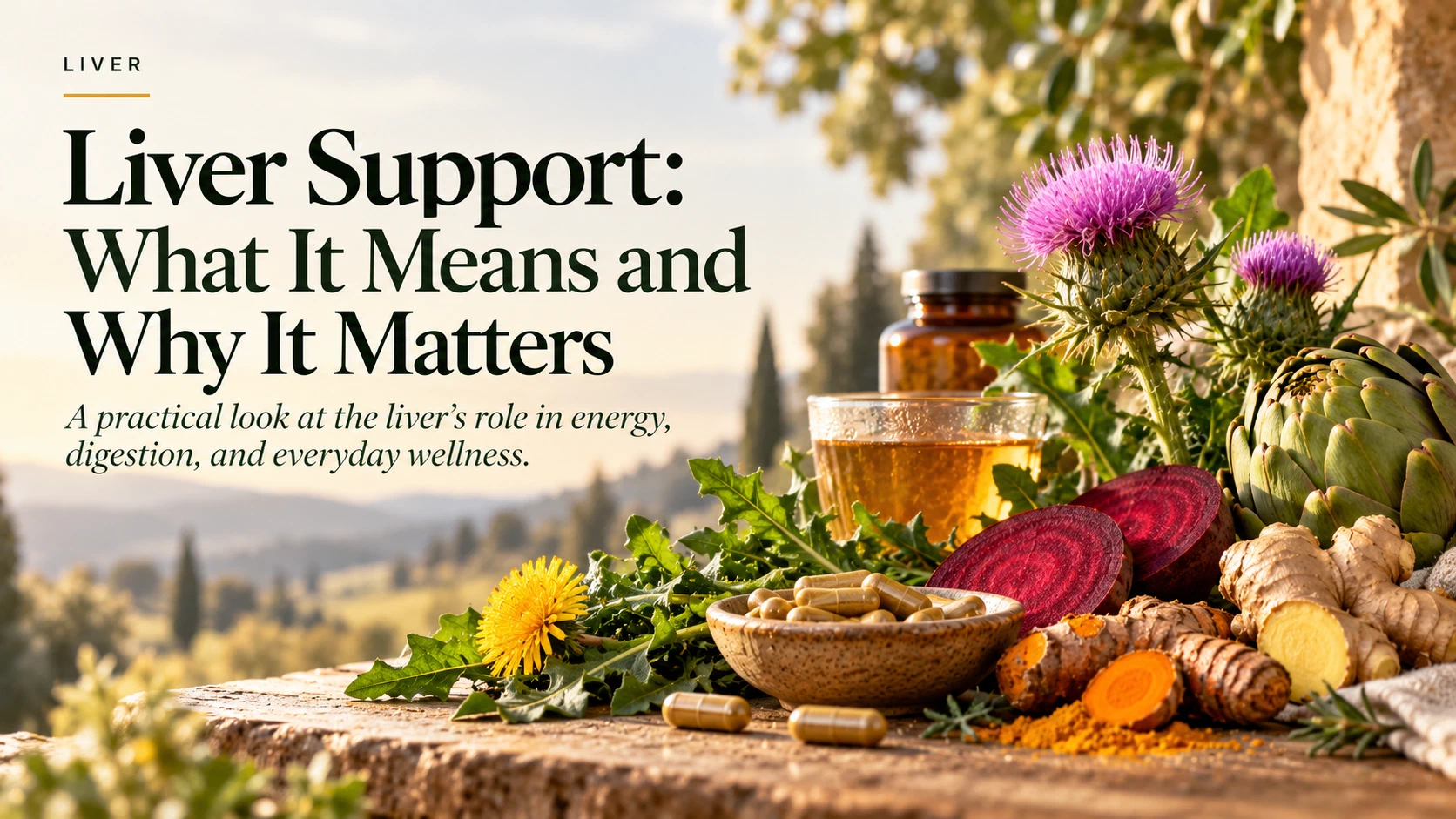
Milk thistle is the famous one. It has a long history of traditional use in Europe, and its seed contains silymarin, among the most studied liver botanicals. Trials in people with established liver disease have been mixed and of low quality (Rambaldi et al., 2007), so we see it as traditional nutritional support, not treatment. Artichoke is the bitter one: its leaf is a traditional digestive and bile-flow herb, and the extract here is standardized to 5% cynarin. Dandelion is the one your lawn is full of. The French call it pissenlit, which means roughly what you suspect, because the leaf is a traditional diuretic, and a small pilot study found some support for that (Clare et al., 2009). Think of it as the hydration member of the team.
Beetroot, turmeric and ginger are the kitchen roots of the blend, foods and spices used for a very long time, and turmeric and ginger in particular are the warming pair that traditional cooking leans on for digestion. Here they come as plain powders. Alfalfa is a nutrient-dense leaf that rounds out the blend with plant nutrients. L-cysteine is the amino acid your liver uses to make glutathione, the antioxidant mentioned above. It is not the same as N-acetylcysteine, the form used in hospitals. Liver Support is a daily nutritional blend, not a treatment for anything.
How to Use It, and Who Should Check First
Take two capsules a day with a big glass of water, every day, not just on the mornings you regret. It is a routine product, not a rescue product. A bottle lasts a month, which makes it easy to build into a routine and easy to review with your pharmacist.
As with any botanical blend, a few sensible cautions apply. If you are pregnant, breastfeeding, under 18 or living with a medical condition, talk to a doctor first. Milk thistle, artichoke and dandelion all belong to the daisy family (Asteraceae), so go carefully if you react to ragweed or chrysanthemums. European herbal guidance for artichoke leaf also advises seeking medical advice first if you have gallstones or other bile duct problems (European Medicines Agency, 2018). Alfalfa is a leafy plant, and leafy plants contain vitamin K, which can interact with warfarin (NIH Office of Dietary Supplements), so ask your pharmacist first if you take it. Turmeric is widely used and generally well tolerated, but rare cases of liver injury have been reported with turmeric supplements (Halegoua-DeMarzio et al., 2023), so mention it if you already take turmeric or curcumin products. If you are unsure whether a botanical blend suits you, a pharmacist can check it against your medicines in a few minutes, which is a better use of five minutes than any amount of reading online, including this.
Nothing in a capsule makes alcohol safer, and the only reliable way to lower the load on your liver is a smaller load, whatever the label says. Yellowing of the skin or eyes, dark urine, pale stools, persistent itching or pain under the right ribs are reasons to see a doctor promptly, not to add a supplement.
- Liver Support (Harmover) Harmover's USA-made botanical blend: 60 capsules, two a day with water. It contains turmeric, beetroot, dandelion leaf, artichoke extract standardized to 5% cynarin, ginger, milk thistle, alfalfa leaf and L-cysteine.
- Milk thistle (Silybum marianum) A daisy-family plant whose seed contains silymarin, a group of antioxidant compounds. It has a long history of traditional use for the liver. Studies in people with liver disease are mixed, so it is described here as nutritional support.
- L-cysteine A sulfur-containing amino acid and one of the building blocks of glutathione, the liver's own antioxidant. It is the free amino acid, not N-acetylcysteine, and it is the one non-botanical ingredient in the blend.
If you take one thing from this, make it respect. Your liver is running hundreds of processes right now, will do the same through every party between here and New Year, and will not send an invoice. Supporting it means not getting in its way and giving it what it uses. Liver Support is a simple two-capsule routine built from botanicals people have reached for over generations, plus the amino acid your liver uses to make glutathione, offered as a modest addition to a balanced lifestyle. Take it with the big glass of water, keep the drink you do not have, and let the chemistry department do what it does best.
Daily support, alongside good habits
Harmover Liver Support is a botanical blend designed to sit alongside a varied diet and healthy daily habits. It is not a substitute for them, or for medical advice.
Explore Liver SupportEducational content, not medical advice.
- Klein AV, Kiat H., 2015. Detox diets for toxin elimination and weight management: a critical review of the evidence. Journal of Human Nutrition and Dietetics, 28(6), 675–686. DOI: 10.1111/jhn.12286. PMID: 25522674. https://doi.org/10.1111/jhn.12286 Evidence type: Scientific review.
- Michalopoulos GK, Bhushan B., 2021. Liver regeneration: biological and pathological mechanisms and implications. Nature Reviews Gastroenterology & Hepatology, 18(1), 40–55. DOI: 10.1038/s41575-020-0342-4. PMID: 32764740. https://doi.org/10.1038/s41575-020-0342-4 Evidence type: Scientific review.
- Lu SC., 2013. Glutathione synthesis. Biochimica et Biophysica Acta (BBA) - General Subjects, 1830(5), 3143–3153. DOI: 10.1016/j.bbagen.2012.09.008. PMID: 22995213. https://doi.org/10.1016/j.bbagen.2012.09.008 Evidence type: Scientific review.
- Committee on Herbal Medicinal Products (HMPC), European Medicines Agency, 2018. European Union herbal monograph on Cynara cardunculus L. (syn. Cynara scolymus L.), folium. EMA/HMPC/194014/2017, 27 March 2018 (final). Section 4.3, contraindications. https://www.ema.europa.eu/en/documents/herbal-monograph/final-european-union-herbal-monograph-cynara-cardunculus-l-syn-cynara-scolymus-l-folium_en.pdf Evidence type: Regulatory monograph (traditional use).
- Committee on Herbal Medicinal Products (HMPC), European Medicines Agency, 2018. Assessment report on Cynara cardunculus L. (syn. Cynara scolymus L.), folium. EMA/HMPC/194013/2017, 27 March 2018 (final). https://www.ema.europa.eu/en/documents/herbal-report/final-assessment-report-cynara-cardunculus-l-syn-cynara-scolymus-l-folium_en.pdf Evidence type: Regulatory assessment (traditional use).
- Rambaldi A, Jacobs BP, Gluud C., 2007. Milk thistle for alcoholic and/or hepatitis B or C virus liver diseases. Cochrane Database of Systematic Reviews, 2007(4), CD003620. DOI: 10.1002/14651858.CD003620.pub3. PMID: 17943794. https://doi.org/10.1002/14651858.CD003620.pub3 Evidence type: Systematic review of human trials (disease context).
- Clare BA, Conroy RS, Spelman K., 2009. The diuretic effect in human subjects of an extract of Taraxacum officinale folium over a single day. Journal of Alternative and Complementary Medicine, 15(8), 929–934. DOI: 10.1089/acm.2008.0152. PMID: 19678785. https://doi.org/10.1089/acm.2008.0152 Evidence type: Small human pilot study (n = 17).
- Halegoua-DeMarzio D, Navarro V, Ahmad J, et al., 2023. Liver injury associated with turmeric: a growing problem. Ten cases from the Drug-Induced Liver Injury Network (DILIN). The American Journal of Medicine, 136(2), 200–206. DOI: 10.1016/j.amjmed.2022.09.026. PMID: 36252717. https://doi.org/10.1016/j.amjmed.2022.09.026 Evidence type: Human case series.
- National Institutes of Health, Office of Dietary Supplements. Vitamin K: fact sheet for consumers. Accessed October 2026. https://ods.od.nih.gov/factsheets/VitaminK-Consumer/ Evidence type: Government source.
This article is intended for informational and educational purposes only. It does not constitute medical advice and should not be used as a substitute for guidance from a qualified healthcare professional. It cannot tell you how your own liver is functioning. If you are pregnant, breastfeeding, under 18, taking medication or living with a medical condition, speak with your doctor or pharmacist before using any supplement. Harmover Liver Support is a food supplement intended to sit alongside a balanced diet and healthy lifestyle, and makes no claim to diagnose, treat, cure or prevent any medical condition.