
Hormonal Health After 35: Energy, Mood, NAD+ and the Midlife Shift
Hormonal change can feel confusing because it rarely shows up as one simple symptom. It can feel like low energy, poor sleep, brain fog, mood changes, lower drive, slower recovery — or just a quiet sense that your body isn't responding the way it used to. Menopause and perimenopause are widely associated with mood changes, brain fog and sleep disruption, and men can also experience physical and emotional changes in midlife linked to testosterone decline. Hormonal health, in other words, touches far more than one thing.
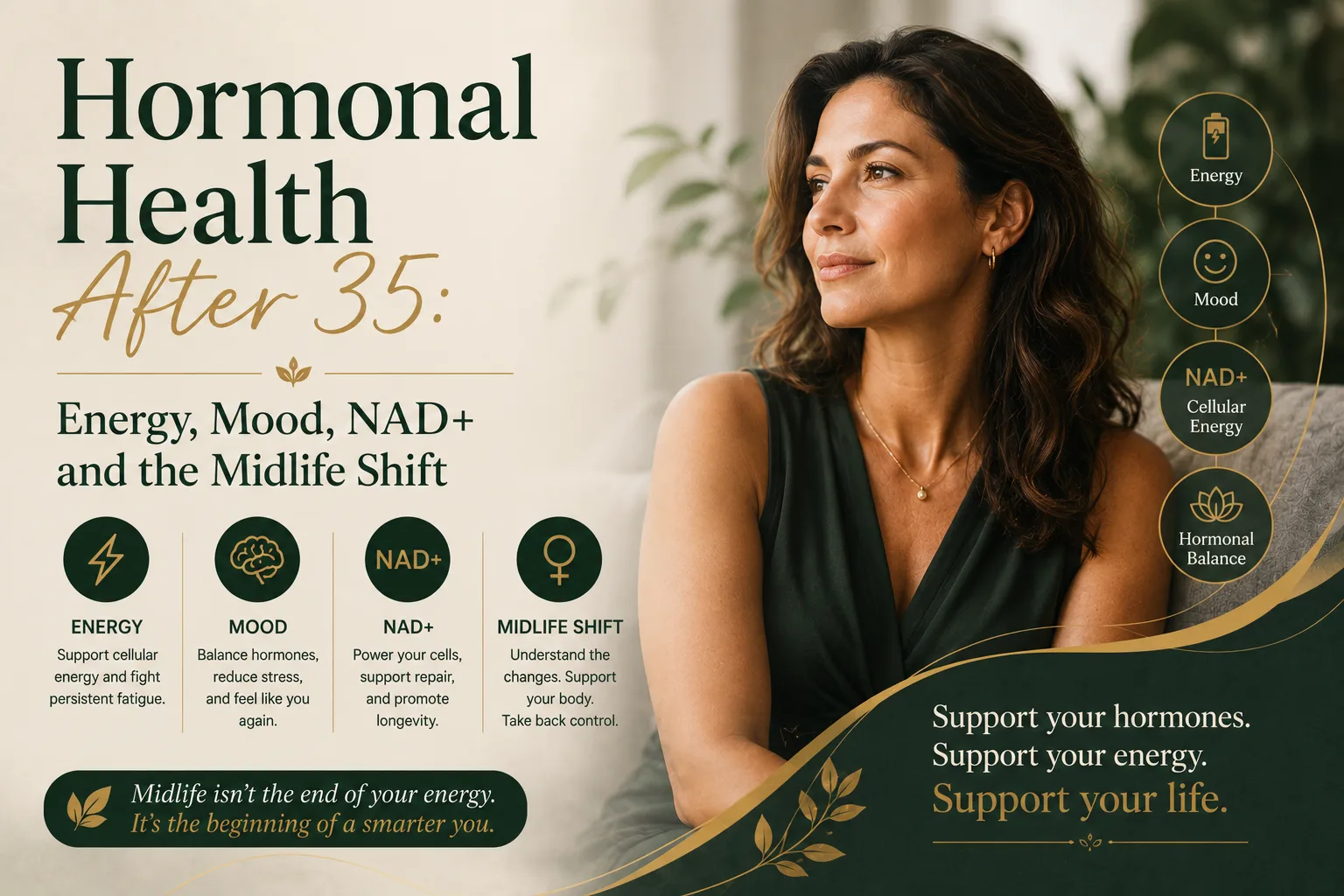
Hormonal health is not only a women's issue
A lot of people still talk about hormonal health as if it belongs only in conversations about women. That misses half the picture. Women may experience perimenopause, menopause, post-partum hormonal change, low libido, disrupted sleep, skin changes, mood shifts and brain fog. Men may experience andropause, declining testosterone, fatigue, reduced drive, changes in mood, loss of muscle and slower recovery.
The details are different, but the theme is similar. Hormonal shifts can affect how you feel in your body, how clearly you think, how deeply you sleep and how much energy you have for the life you're trying to live. NHS guidance lists menopause symptoms including mood changes, low mood, anxiety and memory or concentration problems, while NHS guidance on male menopause describes low mood, loss of sex drive and other physical and emotional symptoms in men in their late 40s to early 50s.
This is why Harmover's hormonal health work is built around both women and men. The same biological pressures can show up differently depending on sex, age, hormones, stress load, health history and stage of life — which is also why a one-size-fits-all approach rarely feels satisfying. None of this is medical advice, and individual symptoms always deserve individual assessment.
Brain fog, poor sleep, low energy, mood shifts and low libido can feel unrelated, but they often appear together during hormonal transition. The helpful question isn't "what single thing fixes this?" — it's "what pattern is my body showing me?"
Why energy and mood often change during hormonal transition
When people talk about hormones, they often focus on the obvious symptoms — hot flushes, libido, testosterone, oestrogen. But the deeper conversation is about how hormonal change affects the whole system.
During menopause, research has connected the transition with sleep problems, mood changes and reduced cognitive performance — sleep disturbance and brain fog are common complaints at this stage of life. For men, late-onset hypogonadism (age-related low testosterone) and its symptoms can include fatigue, reduced libido, erectile changes and mood disturbance.
The point isn't to reduce every midlife symptom to hormones. Stress, sleep, nutrition, medication, thyroid health, blood sugar, alcohol, illness and emotional strain can all matter. But hormones are part of the larger picture, and when they shift, many people feel it across energy, mood, sleep, cognition and drive.
Where NAD+ fits into hormonal health
NAD+ isn't a hormone. It's a coenzyme found in cells, involved in energy metabolism, mitochondrial function, DNA repair and cellular stress response. Reviews of NAD+ biology describe its role in mitochondrial homeostasis and ageing, and broader research has linked age-related NAD+ decline with changes in cellular function.
That matters for hormonal health because hormonal transition isn't just about hormone levels on a lab report. It's also about the body's ability to produce energy, recover, regulate stress, maintain muscle, support cognition and adapt to change. The LathMized® NAD+ Hormonal Protocol, available through Harmover, is positioned around that cellular layer, with separate relevance for menopause, perimenopause and andropause.
NAD+ is described as a shared foundation across both women's and men's hormonal protocols, framed around four pillars commonly disrupted during hormonal change: cellular energy, cognitive clarity, sleep quality and mood. That's a useful way to think about it, because many people don't come looking for "hormone support" in the abstract. They come because they're tired, foggy, sleeping badly, recovering slowly or feeling emotionally flat.
Hormonal support works best when it's layered
One of the strongest ideas here is that hormonal support isn't just one product or one pathway. It connects hormonal health with NAD+ support, female vitality support, testosterone support where clinically appropriate, bone and heart support, and liver support.
That makes sense, because hormonal transition can affect multiple systems at once. Bone health matters because oestrogen and testosterone both play roles in maintaining bone density — which is why Vitamin D3, K2, calcium and magnesium are often discussed together, since calcium absorption and its direction in the body matter for bone and cardiovascular health. Liver support is relevant because the liver is central to hormone metabolism and clearance. Omega-3 and foundational nutrients may support broader cardiovascular, inflammatory and cellular health patterns too.
The important thing is that layered support should still be thoughtful. More is not always better. Starting too many things at once can make it harder to know what's actually helping.
Practitioner guidance is especially important if you use HRT, testosterone therapy or prescription medication, or have medical conditions that need individual review. Testosterone Gel in particular is a prescription medicine in many regions and should only be used under practitioner supervision where regionally eligible — never as casual self-treatment. Hormonal change is not something you should have to simply tolerate, but it's also not something to approach casually.
The best support starts with understanding what stage of life someone is in, what symptoms they're actually experiencing, what they're already taking and what their goals are. Framed that way — guided, personalised and clinically informed — a layered approach makes sense.
- LathMized® NAD+ Hormonal Protocol Harmover's cellular support platform, used within its menopause and andropause protocols. NAD+ plays a role in cellular energy, mitochondrial function and repair pathways — all relevant when people are dealing with fatigue, brain fog, mood changes and slower recovery. It is not hormone therapy and is not a cure for hormonal symptoms; its role is cellular support within a broader, practitioner-guided plan.
- Female Enhancement Positioned as natural support for female wellness, libido and hormonal vitality — relevant for women noticing changes in drive, energy or vitality during hormonal transition. It's supportive wellness nutrition rather than a treatment for sexual dysfunction or menopause; the honest angle is female vitality, confidence and whole-body support.
- Testosterone Gel 1% A practitioner-supervised option for men navigating andropause where eligible. Because testosterone is prescription-regulated in many regions, it should always be framed as requiring practitioner review and regional eligibility. Low testosterone can be associated with reduced libido, fatigue, mood changes and physical changes — but this is never for casual use or self-diagnosis.
Common questions about hormonal health in midlife
A few questions come up often once people start joining the dots between midlife symptoms. The answers below stay within what this article and its references support.
Is hormonal health only relevant to women?
No. Women may experience perimenopause, menopause, post-partum change, disrupted sleep, mood shifts and brain fog; men may experience andropause, declining testosterone, fatigue, reduced drive and slower recovery. The details differ, but hormonal shifts affect energy, thinking, sleep and drive in both — which is why it's framed around women and men.
Why do energy and mood change during hormonal transition?
Research connects menopause with sleep problems, mood changes and reduced cognitive performance, and links low-testosterone symptoms in men with fatigue, reduced libido and mood disturbance. Hormones are only part of it, though — stress, sleep, nutrition, medication and thyroid health can all contribute, so symptoms deserve individual assessment.
How does NAD+ relate to hormonal health?
NAD+ isn't a hormone — it's a coenzyme involved in energy metabolism, mitochondrial function, DNA repair and cellular stress response. It's relevant because hormonal transition also affects the body's ability to produce energy, recover and support cognition. So it sits at the cellular layer of a wider plan, not as hormone therapy or a cure for symptoms.
Should I start lots of supplements at once?
More isn't always better. Starting too many things at once makes it harder to know what's actually helping. A layered approach works best when it's thoughtful and guided — especially if you use HRT, testosterone therapy or prescription medication, or have conditions that need individual review.
What to take away
Hormonal health is personal, but it doesn't have to feel mysterious. Whether you're navigating perimenopause, menopause, andropause, post-partum change, or simply trying to feel more steady in your body, it helps to look beyond isolated symptoms. Energy, sleep, mood, cognition, libido, bone health, liver support and cellular health all belong in the same conversation.
The real message is simple: hormonal change isn't something you have to ignore, push through or silently accept. It's something you can understand, support, and approach with better guidance.
Support the whole picture
Cellular energy, careful assessment and layered, practitioner-guided support for both women and men — explore a whole-body approach to hormonal health.
Explore Hormonal HealthEducational content, not medical advice.
- Gava, G., Orsili, I., Alvisi, S., Mancini, I., Seracchioli, R. and Meriggiola, M.C., 2019. Cognition, Mood and Sleep in Menopausal Transition: The Role of Menopause Hormone Therapy. Medicina, 55(10), 668. DOI: 10.3390/medicina55100668
- Santoro, N., Epperson, C.N. and Mathews, S.B., 2015. Menopausal Symptoms and Their Management. Endocrinology and Metabolism Clinics of North America, 44(3), pp. 497–515. DOI: 10.1016/j.ecl.2015.05.001
- Covarrubias, A.J., Perrone, R., Grozio, A. and Verdin, E., 2021. NAD+ metabolism and its roles in cellular processes during ageing. Nature Reviews Molecular Cell Biology, 22, pp. 119–141. DOI: 10.1038/s41580-020-00313-x
- Barone, B., Napolitano, L., Abate, M. et al., 2022. The Role of Testosterone in the Elderly: What Do We Know? International Journal of Molecular Sciences, 23(7), 3535. DOI: 10.3390/ijms23073535
- Khera, M., Broderick, G.A., Carson, C.C. et al., 2016. Adult-Onset Hypogonadism. Mayo Clinic Proceedings, 91(7), pp. 908–926. DOI: 10.1016/j.mayocp.2016.04.022
- NHS, 2025. Menopause. NHS Health A–Z. Available at: https://www.nhs.uk/conditions/menopause/
- NHS, 2025. Male menopause. NHS Health A–Z. Available at: https://www.nhs.uk/conditions/male-menopause/
This article is intended for informational and educational purposes only. It does not constitute medical advice and should not be used as a substitute for guidance from a qualified healthcare professional. Testosterone Gel is a prescription medicine in many regions and should only be used under practitioner supervision. If you use HRT or other hormone therapy, take medication, or are managing a health condition, speak with your practitioner before starting any new supplement.