
Andropause Explained: The Men's Hormonal Shift Nobody Talks About
A lot of men are told that feeling tired, foggy, flat, less driven — less like themselves — is just part of getting older. Sometimes age is part of the picture, but it's rarely the whole story. Andropause is one way people describe the gradual hormonal and cellular shifts some men experience in midlife and beyond.
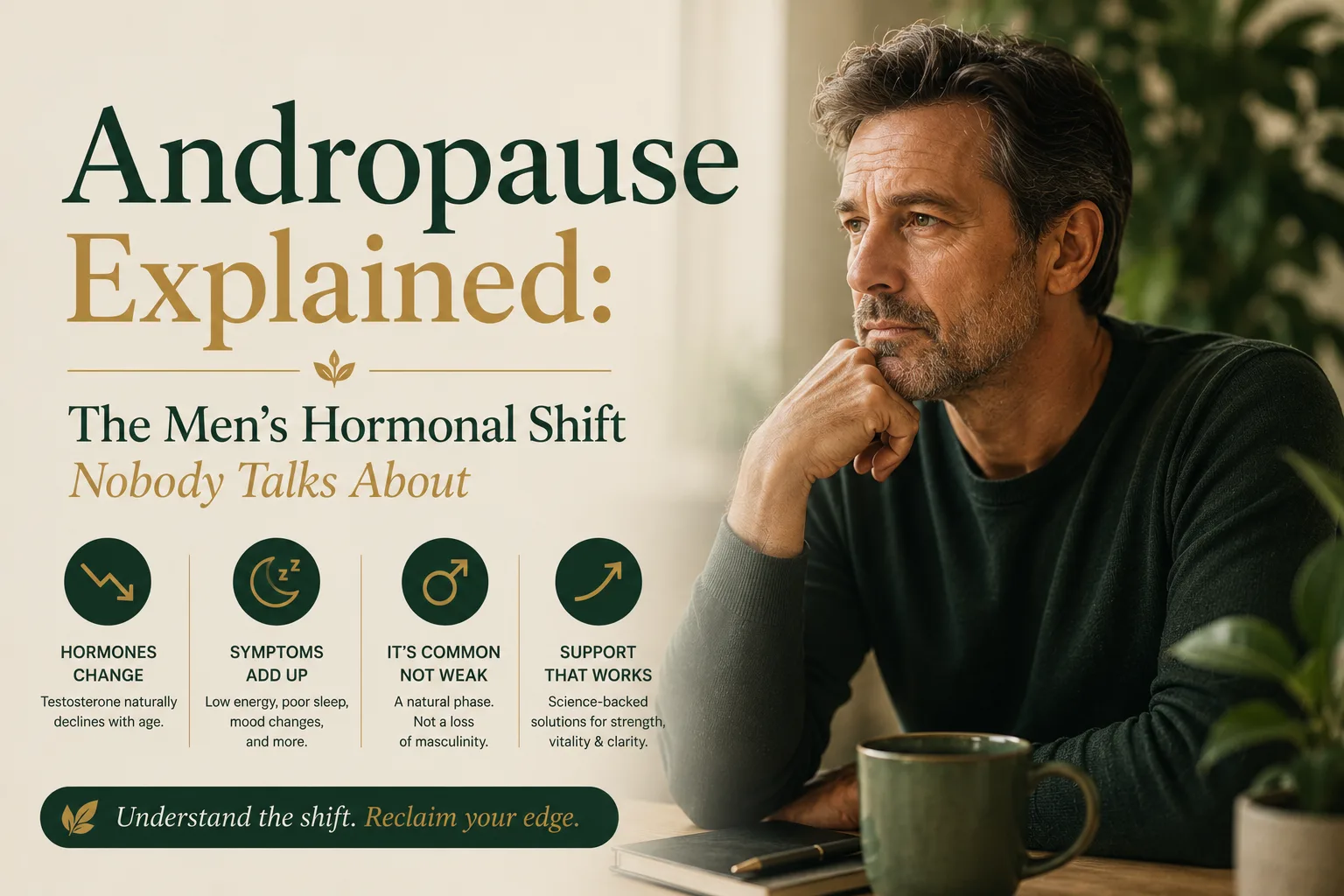
What is andropause?
Andropause isn't quite the male version of menopause. Women experience a clearer reproductive transition, while men usually experience a slower change in testosterone over time. The Mayo Clinic explains that testosterone commonly falls by about 1% per year after age 40, although many older men still remain within the standard range.
That slow pattern is part of why andropause can be confusing. A man may not feel a sudden change — he may simply notice that energy, drive, recovery, sleep, strength, focus or mood no longer feel the same. Some men will have clinically low testosterone. Others may have similar symptoms driven by stress, poor sleep, alcohol, metabolic health, thyroid issues, medication, depression, inflammation or general lifestyle strain.
This is why good hormonal health support shouldn't start with guessing. The American Urological Association guideline describes testosterone deficiency as something that requires both symptoms or signs and properly measured low testosterone — not symptoms alone. At Harmover, we look at men's hormonal health as a wider whole-body conversation: testosterone matters, but so do mitochondrial function (how your cells make energy), NAD+ status, sleep, liver health, bone and heart support, stress load and metabolic resilience. None of this is medical advice, and the right first step is always proper assessment.
Low drive, low energy, poor sleep, mood changes, brain fog and slower recovery can feel like separate problems. In men's hormonal health, they often belong in the same conversation.
The signs men often brush off
The signs of andropause are easy to dismiss because they build slowly. A man might not say "my hormones have changed." He might say "I don't recover like I used to," "I feel tired even when I sleep," "my drive is lower," "my workouts feel harder," or "my focus isn't as sharp."
Clinical guidelines and reviews commonly describe sexual symptoms and fatigue as important presentations of testosterone deficiency. The Canadian clinical practice guideline notes that sexual symptoms and fatigue are among the earliest and most common, while mood changes, altered sleep, poor concentration, weight gain, type 2 diabetes and other metabolic issues may also appear in the broader pattern.
The Endocrine Society emphasises that testosterone therapy should be considered only for men with symptoms and consistently low testosterone confirmed by appropriate testing. That matters — men deserve support, but they also deserve careful assessment rather than casual labelling.
The point isn't to make men anxious about normal ageing. It's to make the conversation more honest. Low energy, reduced libido, low mood, muscle loss, brain fog, poor sleep and slower recovery can genuinely affect quality of life. They're worth paying attention to.
Why NAD+ belongs in the men's hormonal health conversation
NAD+ isn't testosterone. It isn't a hormone at all. It's a coenzyme found in your cells, involved in energy metabolism, mitochondrial function, DNA repair, cellular stress response and many other processes connected with ageing and resilience. A major review in Nature Reviews Molecular Cell Biology describes NAD+ as influencing key cellular functions including metabolism, DNA repair, chromatin remodelling, cellular senescence and immune cell function.
That matters because many men don't describe midlife change only in hormonal language. They describe cellular symptoms in everyday words. Drained. Slower. Foggy. Flat. Less resilient. Not bouncing back from stress, exercise, travel, illness or poor sleep the way they used to.
The LathMized® NAD+ Andropause Protocol, available through Harmover, is designed for men navigating midlife hormonal transition, with a focus on cellular energy, cognitive clarity, sleep quality, mood and recovery. Across the hormonal health range, NAD+ is positioned as part of the shared foundation for both men's and women's protocols, because cellular energy and repair matter across every hormonal transition.
This shouldn't be confused with hormone replacement. NAD+ support does not replace proper testosterone assessment. It belongs in the broader support picture — especially when the main complaints are fatigue, mental sharpness, recovery and simply feeling less vital than before.
Why men's hormonal health needs a bigger support picture
It's tempting to make men's hormonal health only about testosterone. But the body doesn't work in isolated categories.
Energy is shaped by mitochondria, sleep, nutrition, stress, hormones and metabolic health. Libido is shaped by hormones, blood flow, mood, confidence, medication, relationship context and nervous-system state. Recovery is shaped by inflammation, sleep quality, protein intake, training load and cellular repair. Bone and heart health also become more important as men age.
That's why our hormonal health section connects men's vitality with NAD+ support, practitioner-reviewed Testosterone Gel where eligible, and foundational support such as Bone & Heart Support — Vitamin D3, K2, calcium and magnesium all play a part in long-term bone and cardiovascular support. Liver support matters too, because the liver plays a major role in hormone metabolism and clearance.
The key isn't to start everything at once. More is not always smarter. The stronger approach is to understand the pattern, review what someone is already taking, look at symptoms and health history, and build a guided plan that makes sense.
Testosterone Gel is a prescription medicine in many regions. It should only be used under practitioner supervision, after proper assessment and where regionally eligible — never as casual self-treatment. Broader support such as NAD+, Bone & Heart Support and Liver Support still benefits from guidance too, since men are often dealing with overlapping issues rather than one isolated problem.
- LathMized® NAD+ Andropause Protocol Harmover's cellular support platform used in the andropause protocol. NAD+ supports cellular energy, mitochondrial function, DNA repair and cellular stress response, which makes it part of the wider conversation around energy, brain fog, sleep quality, recovery and vitality during midlife. It's cellular support — not hormone replacement, and not a treatment for low testosterone.
- Testosterone Gel 1% A practitioner-supervised option for men where appropriate and regionally eligible. Testosterone deficiency can be associated with reduced libido, erectile changes, low energy, mood changes and physical changes. Because testosterone is prescription-regulated in many regions, it should always be framed as requiring proper review — never casual self-treatment.
- Bone & Heart Support Combines calcium, Vitamin D3, K2 and magnesium. It's relevant to men's hormonal health because ageing and hormonal change can affect bone density, muscle function and cardiovascular wellness. D3 supports calcium absorption, while K2 is commonly discussed for directing calcium in the body. It fits best as foundational support within a broader vitality plan.
Common questions about andropause
A few questions come up often once men start looking into this. The answers below stay within what this article and its references support.
Is andropause the same as male menopause?
Not quite. Women experience a clearer reproductive transition, while men usually see a slower change in testosterone over time — the Mayo Clinic notes it commonly falls by about 1% a year after 40, though many older men stay within the standard range. Because the change is gradual, andropause is easy to miss.
What are the common signs?
Guidelines commonly describe sexual symptoms and fatigue as among the earliest and most common, alongside mood changes, altered sleep, poor concentration and metabolic issues. But similar symptoms can also come from stress, poor sleep, medication or thyroid issues — which is exactly why assessment matters rather than self-diagnosis.
How is low testosterone properly diagnosed?
Bodies like the American Urological Association and the Endocrine Society describe testosterone deficiency as needing both symptoms or signs and consistently low testosterone confirmed by testing — not symptoms alone. Any decision about testosterone therapy is a practitioner one, based on that assessment.
Is NAD+ a testosterone replacement?
No. NAD+ isn't a hormone and doesn't replace testosterone or proper assessment. It's a coenzyme involved in energy metabolism, mitochondrial function, DNA repair and cellular stress response — part of the broader support picture, especially where the main complaints are fatigue, mental sharpness and recovery.
What to take away
Andropause isn't something men need to joke about, ignore, or silently push through. It's also not something to self-diagnose from one symptom or one social-media post. The better path is calm, informed and guided.
When men understand the connection between testosterone, NAD+, cellular energy, sleep, mood, libido and recovery, they can stop seeing midlife change as a mystery and start approaching it with more confidence.
Approach it with confidence
Cellular energy, careful assessment and foundational support — explore a guided, whole-body approach to men's hormonal health.
Explore Men's Hormonal HealthEducational content, not medical advice.
- Bhasin, S., Brito, J.P., Cunningham, G.R. et al., 2018. Testosterone Therapy in Men With Hypogonadism: An Endocrine Society Clinical Practice Guideline. Journal of Clinical Endocrinology and Metabolism, 103(5), pp. 1715–1744. DOI: 10.1210/jc.2018-00229
- Mulhall, J.P., Trost, L.W., Brannigan, R.E. et al., 2018. Evaluation and Management of Testosterone Deficiency: AUA Guideline. Journal of Urology, 200(2), pp. 423–432. DOI: 10.1016/j.juro.2018.03.115
- Morales, A., Bebb, R.A., Manjoo, P. et al., 2015. Diagnosis and management of testosterone deficiency syndrome in men: clinical practice guideline. Canadian Medical Association Journal, 187(18), pp. 1369–1377. DOI: 10.1503/cmaj.150033
- Covarrubias, A.J., Perrone, R., Grozio, A. and Verdin, E., 2021. NAD+ metabolism and its roles in cellular processes during ageing. Nature Reviews Molecular Cell Biology, 22, pp. 119–141. DOI: 10.1038/s41580-020-00313-x
- Barone, B., Napolitano, L., Abate, M. et al., 2022. The Role of Testosterone in the Elderly: What Do We Know? International Journal of Molecular Sciences, 23(7), 3535. DOI: 10.3390/ijms23073535
- Yusri, K., Jose, S.S. et al., 2025. The role of NAD+ metabolism and its modulation of mitochondria in aging and disease. npj Metabolic Health and Disease, 3, 26. DOI: 10.1038/s44324-025-00067-0
- Mayo Clinic, 2025. Male menopause: Myth or reality? Available at: https://www.mayoclinic.org/healthy-lifestyle/mens-health/in-depth/male-menopause/art-20048056
This article is intended for informational and educational purposes only. It does not constitute medical advice and should not be used as a substitute for guidance from a qualified healthcare professional. Testosterone Gel is a prescription medicine in many regions and should only be used under practitioner supervision after appropriate assessment. Persistent symptoms — fatigue, low mood, reduced libido or others — deserve proper evaluation rather than self-diagnosis. If you are taking medication or managing a health condition, speak with your practitioner before starting any new supplement.