
Why Denmark Restricted Ashwagandha and Why Experts Still Disagree
It has been part of Ayurvedic tradition for thousands of years. Millions of people take it for stress. And in 2023, Denmark stopped it being sold in food supplements altogether. If that makes you wonder who is really protecting whom, you are asking the right question. The honest answer is more interesting than either side's headline, and it matters if ashwagandha is in your cupboard.
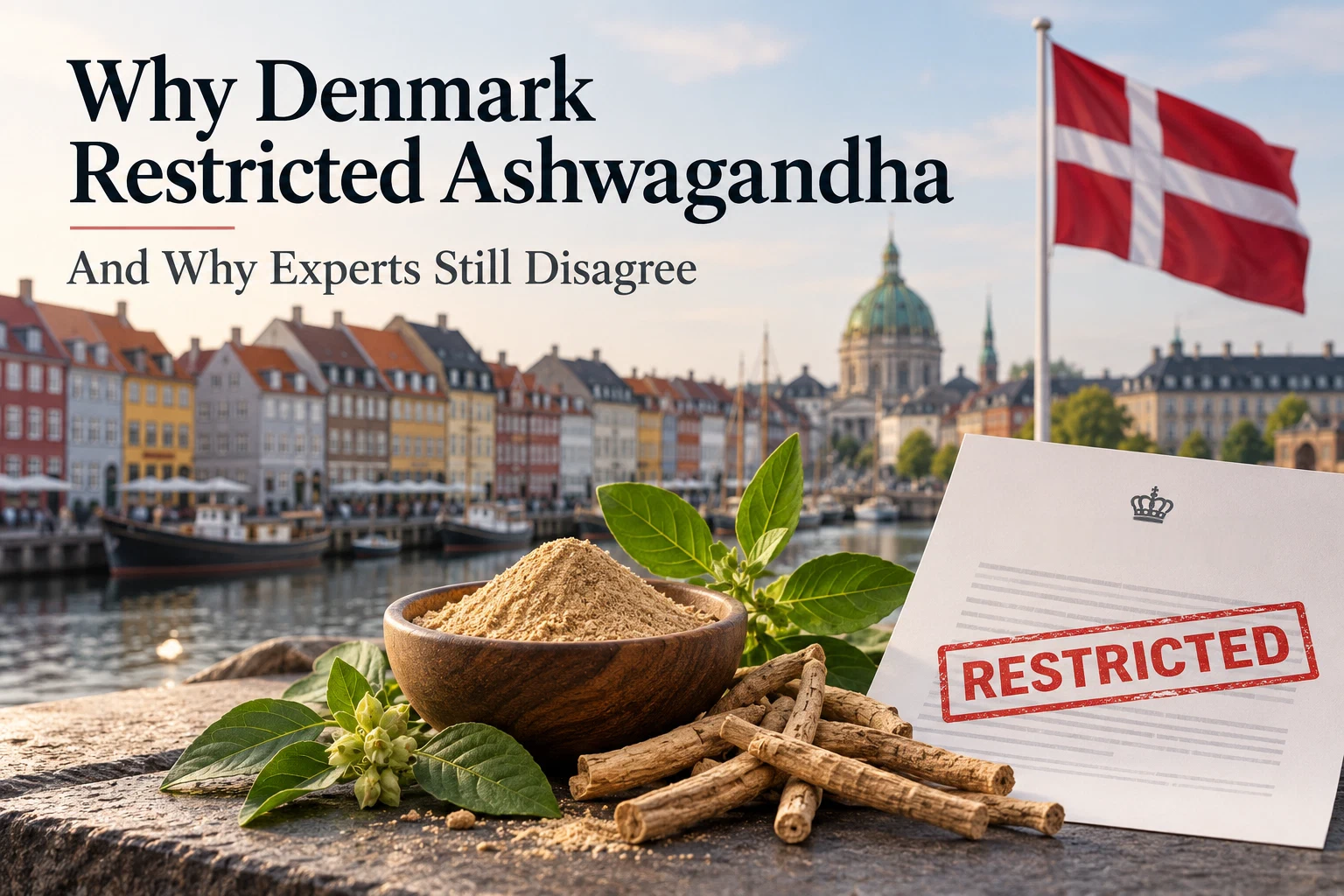
What Actually Happened in Denmark?
In 2019, the Danish Veterinary and Food Administration asked the National Food Institute at the Technical University of Denmark (DTU) to assess whether a safe intake level for ashwagandha could be set. The report, published in 2020, pointed to studies suggesting possible effects on reproduction and sex hormones, the thyroid, the immune system and the nervous system.
Its conclusion is the part most people miss. The report did not say ashwagandha had been proven dangerous. It said there was not enough evidence to establish a safe lower intake limit for the root or its extracts. Denmark takes a precautionary approach to food safety, so that uncertainty alone was treated as a reason to act.
In 2023, the Danish food authority concluded that products containing ashwagandha could not be lawfully sold as foods, including food supplements, in Denmark. It also used the EU's Rapid Alert System for Food and Feed to notify other member states about dozens of ashwagandha products being sold online. That set off a chain reaction across Europe.
It helps to be precise about what kind of rule this is. It is a food-law decision that applies in Denmark and covers food supplements. It is not a finding that the plant is poisonous, it is not an EU-wide ban, and it says nothing about ashwagandha being a crime to own. It is a restriction on how ashwagandha can be sold as a food.
Denmark's decision rested on the lack of a proven safe intake level, not on proof of harm. France, looking at much of the same evidence, kept ashwagandha on sale with warnings for specific groups. Same herb, same science, very different rules.
The Rest of Europe Is Split
Germany's Federal Institute for Risk Assessment (BfR) had flagged ashwagandha for a closer look as far back as 2013, citing possible hormonal effects, a reported traditional use to induce miscarriage, and a lack of toxicology data. In 2024, the Dutch public health institute RIVM advised against using it, citing concerns that included possible hormonal effects and reports of liver harm.
France took a different route. In April 2024, the French food safety agency ANSES advised pregnant and breastfeeding women, under-18s, and people with thyroid, liver or heart conditions to avoid it, and urged caution for people taking certain medicines. It did not stop everyone else from buying it.
Also in 2024, a working group of the heads of Europe's national food safety agencies proposed ashwagandha as one of a small number of botanicals that could go through a formal EU safety review. If that review goes ahead and finds an unacceptable risk, it could lead to restrictions across the whole EU. The UK's Food Standards Agency launched its own call for evidence the same year.
So the same scientific uncertainty has produced a restriction in one country, targeted warnings in another, and business as usual in others. That is not a cover-up. It is a genuine disagreement about how much proof of safety a food supplement should need.
What the Defenders Say
Ashwagandha has serious defenders, and their arguments deserve a fair hearing. Critics of the Danish report say it did not properly separate the root, which is the part traditionally used, from the leaves. They also argue it misread some hormone studies, treating a shift back towards normal levels as if it were damage. Some experts blame adulterated or poorly made products for many of the problems reported.
There is supportive human research too. In a well-known 2012 trial, 64 adults under chronic stress took either ashwagandha root extract or a placebo for 60 days. The ashwagandha group reported lower stress scores and had lower blood cortisol levels than the placebo group. In 2025, botanical safety researchers reviewing the literature argued that fears about miscarriage are not supported by the available evidence.
Now apply the same scepticism in the other direction. Much of the public defence of ashwagandha is funded or led by companies that sell ashwagandha extracts, and many of the clinical trials are sponsored by extract makers. That does not make them wrong. It does mean that "follow the money" applies to industry just as much as to regulators. We sell adaptogen products ourselves, so please hold us to that standard too.
Root, Leaf and Withanolides
Much of the argument comes down to which part of the plant is in the capsule. Ashwagandha (Withania somnifera) is a shrub in the nightshade family, and its root is the part most research and most regulators focus on. Its activity is thought to come largely from a group of natural compounds called withanolides, which is why many supplements are standardised to a stated percentage of them.
The leaves contain higher levels of some withanolides, particularly one called withaferin A. In April 2026, India's Ministry of Ayush moved to prohibit the use of ashwagandha leaf in products, although several Indian high courts have since granted interim stays following industry challenges. For you, the practical point is simple: check which part of the plant a product uses.
What the Real Risks Look Like
The strongest safety signal is the liver. In 2020, doctors in Iceland and the US described five people who developed jaundice after taking ashwagandha supplements, usually two to twelve weeks after starting. None suffered liver failure, and those who were followed up recovered within months of stopping. Further cases have since been reported in India and elsewhere. These are rare, but they are real.
Other concerns are less settled: possible effects on thyroid hormones, cortisol, blood sugar and the immune system, and its listed traditional use to induce abortion, which supporters strongly dispute.
Taking all of this together, it is sensible to speak to a health professional before using ashwagandha if you are pregnant, trying to conceive or breastfeeding, if you are under 18, if you have a thyroid, liver or heart condition, or if you take any regular medication. Stop and seek medical advice if you notice yellowing skin or eyes, dark urine, persistent itching or unexplained nausea.
Quality matters as well. Look for products that state they use the root only, name a standardised extract, and come from makers who can show independent testing.
The truth about ashwagandha sits in an uncomfortable middle. It is not a miracle herb that regulators are hiding from you, and it is not a poison that industry is forcing on you. It is a traditional plant with some promising research, a small but real set of safety signals, and a lot of unanswered questions. You deserve to hear both sides and decide for yourself, ideally with someone who knows your health history.
- Chandrasekhar, K., Kapoor, J. and Anishetty, S., 2012. A prospective, randomized double-blind, placebo-controlled study of safety and efficacy of a high-concentration full-spectrum extract of ashwagandha root in reducing stress and anxiety in adults. Indian Journal of Psychological Medicine, 34(3), 255–262. https://doi.org/10.4103/0253-7176.106022
- Björnsson, H.K., Björnsson, E.S., Avula, B., Khan, I.A., Jonasson, J.G., Ghabril, M., Hayashi, P.H. and Navarro, V., 2020. Ashwagandha-induced liver injury: A case series from Iceland and the US Drug-Induced Liver Injury Network. Liver International, 40(4), 825–829. https://doi.org/10.1111/liv.14393
- Philips, C.A., Valsan, A., Theruvath, A.H. et al., 2023. Ashwagandha-induced liver injury: A case series from India and literature review. Hepatology Communications, 7(10). https://doi.org/10.1097/HC9.0000000000000270
- Hancocks, N., 2026. Timeline: Will authorities de-throne the King of Herbs? NutraIngredients, 6 July 2026. https://www.nutraingredients.com/Article/2026/07/06/timeline-will-authorities-de-throne-the-king-of-herbs/
- ANSES, 2024. Opinion on the risks associated with the consumption of food supplements containing ashwagandha (Withania somnifera). French Agency for Food, Environmental and Occupational Health & Safety, April 2024.
- World Health Organization, 2009. WHO Monographs on Selected Medicinal Plants, Volume 4: Radix Withaniae. Geneva: WHO.
- Technical University of Denmark, National Food Institute, 2020. Risk assessment of ashwagandha (Withania somnifera), commissioned by the Danish Veterinary and Food Administration.
- German Federal Institute for Risk Assessment (BfR), 2013. Risk assessment of Withania somnifera (ashwagandha) in food supplements, recommending inclusion in the EU Article 8 procedure. As summarised in reference 4.
This article is intended for informational and educational purposes only and is not medical advice. Regulatory positions on ashwagandha differ between countries and are changing; the positions described here reflect the sources cited above at the time of writing. If you are pregnant, have a medical condition or take any medication, please speak to your doctor or pharmacist before using ashwagandha.