
Ivermectin and Parasites: What This Nobel-Winning Antiparasitic Actually Does
You have probably seen the word "ivermectin" more times in the last few years than in your whole life before that — usually attached to a heated headline rather than a clear explanation. Strip away the noise and you find something quietly remarkable: a compound pulled from a scoop of soil that went on to win a Nobel Prize and spare millions of people from blindness. So what is it really, what does it have to do with the parasites living in and around us, and why has parasite health become such a talking point?
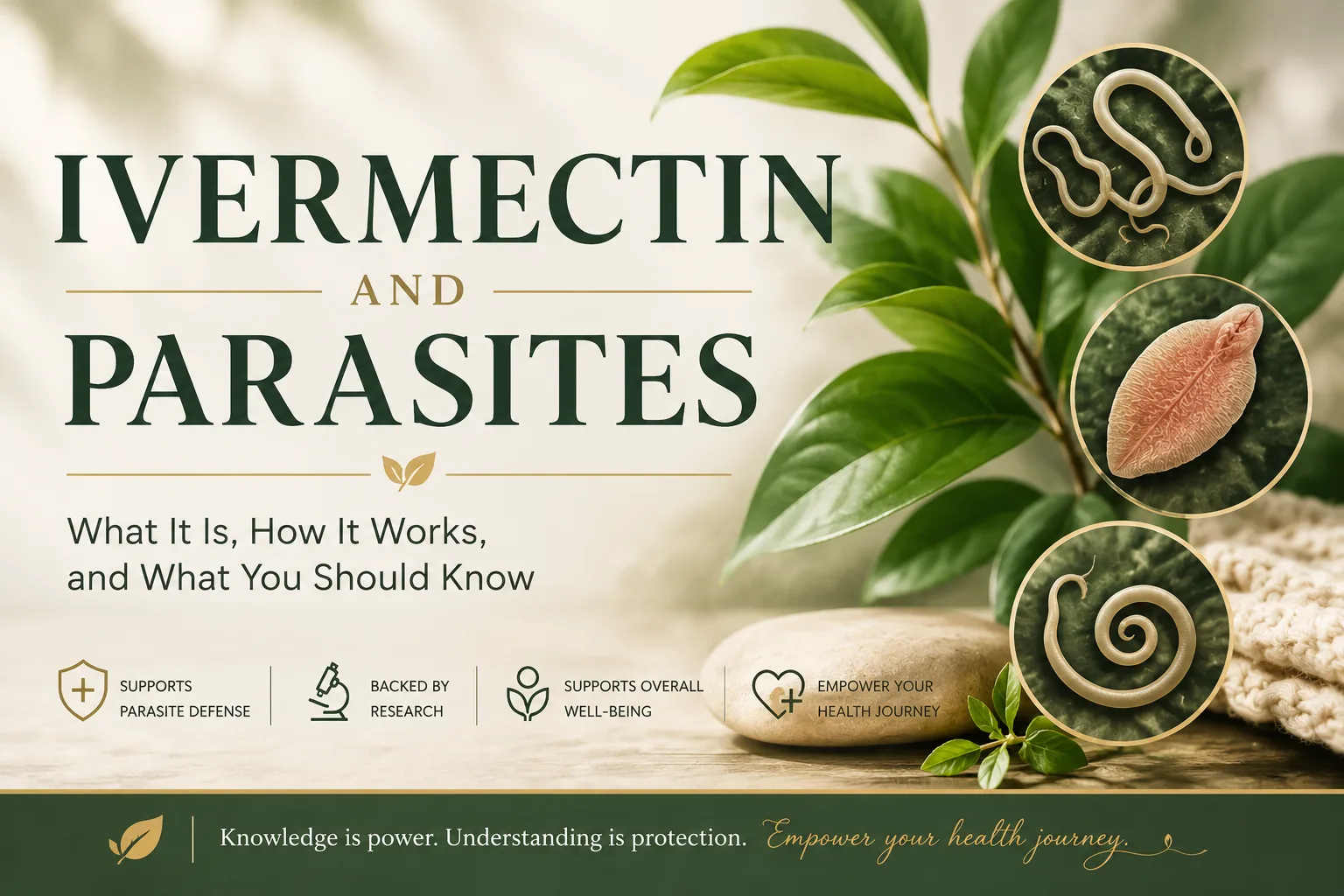
Why are we all suddenly talking about parasites?
Parasites have an image problem. For most people in wealthy countries they feel like a problem from somewhere else, or from some other century — the sort of thing you deworm a dog for, not something a healthy adult needs to think about. That instinct is only half right.
Parasitic infections remain one of the most common health conditions on the planet, and interest in them has surged as more people take a closer look at gut health and how the whole digestive system shapes the way they feel day to day. The scale is genuinely large: the World Health Organization estimates that soil-transmitted worms alone infect roughly 1.5 billion people — around a quarter of the world's population — mostly through contaminated soil, food and water. The usual suspects are roundworm, whipworm and hookworm.
In regions with good sanitation these infections are far less common, but travel, food handling, pets and imported produce mean the topic is not as distant as it once felt. That is a big part of why parasites keep coming up in wellness conversations — people want to understand a category of health that used to be invisible to them.
One honest caveat before we go further. Being curious about parasites is entirely reasonable; self-diagnosing one is not. Many of the symptoms people pin on parasites — bloating, fatigue, irregular digestion — have dozens of possible causes. Curiosity is a good starting point. A qualified practitioner and an actual test are how you get an answer.
So what exactly is ivermectin?
Ivermectin is an antiparasitic medication, and its origin story is the kind of thing that sounds made up. In the 1970s, the Japanese microbiologist Satoshi Ōmura was collecting soil samples in the hope of finding useful bacteria. One sample — reportedly from soil near a golf course — contained a microbe called Streptomyces avermitilis. Working with William Campbell at the pharmaceutical company Merck, the team isolated a compound from it called avermectin, then chemically refined it into a more effective, safer version: ivermectin.
It turned out to be extraordinarily good at its job. Ivermectin became a frontline tool against river blindness (onchocerciasis) and lymphatic filariasis, two devastating parasitic diseases affecting some of the poorest communities in the world. Its impact was significant enough that in 2015 Ōmura and Campbell shared the Nobel Prize in Physiology or Medicine for the discovery.
In humans, ivermectin is a prescription medicine approved by regulators including the U.S. Food and Drug Administration for specific parasitic infections — principally intestinal strongyloidiasis and onchocerciasis — with topical versions approved for head lice and the skin condition rosacea. It is a real, well-studied drug with clearly defined, approved uses.
The soil microbe behind ivermectin was found in a single, ordinary sample of Japanese dirt. The drug it produced is now used against parasitic diseases that once blinded millions, and it earned a share of the 2015 Nobel Prize in Medicine. Few compounds discussed in wellness circles have a paper trail this serious.
How do antiparasitics like ivermectin actually work?
The clever part of ivermectin is how precisely it targets the parasite while largely leaving the human host alone. Many parasites — worms and some insects — rely on particular nerve and muscle channels called glutamate-gated chloride channels: tiny gateways in their cells that control movement. Humans do not use these in the same way.
Ivermectin binds to those channels, which paralyses the parasite's muscles. The parasite can no longer move or feed, and the body clears it. Because those specific channels are not readily accessible in the human nervous system at normal doses, the drug can act on the parasite without doing the same to us.
This is the general principle behind antiparasitic medicines: find a biological feature the parasite depends on and the host does not, then target it. Ivermectin is one example, but it sits within a broader toolkit.
- Ivermectin Derived from avermectin, a compound produced by the soil bacterium Streptomyces avermitilis. It binds to glutamate-gated chloride channels in many parasites, paralysing them so the body can clear the infection — channels that function differently in humans, which is what underlies its selectivity. In people it is a prescription medicine approved for specific parasitic infections such as intestinal strongyloidiasis and onchocerciasis, with topical forms approved for head lice and rosacea. It appears here as an educational case study in how antiparasitic drugs are discovered and how they work, not as a product recommendation.
- Albendazole & Praziquantel Mentioned to show that ivermectin is one tool among several, not a universal "parasite answer". Albendazole is widely used against intestinal roundworms, while praziquantel targets flatworms such as tapeworms and schistosomes. They act through different biological mechanisms than ivermectin — which is precisely why identifying the specific parasite matters first. They illustrate the breadth of the antiparasitic toolkit and reinforce the point at the centre of this article: diagnosis and professional guidance come before anything else.
There is no single "parasite drug" that fits every situation. The right choice depends on the specific organism, and that is a call for a clinician, not a guess. If you want the broader picture of how this fits into a considered approach to gut health, our complete guide to parasite cleansing covers what the evidence supports and what it does not.
Reading the ivermectin conversation clearly
It is impossible to talk about ivermectin in 2026 without acknowledging how tangled its public reputation has become. Much of the recent attention has focused on proposed uses well outside its established antiparasitic role.
Here it is worth being careful and even-handed. For its approved parasitic indications, ivermectin has a long, strong track record. For other proposed uses, the evidence is contested, still being studied, or not supported by regulators — and it is fair to say reasonable experts have disagreed about how to interpret some of that research. Educationally, the honest position is to separate the well-established from the unsettled rather than flatten everything into a single verdict.
Two practical points matter regardless of where anyone lands in that debate. First, the veterinary versions of ivermectin sold for livestock are formulated and dosed for large animals and are not intended for human use; regulators have specifically warned against using them this way. Second, because ivermectin is a prescription medicine, the safe and legal path is a conversation with a qualified healthcare provider who can weigh your actual situation, any other medications you take, and correct dosing. Our aim here is to explain, not to prescribe — nothing in this article is medical advice.
Common questions about ivermectin and parasites
These are the questions that come up most often once people start reading around the subject. The answers below stay within what the evidence cited in this article actually supports.
How common are parasitic infections worldwide?
More common than most people in high-income countries assume. The World Health Organization estimates that soil-transmitted worms alone infect roughly 1.5 billion people — around a quarter of the world's population — mostly through contaminated soil, food and water. The most frequent are roundworm, whipworm and hookworm. Where sanitation is good these infections are far less common, though travel, food handling, pets and imported produce keep the topic relevant.
What is ivermectin approved for in humans?
It is a prescription medicine approved by regulators including the U.S. Food and Drug Administration for specific parasitic infections — principally intestinal strongyloidiasis and onchocerciasis, the parasitic disease better known as river blindness. Topical versions are separately approved for head lice and the skin condition rosacea. Those are its defined, approved uses.
How does ivermectin work on parasites?
It binds to glutamate-gated chloride channels — nerve and muscle gateways that many parasites depend on and that humans do not use in the same way. Binding to them paralyses the parasite's muscles, so it can no longer move or feed, and the body clears it. That difference between parasite and host biology is what gives the drug its selectivity.
Is veterinary ivermectin safe for people to use?
No. The versions sold for livestock are formulated and dosed for large animals and are not intended for human use, and regulators have specifically warned against using them this way. The human formulation is a prescription medicine, which means the appropriate route is a conversation with a qualified healthcare provider who can assess your situation and the correct dose.
Can you tell from symptoms alone whether you have a parasite?
Not reliably, and this is worth taking seriously. Bloating, fatigue and irregular digestion are the symptoms most often attributed to parasites, and all three have dozens of possible causes — many of them far more likely. Testing through a qualified practitioner is what turns a suspicion into an answer, and it also rules out the other explanations worth knowing about.
What to take away
Here is what we would love you to walk away with. Parasites are a real, common part of human health — not a fringe worry, and not a reason to panic. Ivermectin is one of the most successful antiparasitic discoveries in modern medicine, with a clear set of approved uses and a genuinely inspiring backstory. It is also a prescription drug wrapped in a great deal of online noise, which is all the more reason to keep your information sources calm, accurate and grounded.
If reading this made you curious about your own gut and digestive health, that curiosity is worth following — ideally with a knowledgeable practitioner alongside you, and good science in your back pocket.
Start with the foundations
Understanding your gut is where most of this begins. Explore the essentials, explained clearly and without the hype.
Explore Gut Health Basics- World Health Organization, 2023. Soil-transmitted helminth infections — Fact sheet. Geneva: WHO. Available at: https://www.who.int/news-room/fact-sheets/detail/soil-transmitted-helminth-infections
- Crump, A. and Ōmura, S., 2011. Ivermectin, 'wonder drug' from Japan: the human use perspective. Proceedings of the Japan Academy, Series B, 87(2), pp. 13–28. DOI: 10.2183/pjab.87.13
- Ōmura, S. and Crump, A., 2004. The life and times of ivermectin — a success story. Nature Reviews Microbiology, 2(12), pp. 984–989. DOI: 10.1038/nrmicro1048
- The Nobel Assembly at Karolinska Institutet, 2015. The Nobel Prize in Physiology or Medicine 2015 — Press release (William C. Campbell and Satoshi Ōmura; Tu Youyou). Available at: https://www.nobelprize.org/prizes/medicine/2015/press-release/
- U.S. Food and Drug Administration, 2021 (updated). Why You Should Not Use Ivermectin to Treat or Prevent COVID-19. Silver Spring, MD: FDA. Available at: https://www.fda.gov/consumers/consumer-updates/why-you-should-not-use-ivermectin-treat-or-prevent-covid-19
- U.S. Centers for Disease Control and Prevention. Parasites — About Parasites. Atlanta, GA: CDC. Available at: https://www.cdc.gov/parasites/about/index.html
This article is provided for educational purposes only and is not medical advice, diagnosis or treatment. Ivermectin is a prescription medicine; veterinary formulations are not intended for human use. Always speak with a qualified healthcare professional before making decisions about your health, particularly if you are pregnant, breastfeeding, taking other medications or managing an existing condition.