
Eat to Live: How a Simple Tuna Salad Quietly Feeds Your Skin
My stepdad, Mike, has a saying: he doesn't live to eat, he eats to live. For a long time that sounded a little joyless to me — until I watched the way he actually eats. Slowly, gratefully, as if every forkful is doing a quiet job somewhere deep inside him. He's right, of course. Every bite you take becomes you: your energy, your mood, and yes, the skin you see in the mirror.
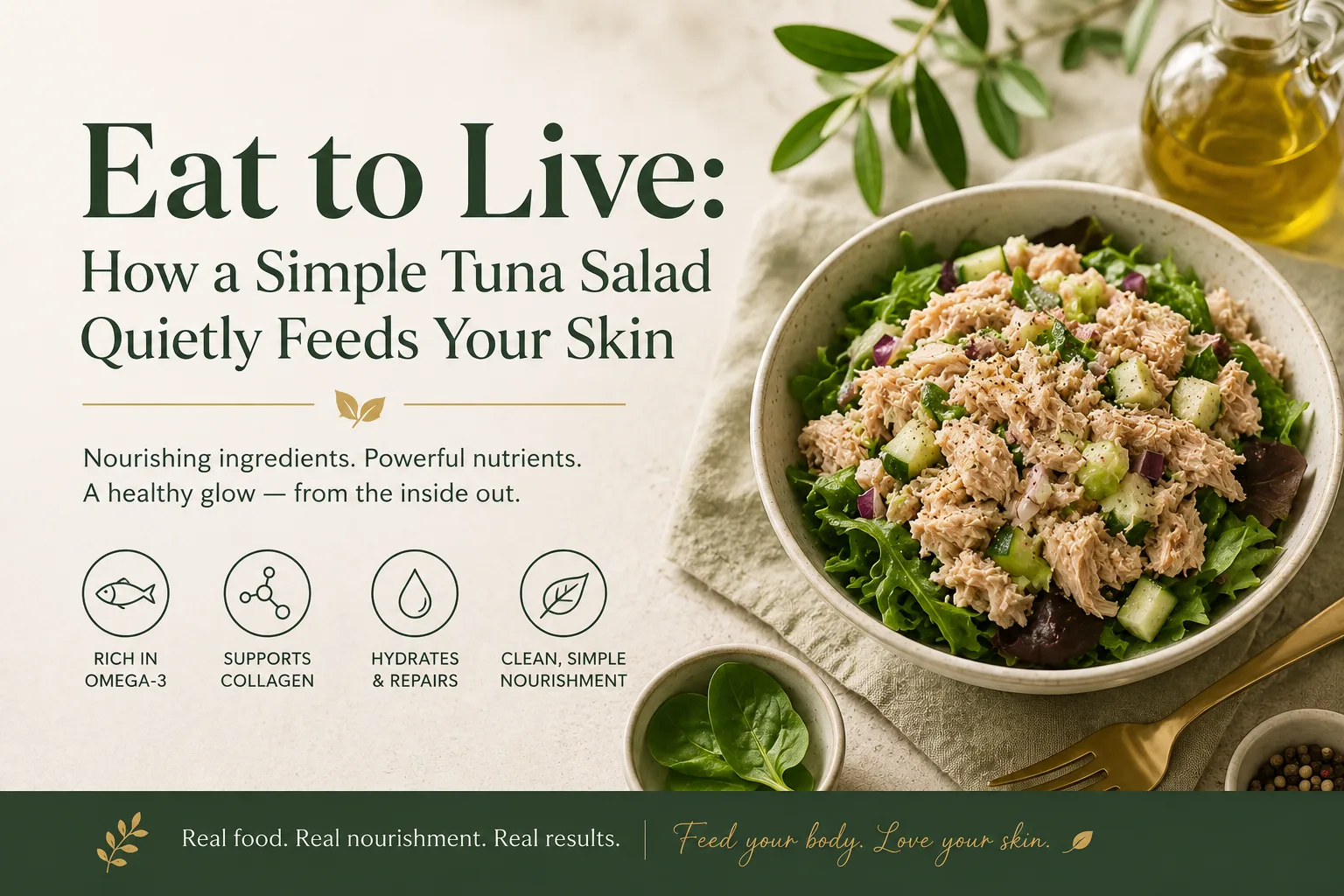
Eat to live — and still savour every bite
Here's the lovely part: eating to live and loving your food were never opposites. The same plate that delights your tastebuds is busy feeding trillions of cells, including the ones that make up your skin — your largest organ, and your first line of defence against the world. Skin renews itself constantly, and it builds that new tissue out of the raw materials you hand it at every meal.
So when we talk about beauty "from within", we mean it almost literally. Glow isn't painted on; it's grown, cell by cell, from what's on your fork. The earth grows lemons and leafy greens and herbs packed with exactly what a body needs, and there's something grounding about pausing to be grateful for that before you tuck in. Gratitude doesn't make food any less delicious. If anything, it helps you taste it properly.
My daughter's tuna salad, reimagined
This recipe started in my daughter Daphne's kitchen, and I've happily tinkered with it until it became a household staple. It's bright, briny, herby and ridiculously easy — the kind of thing you can pile onto sourdough, fold into a wrap, or eat straight from the bowl standing at the counter. No judgement.
4 × 145g cans tuna, drained · 3 tbsp mayonnaise · 1 tbsp Dijon mustard · juice and zest of 1 lemon · 2 tbsp capers, plus a little of the juice · 10 cornichons, chopped, plus a little of the juice · 1 stick of celery, chopped · 5 spring onions, chopped · 2 tbsp fresh dill, chopped · 2 tbsp fresh parsley, chopped · salt and pepper, to taste
Drain the tuna and flake it into a big bowl. Add the mayonnaise, Dijon, lemon juice and zest, capers, cornichons, celery, spring onions, dill and parsley. Fold everything together gently, season with salt and pepper to taste, and you're done. It keeps happily in the fridge for a day or two — if it lasts that long.
Tuna carries more mercury than most fish, so there is sensible guidance on how much to eat. In the UK, the NHS advises that if you are pregnant or trying for a baby you should have no more than four medium cans of tuna a week (around 140g drained each), or no more than two fresh tuna steaks. If you are breastfeeding, the NHS sets no limit on tuna. Worth knowing: this recipe uses four cans and is built to feed several people over a couple of days, so it is close to that weekly allowance in one bowl — easy to share, worth pacing if you are in that group. Guidance differs by country, so check your national advice, and speak to your midwife or practitioner about what is right for you.
What's actually feeding your skin in every bite
Let's wander through that bowl and meet the nutrients doing quiet work behind the scenes. This is what food for skin health actually looks like in practice: not an exotic ingredient list, but a handful of ordinary things pulling together.
Tuna is the heart of the dish, and it's a generous source of long-chain omega-3 fatty acids (EPA and DHA), complete protein and the mineral selenium. Your skin cells are wrapped in membranes built partly from these fats, and research associates a good omega-3 intake with a stronger, more comfortable skin barrier and better hydration. The protein, meanwhile, supplies the amino acids your body uses to make collagen — the scaffolding that keeps skin firm and springy.
Lemon, both the juice and that fragrant zest, brings vitamin C. This one's a quiet hero: your body can't make collagen without it, and it doubles as an antioxidant that supports your skin against everyday environmental stress. Don't skip the zest — a lot of the aromatic goodness lives in the peel.
Fresh dill and parsley aren't just a garnish. These herbs are surprisingly rich in vitamin C and in plant compounds called polyphenols — the antioxidants plants make to look after themselves, and which lend us a hand when we eat them. Chopping a generous two tablespoons of each is doing more than making the bowl look pretty.
Spring onions add another little hit of vitamin C and antioxidant compounds, while celery brings water and crunch: a gentle reminder that hydration is a food, not just something you sip.
Capers and cornichons are the briny troublemakers that make this salad sing, and they bring their own polyphenols along — capers are notably high in a flavonoid called quercetin. Because they're brined and fermented, they also slot naturally into a way of eating that's friendly to your gut, and gut and skin tend to keep good company.
And a word on the mayonnaise and mustard: a little fat isn't the enemy here. Some of skin's most useful nutrients are fat-soluble, which means a bit of fat on the plate actually helps your body absorb them. Balance, not deprivation.
- Omega-3 (EPA & DHA) Long-chain omega-3 fats found in oily fish such as tuna. Your body weaves them into the membranes of skin cells, where they help keep those cells supple and well-hydrated. A good dietary intake is associated with a more comfortable, resilient skin barrier. Because the body can't produce these efficiently on its own, food is the practical way to get them.
- Vitamin C A water-soluble vitamin abundant in citrus, fresh herbs and many vegetables. It is an essential cofactor for collagen synthesis — your body literally cannot build collagen without it — and it acts as an antioxidant that supports the skin against everyday environmental stress. We can't store much of it, so topping up regularly through food makes good sense.
- Polyphenols & Flavonoids Natural plant compounds behind many of the colours and flavours in herbs, onions, capers and citrus. They act as antioxidants, helping to neutralise the reactive molecules involved in skin ageing and inflammation. Eaten as part of whole foods, they arrive alongside fibre and other nutrients that help the body use them. Capers are a particularly rich source of the flavonoid quercetin.
Skin is your largest organ, and it's forever rebuilding itself. The materials for that renewal — proteins, healthy fats, vitamins and antioxidants — come straight from your plate. A colourful, whole-food meal is one of the kindest things you can hand it.
Common questions about food for skin health
A few questions come up often once people start thinking about what they eat and how their skin behaves. Everything below stays within what this article and its references actually support.
What foods are good for skin health?
The ones that supply the raw materials your skin rebuilds itself from. Oily fish such as tuna brings long-chain omega-3 fats and complete protein; citrus and fresh herbs bring vitamin C; colourful plants bring polyphenols. What matters as much as any single item is that they arrive together — a whole meal lets the fats carry the fat-soluble nutrients alongside them.
How do omega-3 fats support your skin?
Your skin cells are wrapped in membranes built partly from fats, and your body weaves long-chain omega-3s (EPA and DHA) into those membranes. Research associates a good omega-3 intake with a stronger, more comfortable skin barrier and better hydration. Because the body can't produce these efficiently on its own, food is the practical route.
Why does vitamin C matter for collagen?
It's an essential cofactor for collagen synthesis — your body simply cannot build collagen without it. It also works as an antioxidant, supporting your skin against everyday environmental stress. We can't store much of it, which is why regular top-ups through food make more sense than occasional large doses.
Do you need fat in the meal for these nutrients to work?
It genuinely helps. Several of the nutrients most useful to skin are fat-soluble, so a little fat on the plate improves how much your body actually absorbs. That's part of why a dressed salad can serve you better than the same ingredients eaten dry — and why the mayonnaise here is doing more than adding flavour.
Is a whole meal better than taking the nutrients separately?
For everyday eating, food first is the sound instinct: a real meal delivers these nutrients as a team, in a form your body recognises. That said, most of us don't manage oily fish several times a week, and honesty about that gap is more useful than pretending otherwise. A supplement earns its place by filling a shortfall — not by replacing the bowl.
A small plate, a whole-body thank you
Notice that nothing in this bowl is a miracle ingredient — and that's exactly the point. There's no single super-food doing all the lifting, just a handful of honest things the earth already makes, working together. That teamwork is something a whole, real meal does better than any isolated capsule: the fats help carry the vitamins, the antioxidants keep each other company, and the whole thing arrives in a form your body recognises and knows what to do with.
So this is "eat to live" in practice — not a joyless philosophy, but a generous one. You feed your cells, you thank the soil and the sea that grew the meal, and then you enjoy every herby, lemony, briny mouthful. Living well and eating well were never meant to be at odds. None of this is medical advice, of course; it's just good food, understood a little better.
You don't need a complicated regime to eat beautifully. You need real food, a little gratitude, and the willingness to actually enjoy it. Make the tuna salad, pile it high, and taste it properly — your cells, and your stepdad's wisdom, will thank you.
Mind the gap
Oily fish a few times a week is the ideal. When life doesn't quite get you there, a pharmaceutical-grade fish oil helps fill the shortfall.
Top Up Your Omega-3s- Pullar, J.M., Carr, A.C. and Vissers, M.C.M., 2017. The Roles of Vitamin C in Skin Health. Nutrients, 9(8), 866. DOI: 10.3390/nu9080866
- Huang, T-H., Wang, P-W., Yang, S-C., Chou, W-L. and Fang, J-Y., 2018. Cosmetic and Therapeutic Applications of Fish Oil's Fatty Acids on the Skin. Marine Drugs, 16(8), 256. DOI: 10.3390/md16080256
- Balić, A., Vlašić, D., Žužul, K., Marinović, B. and Bukvić Mokos, Z., 2020. Omega-3 versus Omega-6 Polyunsaturated Fatty Acids in the Prevention and Treatment of Inflammatory Skin Diseases. International Journal of Molecular Sciences, 21(3), 741. DOI: 10.3390/ijms21030741
- Cao, C., Xiao, Z., Wu, Y. and Ge, C., 2020. Diet and Skin Aging — From the Perspective of Food Nutrition. Nutrients, 12(3), 870. DOI: 10.3390/nu12030870
- National Health Service (NHS). Fish and shellfish. Available at: https://www.nhs.uk/live-well/eat-well/food-types/fish-and-shellfish-nutrition/
This article is intended for informational and educational purposes only. It does not constitute medical or dietary advice and should not be used as a substitute for guidance from a qualified healthcare professional. Individual needs vary — if you are pregnant, breastfeeding, managing an existing condition or following a restricted diet, speak with your practitioner about what is right for you.