
What Is Tallow Cream, and Why Are Men and Women Switching to This Simple, Nutrient-Dense Moisturizer?
Walk down any skincare aisle and you'll meet the same quiet overwhelm: dozens of jars, ingredient lists you'd need a chemistry degree to read, and prices that climb the moment a label whispers "luxury." It's little wonder that so many people — men and women alike — are drifting toward the opposite idea: one simple product, made from a handful of ingredients you can actually name, that does a lot for a little. Grass-fed beef tallow cream is one of those back-to-basics options, and it's worth understanding why it keeps winning people over.
What Exactly Is Tallow Cream?
Tallow is rendered beef fat — the clean, purified fat people used for cooking, soap and skincare long before modern cosmetics existed. When it comes from grass-fed, grass-finished cattle and is gently rendered, what's left is a soft, stable fat that melts into the skin at body temperature. As a beef tallow cream for skin, it's about as close to single-ingredient skincare as a moisturizer gets.
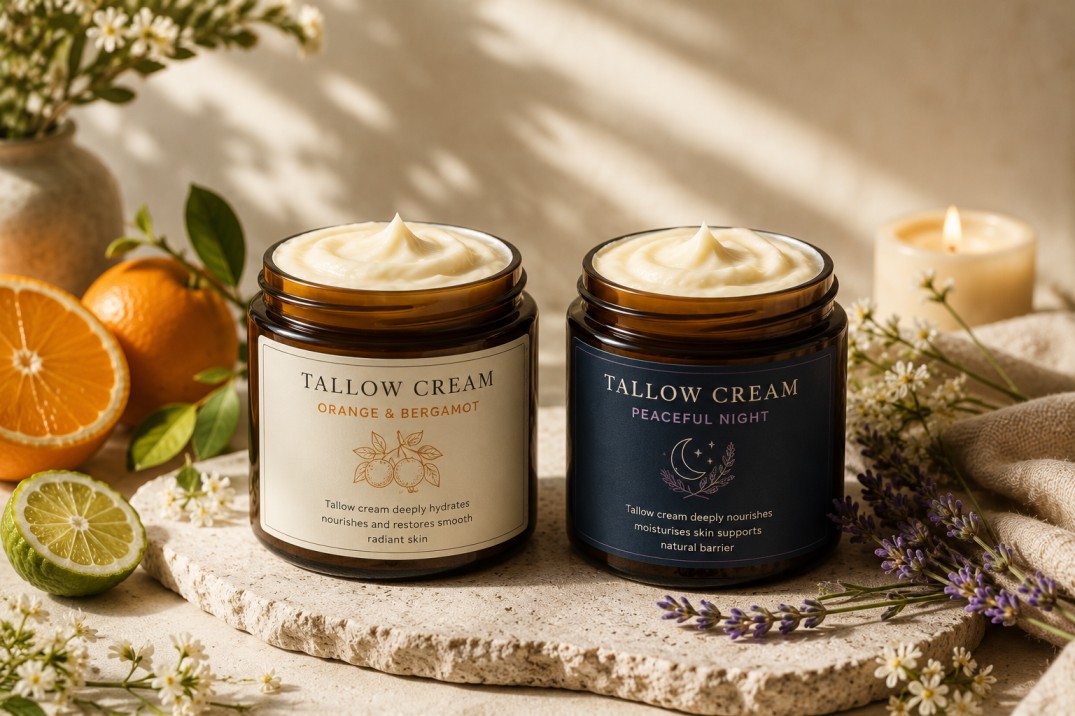
This particular cream keeps things refreshingly short: grass-fed beef tallow, organic extra virgin olive oil, organic golden jojoba oil, and a small amount of organic sweet orange and bergamot essential oils for scent. That's the whole list — no synthetic preservatives, no fillers, no long fragrance cocktail. For anyone tired of decoding labels, that simplicity is a feature, not a compromise.
Why Your Skin Seems to "Recognize" It
The most interesting thing about tallow is biochemical. Your skin makes its own oil, called sebum, built largely from oleic, palmitic and stearic acids — roughly 41% oleic, 25% palmitic and 12% stearic. Beef tallow's fatty-acid profile sits remarkably close to that, which is part of why it tends to absorb into the skin's outer layers rather than simply sitting on top.
A 2024 scoping review in the journal Cureus looked across the available research and concluded that tallow is broadly biocompatible with healthy skin and may offer hydration and mild soothing benefits. The jojoba oil in the blend works on the same principle from the plant world: it's technically a liquid wax ester — a stable, oil-like substance — whose structure closely mirrors the wax esters in human sebum, which is part of why it's so well tolerated, even on sensitive skin.
It's worth being honest about the limits, too. Tallow isn't identical to sebum — your skin's oil also contains squalene and wax esters that tallow doesn't — and the research base is still thin, leaning more on individual fatty acids than on long human trials. So the fair way to describe tallow is "familiar to the skin and a genuinely good moisturizer," not "a miracle." That honesty is part of why thoughtful users trust it.
Human sebum is roughly 41% oleic, 25% palmitic and 12% stearic acid — and grass-fed tallow's profile sits strikingly close. That biological "familiarity," delivered through a five-ingredient jar, is the whole appeal: simple inputs your skin already recognizes.
Nutrition Per Jar: The "Most Bang for Your Buck" Case
There's a phrase in nutrition — nutrient density — for foods that pack a lot of goodness into a small serving. Tallow cream is the skincare version of that idea. Grass-fed tallow naturally carries the fat-soluble vitamins A, D, E and K, the same vitamins skin draws on to stay resilient and comfortable. Add olive oil — rich in vitamin E and antioxidant polyphenols — and jojoba, prized for its stability and light feel, and a single small jar is quietly doing several jobs at once.
That's where the value really shows. One 2 oz jar can stand in for a face moisturizer, a body balm, a cuticle salve and a dry-patch rescue — head to toe, as the label puts it. There's no need for a ten-step routine or four separate products when one nutrient-dense balm covers the basics. For a household where both partners simply want something that works without fuss or a big monthly spend, that math is hard to argue with.
- Grass-Fed Beef Tallow Rendered fat from grass-fed, grass-finished cattle. Its fatty-acid makeup — largely oleic, palmitic and stearic acids — closely resembles human sebum, so it absorbs well and helps soften and protect the skin's surface rather than simply coating it. It also carries the fat-soluble vitamins A, D, E and K, and forms the moisturizing base of the cream.
- Organic Extra Virgin Olive Oil A traditional emollient rich in oleic acid, vitamin E and antioxidant polyphenols. It adds slip and softness and rounds out the blend as a supporting oil within the tallow base.
- Organic Golden Jojoba Oil Technically a liquid wax ester rather than a true oil, with a structure that closely mirrors the wax esters in human sebum. That makes it lightweight, very stable and well tolerated even by sensitive skin, helping the cream absorb cleanly without a heavy, greasy finish.
- Sweet Orange & Bergamot Oils Organic citrus essential oils added in small amounts for a light, uplifting scent. Citrus oils can increase the skin's sensitivity to sunlight, so the cream is best applied in the evening or worn under sun protection.
Is It Right for You? (Yes, for Most People)
One of tallow cream's quiet strengths is how widely it suits people. Because its fats are so close to what skin already makes, it tends to be gentle enough for dry, sensitive or weather-stressed skin, and it's labeled as safe for all ages and skin types. Men often like that it's a single, no-nonsense step after a shower or shave; women often appreciate that it layers easily and doubles as a body and hand treatment.
Using it well couldn't be simpler:
Warm a small amount on your fingertips — a little goes a long way.
Massage it into clean, slightly damp skin; the dampness helps it absorb.
Give it a few minutes to sink in before dressing or layering anything on top.
If your skin is very oily or acne-prone, patch-test first and start sparingly, since tallow is high in oleic acid, which doesn't suit everyone. And because the blend contains citrus essential oils, it's a good habit to apply it in the evening or to keep sun-exposed skin protected afterward. None of this is medical advice — if you have a specific skin concern, it's always worth checking with a professional who knows your history.
If there's one thing to take away, it's that good skincare doesn't have to be complicated or expensive. Tallow cream isn't promising to transform you overnight — and you should be wary of anything that does. What it offers is quieter and more durable: a short, honest ingredient list, real nutritional richness, and a texture your skin seems to know. For the many people, men and women both, who simply want something useful and uncomplicated, that's plenty.
Try the Tallow Cream — Orange & Bergamot
One small jar, five simple ingredients, head to toe. A nutrient-dense balm that deeply hydrates and nourishes for smooth, radiant skin — without the ten-step routine.
Explore Beauty & SkinPrefer something fragrance-light for the evening? The Tallow Cream — Peaceful Night uses the same nourishing base to moisturize and support your skin's natural barrier overnight.
- Russell MF, Sandhu M, Vail M, Haran C, Batool U, Leo J. (2024). Tallow, Rendered Animal Fat, and Its Biocompatibility With Skin: A Scoping Review. Cureus, 16(5), e60981. doi:10.7759/cureus.60981. (PMID: 38910727)
- Beef Tallow-Based Skincare Claims in Social Media: A Cross-Sectional Analysis. (2025). Journal of Cosmetic Dermatology. Open access; PMCID: PMC12661468.
- Pappas A. (2009). Epidermal surface lipids. Dermato-Endocrinology, 1(2), 72–76.
- Chakrabarty S, Jigdrel K, Mukherjee P, Paul T, Drakpa D, Gupta J. (2024). Bioactivities of Jojoba Oil Beyond Skincare. Journal of Medicinal Food. doi:10.1089/jmf.2023.k.0062.
Harmover Insights is intended for educational purposes only and does not constitute medical advice. Tallow cream is a cosmetic moisturizer, not a treatment for any skin condition. If you have sensitive, reactive or compromised skin, patch-test first and consult a qualified professional. Individual results vary.