
Collagen Peptides for Skin: Why Beauty Support Starts Beneath the Surface
For a long time, I assumed good skin came down to what I put on my face — the right serum, a richer cream, one more step in the routine. The more I’ve learned through Harmover, though, the more I’ve come to see real skin support as something that works in both directions at once: what you apply at the surface, and what you give your body from within.
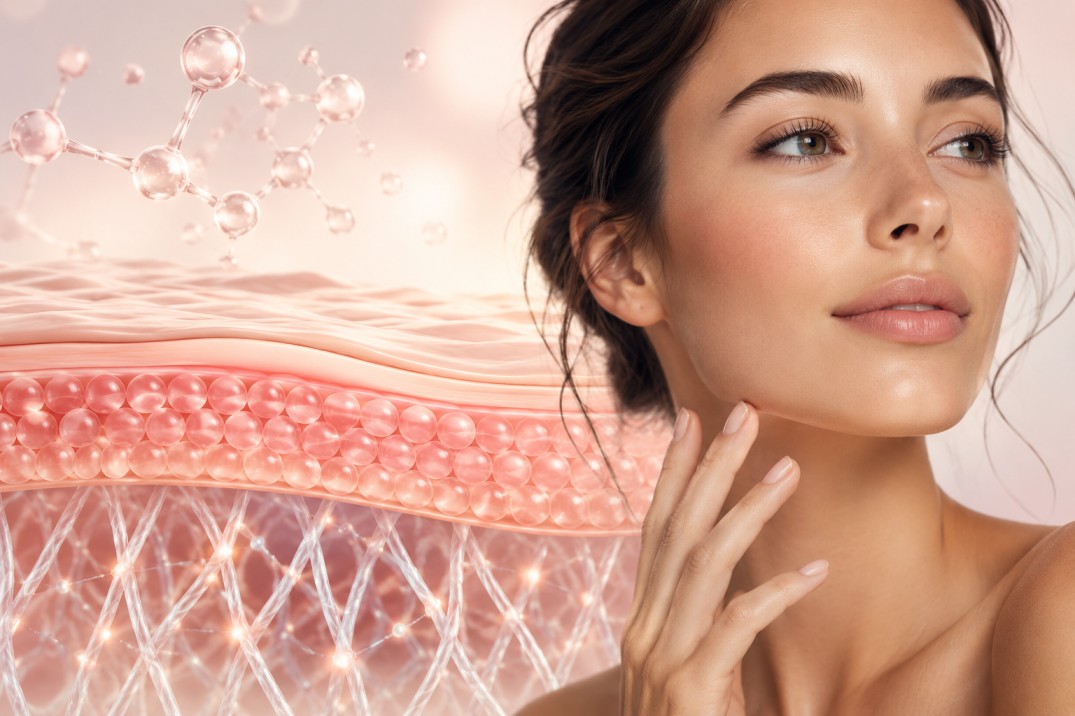
Why skin health is not only topical
Topical skincare genuinely matters. A good moisturiser helps support the skin barrier, retinoids can encourage cell turnover, and a well-formulated peptide serum can earn its place in a more considered routine. But your skin isn’t separate from the rest of you. It’s living tissue, and it quietly reflects your nutrition, hydration, levels of inflammation, oxidative stress, sleep, hormones and your body’s capacity to repair itself.
That’s really why the “beauty from within” conversation is worth having. Collagen, antioxidants and anti-inflammatory compounds aren’t here to replace your skincare — they support the deeper environment your skin depends on. This becomes more relevant as we age, because natural collagen production gradually slows, skin can grow thinner and drier, and changes like fine lines, softer elasticity and a loss of brightness tend to become more noticeable.
For me, that’s the shift that made collagen peptides far more interesting. They aren’t a quick cosmetic trick. They’re part of the foundation sitting underneath the surface. Once you start thinking about skin this way, beauty feels less like covering something up and more like giving your body what it needs to build, repair and stay resilient.
What hydrolysed collagen peptides actually do
Collagen is one of the main structural proteins in your skin, giving it firmness, elasticity and strength. The catch is that whole collagen molecules are simply too large to be absorbed intact in any useful way. Hydrolysed collagen has been broken down into much smaller peptides — fragments your body finds far easier to absorb and put to work.
It helps to be honest about how this works. Collagen powder doesn’t travel straight to your face and reassemble itself into fresh skin — the reality is more nuanced. What these peptides may do is supply amino acids and bioactive fragments that support fibroblasts, the cells responsible for producing collagen and other parts of the skin’s supporting matrix.
This is why Harmover’s Grass-Fed Hydrolysed Collagen Peptides focus on Type I and Type III collagen, the types most relevant to skin, hair, nails and connective tissue. It suits the Harmover way of thinking, because the goal isn’t simply to look better on the surface. It’s to support the underlying structure that helps skin feel stronger, smoother and more resilient over time.
The evidence is becoming more serious, too. A 2023 systematic review and meta-analysis reported that hydrolysed collagen supplementation improved skin hydration and elasticity across randomised controlled trials, and a 2024 randomised, double-blind, placebo-controlled trial likewise noted improvements in skin elasticity. More research is always welcome, but this has moved well beyond a vague beauty trend — there’s a genuine and growing body of clinical work behind it.
Why collagen works better as part of a full beauty routine
The strongest skin support is rarely any single thing. That’s exactly why Harmover’s Beauty & Skin range is built around both outside-in and inside-out support.
Collagen peptides look after the internal, structural side of the story. Retinol and peptide skincare handle surface renewal. Tallow creams tend to the barrier and the skin’s lipids. Resveratrol and turmeric speak to oxidative stress and inflammation. Taken together, these categories make far more sense than treating skin as though it only ever needs one cream or one supplement.
Retinoids are among the best-studied topical ingredients for photoageing, with research pointing to benefits for skin texture, collagen-related pathways and visible signs of ageing. Resveratrol has been studied for the antioxidant and anti-inflammatory pathways tied to skin ageing, particularly oxidative stress. Curcumin, the active compound in turmeric, is widely researched for the inflammatory pathways that may be relevant to skin health, as well.
That’s what I appreciate about collagen as the anchor for this piece. It doesn’t try to do everything. It does one important job in the bigger picture — supporting the material your skin relies on to stay firm, elastic and resilient — and the rest of your routine can build around it.
What I’d want someone to know before starting
Collagen isn’t an overnight transformation, and it helps to set that expectation early. If you’re hoping for dramatic change within a few days, you’ll probably feel let down. Skin support rewards consistency, because the skin’s matrix doesn’t rebuild in an instant — it takes time, and it takes showing up. And, as ever, none of this is medical advice; if you’re pregnant, managing a health condition or taking medication, it’s worth a quick word with your GP or a qualified professional before adding anything new.
Support your skin’s foundation
Harmover’s Grass-Fed Hydrolysed Collagen Peptides focus on Type I and Type III collagen — the structure your skin, hair and nails are built on.
Explore Beauty & Skin- Pu, S.-Y., Huang, Y.-L., Pu, C.-M., Kang, Y.-N., Hoang, K. D., Chen, K.-H., & Chen, C. (2023). Effects of Oral Collagen for Skin Anti-Aging: A Systematic Review and Meta-Analysis. Nutrients, 15(9), 2080. https://doi.org/10.3390/nu15092080
- Demir-Dora, D., Ozsoy, U., Yildirim, Y., Yilmaz, O., Aytac, P., Yilmaz, B., Dogan Kurtoglu, E., Akman, A., Tezman, S., Inaloz, H. S., & Erenmemisoglu, A. (2024). The Efficacy and Safety of CollaSel Pro® Hydrolyzed Collagen Peptide Supplementation in Improving Skin Health in Adult Females: A Double-Blind, Randomized, Placebo-Controlled Clinical Study. Journal of Clinical Medicine, 13(18), 5370. https://doi.org/10.3390/jcm13185370
- Mambwe, B., Mellody, K. T., Kenyon, J., Watson, R. E. B., & Langton, A. K. (2025). Cosmetic retinoid use in photoaged skin: A review of the compounds, their use and mechanisms of action. International Journal of Cosmetic Science, 47(1), 45–61. https://doi.org/10.1111/ics.13013
- Farris, P., Krutmann, J., Li, Y.-H., McDaniel, D., & Krol, Y. (2013). Resveratrol: A Unique Antioxidant Offering a Multi-Mechanistic Approach for Treating Aging Skin. Journal of Drugs in Dermatology, 12(12), 1389–1394.
- Vaughn, A. R., Branum, A., & Sivamani, R. K. (2016). Effects of Turmeric (Curcuma longa) on Skin Health: A Systematic Review of the Clinical Evidence. Phytotherapy Research, 30(8), 1243–1264. https://doi.org/10.1002/ptr.5640
This article is for educational purposes only and is not intended as medical advice, diagnosis or treatment. Always consult a qualified healthcare professional before starting any new supplement, particularly if you are pregnant, breastfeeding, taking medication or managing a health condition.